

This guide covers optimizing your ecommerce site for Search Engines in practical terms—what to prioritize first, common pitfalls, and how to apply the ideas step by step.
Introduction
Optimizing your ecommerce site for search engines means enhancing various elements of your website to improve its visibility in search engine results, ultimately driving more organic traffic and increasing sales. In 2026, this practice is crucial as the ecommerce landscape becomes increasingly competitive, with businesses striving to capture the attention of savvy online consumers. “Optimizing Your ecommerce site for search engines” involves a strategic approach to SEO, ensuring that your site not only attracts visitors but also converts them into loyal customers.
Last updated: April 2026
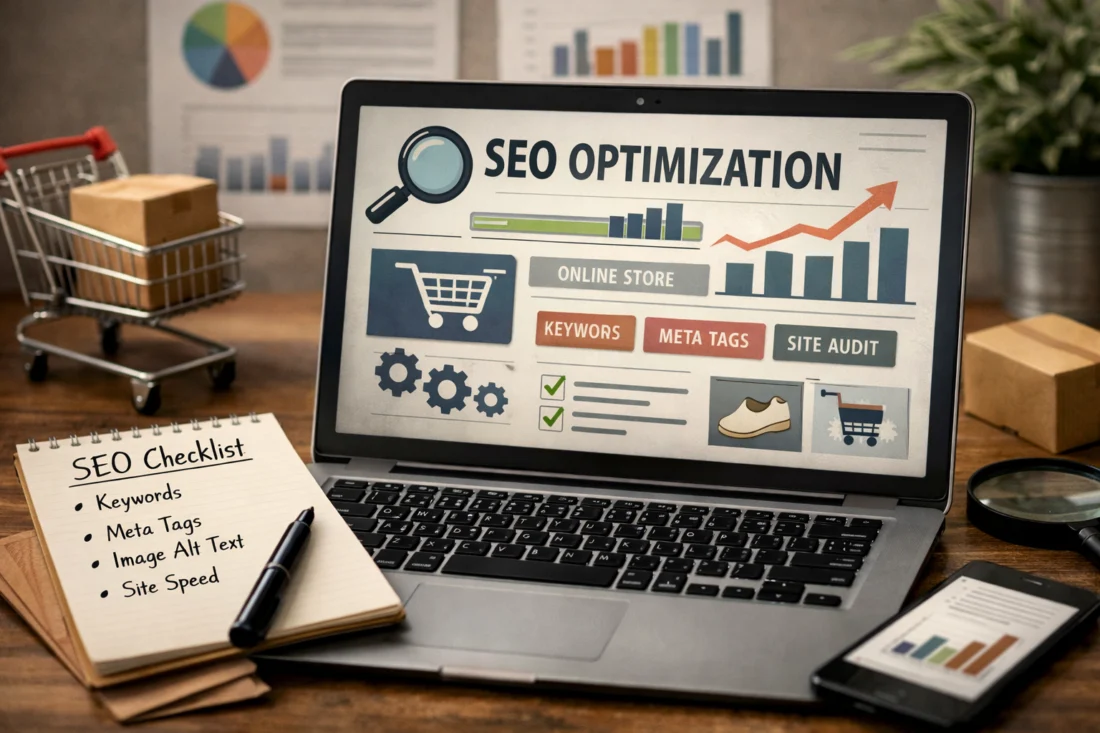
SEO remains a vital component for ecommerce businesses, serving as a powerful tool to enhance online visibility and credibility. It’s not just about being found; it’s about being chosen by users over countless competitors. As the search algorithms evolve, staying ahead with cutting-edge SEO techniques can make a significant difference in your business’s bottom line. Whether you’re an ecommerce business owner or a digital marketer aiming to boost your site’s search visibility, understanding the nuances of SEO is imperative.
What Are the Key Elements of SEO for Ecommerce Sites?
The key elements of SEO for ecommerce sites include on-page SEO, technical SEO, and off-page SEO strategies tailored to meet the unique needs of online stores. On-page SEO focuses on optimizing individual web pages to rank higher and earn more relevant traffic, while technical SEO deals with improving the infrastructure of a website to help search engines crawl and index it more effectively. Off-page SEO involves activities like link building to enhance the site’s authority and reputation.

Understanding these components is crucial because each plays a specific role in how search engines perceive and rank your ecommerce site. On-page seo involves aspects like keyword optimization, quality content, and meta tags, ensuring that your pages are relevant and user-friendly. Technical SEO includes elements like site speed, mobile-friendliness, and secure connections (HTTPS), which impact how search engines crawl your site. Meanwhile, off-page SEO, such as building backlinks from reputable sites, enhances your site’s authority and trustworthiness.
Consider a well-optimized ecommerce site like Amazon, which uses a combination of these strategies to maintain its dominance in search results. Common misconceptions about ecommerce SEO include the idea that it’s a one-time task or that only on-page SEO matters. In reality, it requires ongoing effort across all SEO elements to stay competitive and responsive to algorithm changes.
Tip: Regularly update your product descriptions with fresh, relevant content to boost on-page SEO.
How to Conduct keyword research for Ecommerce?
To conduct keyword research for ecommerce, start by identifying high-intent keywords that potential customers are using to search for products. Utilize tools like Google Keyword Planner, SEMrush, and Ahrefs to discover keywords with high search volume and low competition.
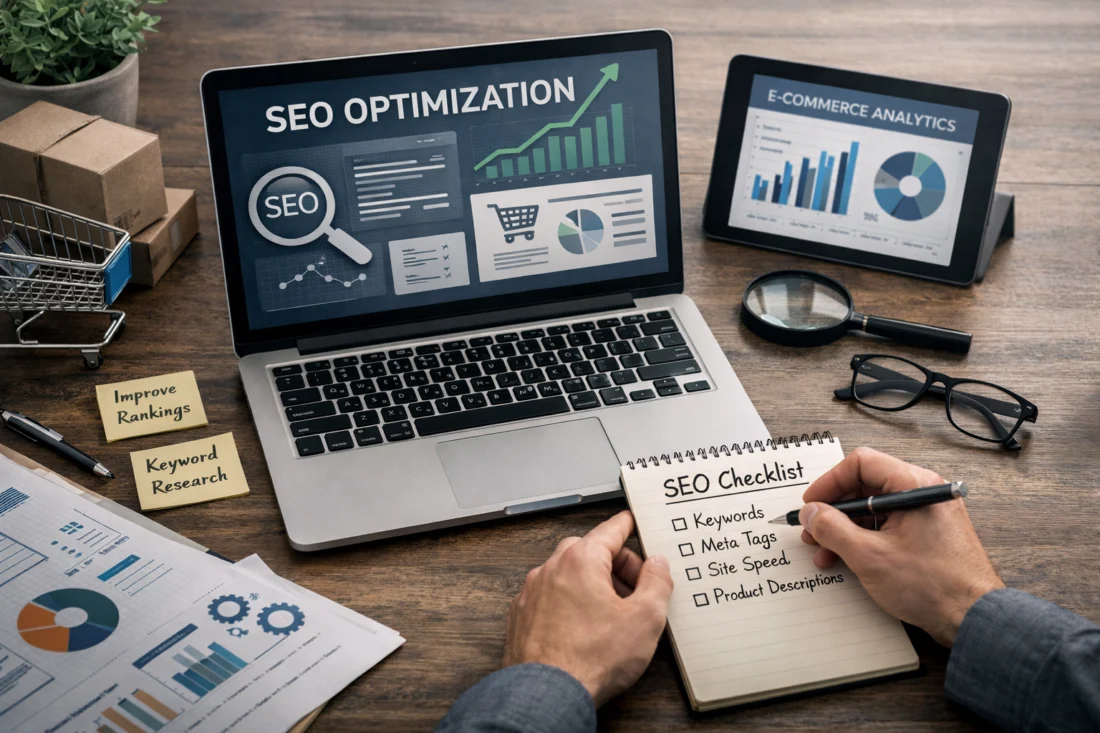
Keyword research is vital because it helps you understand what your audience is searching for and tailor your content to match their needs. Begin by exploring SEO copywriting techniques for optimizing your ecommerce site, then use keyword research tools to expand and refine this list. Look for long-tail keywords, which are more specific phrases that usually convert better due to their targeted nature. Implementing these keywords strategically on your site can lead to higher search rankings and increased traffic.
For instance, a successful keyword strategy might focus on seasonal trends, like “summer dresses 2026,” to capture timely interest and drive sales. One mistake to avoid is focusing solely on high-volume keywords; instead, balance your strategy with a mix of high and low-competition keywords to maximize visibility and conversion potential.
Transform Your Online Storewith Expert SEO & Design
Optimizing your ecommerce site for search engines is key to driving traffic and increasing sales. Let eDesignerz help you create a fast, modern, and mobile-friendly website that converts visitors into loyal customers.
Tip: Regularly review and update your keyword strategy to align with changing consumer trends and search behaviors.
What Are Common SEO Mistakes in Ecommerce?
Common SEO mistakes in ecommerce include neglecting technical SEO, overloading pages with keywords, and ignoring mobile optimization. These errors can significantly hinder search rankings and deteriorate user experience.

Failing to optimize for technical SEO can result in slow page load times, poor mobile responsiveness, and crawl errors, all of which negatively impact search engine rankings. Overloading product pages with keywords, also known as keyword stuffing, can lead to penalties from search engines and a poor user experience that deters potential customers. Additionally, ignoring the mobile experience in a mobile-first world can lead to missed opportunities, as more consumers use smartphones to shop online.
Consider a real-life example where an ecommerce site suffered a drop in rankings due to duplicate content issues, which confused search engines about which page to prioritize. Typical strategies might fail when they don’t consider user experience, such as creating content that is not engaging or valuable to the target audience.
Tip: Conduct regular technical SEO audits to identify and fix issues before they impact your site’s performance.
How to Optimize Product Pages for SEO?
To optimize product pages for SEO, focus on crafting compelling product descriptions, utilizing schema markup, and optimizing metadata. This ensures that your product pages are both search-engine-friendly and appealing to potential customers.

Product page optimization is crucial because it directly affects how search engines understand your products and how users perceive them. Start by writing unique, informative product descriptions that highlight the benefits and features of your products. Use schema markup to provide additional context to search engines, such as product ratings, prices, and availability, which can enhance your listings in search results. Metadata, including title tags and meta descriptions, should be optimized with relevant keywords to improve click-through rates from search engines.
An example of an optimized product page might include a clear and concise title, a detailed description with bullet points for readability, high-quality images, and user reviews. What many get wrong about product page SEO is neglecting the importance of user-generated content like reviews, which can boost credibility and engagement.
Tip: Regularly update product pages with new images and descriptions to keep them fresh and relevant.
How Does Site Structure Affect Ecommerce SEO?
Site structure plays a significant role in ecommerce seo by influencing how search engines crawl and index your site, as well as how users navigate and engage with your content. An SEO-friendly site structure organizes content logically, making it easier for both users and search engines to find important pages.
A well-designed site structure is essential because it enhances the user experience, which is a key factor in search engine rankings. Start by organizing your site into clear categories and subcategories, ensuring that important pages are easily accessible within a few clicks. A clean URL structure that reflects your site’s hierarchy can also aid in better indexing by search engines.
For instance, a well-structured ecommerce site like Walmart uses clear navigation and breadcrumb trails, helping users and search engines understand the relationship between pages. Tradeoffs between user experience and SEO might arise when overly complex navigation hampers user satisfaction, even if it technically aids SEO.
Tip: Use breadcrumb navigation to improve user experience and provide additional context to search engines.
What Are the best tools for ecommerce SEO in 2026?
In 2026, the best tools for ecommerce SEO include SEMrush, Ahrefs, Moz, and google search console. These tools offer a comprehensive suite of features that help optimize your ecommerce site effectively.
Each tool provides unique benefits, from keyword research and competitor analysis to site audits and performance tracking. For instance, SEMrush offers in-depth keyword analysis and competitor insights, while Ahrefs is known for its robust backlink analysis capabilities. Moz provides excellent local SEO features, and Google Search Console offers valuable data on search performance and indexing issues.
A practical comparison might highlight SEMrush for its all-in-one SEO toolkit, while Ahrefs excels in link analysis. Advanced features like AI-driven insights and predictive analytics set top tools apart, offering a competitive edge in 2026.
Tip: Regularly explore new features and updates within your SEO tools to leverage the latest advancements and maintain a competitive edge.
How to Optimize Ecommerce Sites for Mobile SEO?
Optimizing ecommerce sites for mobile seo is crucial because a significant portion of online shopping occurs on mobile devices. Techniques include implementing responsive design, optimizing mobile page speed, and simplifying navigation.
Mobile optimization matters because it directly impacts user experience and search engine rankings, as Google prioritizes mobile-friendly sites. Start by ensuring your site uses responsive design to adapt seamlessly to different screen sizes. Optimize images and leverage browser caching to improve load times, as faster pages reduce bounce rates and increase conversions. Simplifying navigation, such as using a hamburger menu, can enhance usability on smaller screens.
Ecommerce Success Begins with Visibility.
Transform Your Online Store with Expert SEO.
At eDesignerz, we specialize in optimizing ecommerce sites to enhance search engine visibility, ensuring that your products reach the right customers. Let us help you turn traffic into sales with tailored SEO solutions.
29+ Years of Experience Satisfaction-Focused Approach
An example of a mobile-optimized ecommerce site might feature streamlined checkout processes and large, touch-friendly buttons. A common misconception about mobile SEO is that it’s just about design, but performance and user experience are equally critical.
Tip: Regularly test your mobile site using Google’s Mobile-Friendly Test tool to identify and address potential issues.
What Role Does Content Play in Ecommerce SEO?
Content plays a pivotal role in ecommerce SEO by attracting organic traffic, engaging users, and supporting other SEO efforts like link building and social sharing. Quality content helps establish authority and trustworthiness in your niche.
Content matters because it enables you to target relevant keywords, answer user queries, and provide value that encourages engagement and sharing. Types of content that drive ecommerce success include detailed product descriptions, blog posts, user guides, and video content. These not only enhance SEO but also help in building a community around your brand.
Effective content strategies might involve creating buying guides that address common customer questions or developing a blog that highlights industry trends. How content supports other SEO efforts is often overlooked; for instance, valuable content can attract backlinks and drive social media engagement, boosting overall SEO.
Tip: Incorporate customer reviews and testimonials into your content strategy to build trust and enhance SEO.
How to Leverage Link Building for Ecommerce?
Link building for ecommerce involves acquiring high-quality backlinks from reputable websites to boost site authority and improve search rankings. Effective strategies include guest blogging, influencer partnerships, and creating shareable content.
Link building is essential because it signals to search engines that your site is credible and authoritative. Start by identifying reputable sites within your industry and reach out for guest blogging opportunities or collaborative content. Influencer partnerships can also yield valuable backlinks, especially if influencers share your content with their audience. Creating shareable content, such as infographics or research reports, can naturally attract links from other sites. Learn more about optimizing your ecommerce site for search engines to enhance your strategy.
A successful link building campaign might involve a case study where partnerships with industry leaders led to significant traffic increases. Limitations of aggressive link building include the risk of acquiring low-quality links, which can harm your site’s reputation.
Tip: Focus on building relationships with industry influencers to gain natural backlinks and enhance your SEO efforts.
What Are Advanced SEO Strategies for Ecommerce in 2026?
Advanced SEO strategies for ecommerce in 2026 include leveraging AI and machine learning to personalize user experiences, implementing voice search optimization, and utilizing data analytics for predictive insights.
These strategies are critical as they align with evolving consumer behavior and technological advancements. AI and machine learning can help tailor product recommendations and content to individual users, enhancing engagement and conversion rates. Voice search optimization involves optimizing content for natural language queries as more consumers use voice-activated devices. Data analytics offers predictive insights, allowing you to anticipate trends and adjust your strategy accordingly.
Examples of advanced strategies in action might include a site using AI-driven chatbots to enhance customer service or employing machine learning algorithms to refine product recommendations. Future trends in ecommerce SEO point towards increased use of AI for personalization and a greater focus on sustainability-related searches.
Tip: Stay informed about emerging technologies and continuously experiment with new SEO tactics to remain competitive.
FAQ Section
What is ecommerce SEO?
Ecommerce SEO involves optimizing an online store to improve its visibility in search engine results. This includes on-page optimizations, technical SEO, and content strategies that align with search engine algorithms to attract and convert visitors.
How often should I update my ecommerce site’s SEO?
Regular SEO audits and updates are crucial for maintaining search visibility. Consider conducting a comprehensive SEO audit at least quarterly to identify opportunities for improvement and adapt to algorithm changes.
Can ecommerce SEO increase sales?
Yes, effective SEO can lead to increased sales by driving targeted organic traffic to your site, improving user experience, and enhancing conversion rates. A well-optimized site is more likely to attract and retain customers.
What is the best platform for ecommerce SEO?
Popular ecommerce platforms like Shopify, WooCommerce, and Magento offer robust SEO capabilities. The best platform depends on your specific needs, such as ease of use, customization options, and budget.
How do I track SEO performance for my ecommerce site?
Use analytics tools like Google Analytics and Google Search Console to monitor SEO performance. These tools provide insights into traffic sources, keyword rankings, and user behavior, helping you gauge the effectiveness of your SEO efforts.
What is the difference between on-page and off-page SEO?
On-page SEO focuses on elements within your site, such as content and meta tags, while off-page SEO involves external factors like backlinks and social signals. Both are essential for a comprehensive SEO strategy.
How can I improve my ecommerce site’s loading speed?
Enhance site speed by optimizing images, enabling browser caching, and using a content delivery network (CDN). Faster loading times improve user experience and can positively impact search rankings.
Are product reviews important for SEO?
Yes, product reviews provide user-generated content that can improve SEO by adding fresh, relevant content to your site. They also enhance credibility and can influence purchasing decisions.
Social media can indirectly impact SEO by driving traffic, increasing brand awareness, and generating backlinks. While social signals aren’t direct ranking factors, they contribute to overall online visibility.
What is local SEO and how does it apply to ecommerce?
local seo involves optimizing your ecommerce site to attract local customers, often through Google My Business listings and local keyword targeting. It’s beneficial for ecommerce businesses with a physical presence or local delivery options.
OPTIMIZE WITH EXPERT HELP
Transform your ecommerce site into a sales powerhouse with our tailored website design, WordPress development, and SEO strategies that drive traffic and conversions.
REQUEST A FREE CONSULTATIONConclusion
In conclusion, a comprehensive SEO strategy is essential for ecommerce success in 2026. Regular updates and staying abreast of new trends are crucial for maintaining search visibility and driving sales. Implementing a full SEO audit and strategy overhaul can help identify areas for improvement. As your business grows, consider hiring an SEO specialist or agency for ongoing support to ensure your site remains competitive in the evolving ecommerce landscape.