
Ecommerce SEO in 2026 needs to grow qualified organic traffic, make product and category pages easier to discover, and convert searchers without depending only on paid ads. The Best SEO Strategies for ecommerce sites are the ones that fix crawl and index issues, match pages to buyer intent, and improve the parts of the store that actually influence revenue. That matters because ecommerce sites are uniquely exposed to duplicate content, thin product pages, faceted navigation problems, and intense competition, so isolated tactics rarely move the business on their own.
The right ecommerce SEO strategy is less about doing everything and more about choosing the highest-leverage work in the right order. For some stores, that means technical cleanup first; for others, it means better category content, stronger internal linking, or smarter ecommerce keyword research. This guide focuses on what works, what to avoid, and how to build an SEO plan that fits your catalog size, development resources, and margin priorities.
How to Build an Ecommerce SEO Plan That Actually Drives Sales
The best ecommerce SEO plan starts with revenue goals, not tactics. If you do not know which categories, products, or seasonal periods matter most to the business, you can win traffic that looks good in reports but does little for sales.
A practical plan begins by identifying which pages should earn traffic for high-intent queries and which pages should support those pages through education or comparison. That means aligning the roadmap with category growth, margin priorities, stock availability, and seasonality. A store selling winter gear should not optimize the same way in July as it does in November, and a low-margin category may not deserve the same effort as a premium one. This is where SEO campaign planning matters: the technical work, content work, and internal links should all support the same commercial outcome.
To effectively assess your SEO efforts, it's essential to look at a variety of success metrics beyond just rankings. Monitoring factors such as organic revenue, non-brand sessions, click-through rate, index coverage, and conversion rates by page type can provide deeper insights. Rankings hold significance only when they align with profitable demand. A frequent misstep is focusing on traffic growth from informational queries that do not lead to product discovery or promoting categories that attract a lot of search interest but yield low margins. Leveraging insights from SEO performance indicators allows you to determine whether your strategies are making your store more accessible and enhancing the purchasing process for customers.
A good planning model also separates quick wins from compounding work. Title tag improvements, internal linking fixes, and index control can often show results faster, while category expansion, content hubs, and authority building take longer. The strongest plans prioritize the blockers that stop the site from being crawled, indexed, or understood, then layer in content and conversion improvements. In ecommerce, traffic for traffic’s sake is a trap unless the demand matches products you can actually sell at a healthy margin.
Keyword Research for Ecommerce: Match Products to Search Demand
Ecommerce keyword research should focus on commercial and transactional intent first. The goal is not to collect the biggest list of keywords; it is to connect each meaningful search phrase to the right category page, product page, comparison page, or supporting content.
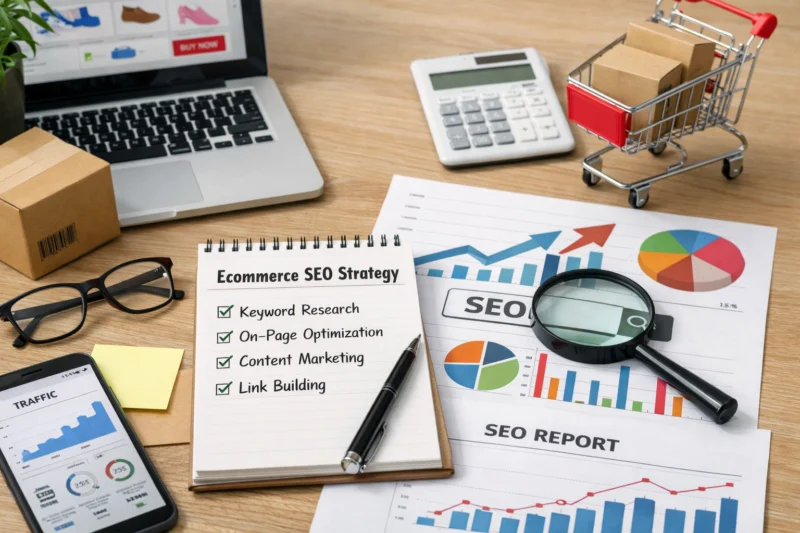
Good keyword research starts by grouping terms by intent and page type. Category pages usually target broader commercial phrases such as running shoes, black office chairs, or organic dog food. Product pages target more specific terms with model names, sizes, materials, colors, and use cases. Informational pages can support those money pages with queries like how to choose a running shoe or what size office chair do I need. This structure keeps your site from creating overlap where multiple URLs compete for the same query.
Modifiers matter because shoppers search differently than keyword tools suggest. People use words like best, affordable, premium, comparison, durable, lightweight, pet-safe, waterproof, and brand vs. non-brand to refine intent. The best opportunities are often low-volume phrases that signal a strong buying mindset. For example, a query like 14-inch laptop sleeve leather may look small in a tool, but if the page matches the exact need, conversion can outperform a much larger head term. That is why ecommerce keyword research should include product attributes, customer language, and sales data—not just search volume.
When managing large catalogs, it's essential to implement a structured keyword mapping strategy. If two collection pages are competing for the same keyword, Google might alternate between them or overlook both entirely. Similarly, if numerous product pages aim to rank for a broad category term, it can dilute the site's overall effectiveness. A clear mapping approach designates one primary intent per destination page while utilizing supporting keywords around it. This method not only simplifies future snippet strategies and content planning but also clarifies which page is best suited to address specific queries.
On-Page SEO for Product and Category Pages
On-page SEO for ecommerce pages should make the page easier to understand for search engines and more convincing for shoppers. The best product and category pages combine keyword relevance, clear differentiation, and practical buying information.
EXPERT SEO STRATEGIES
Transform your ecommerce site with tailored SEO strategies that attract traffic and drive sales. Let's build a winning plan together!
Title tags and meta descriptions should reflect the query, the product type, and a reason to click. A category page title can include the core term plus a differentiator such as size, use case, or brand selection. Meta descriptions do not directly drive rankings, but they influence click-through rate, which can matter when several competitors are competing for the same query. This is where on-page SEO basics still matter in 2026: search intent, clarity, and relevance beat clever wording.
Category pages need unique copy that does more than repeat the keyword. A strong category intro explains what the products are for, how to choose between subtypes, and why the assortment is different from a competitor’s. Product pages should go deeper with specifications, compatibility, dimensions, ingredients, shipping details, return policies, and trust signals like warranty or certified materials. That information helps buyers decide and gives search engines more context about the page’s purpose. In many cases, a product page with better details outranks a more generic page even if the competitor has stronger domain authority.
Balancing keyword usage with engaging copy can be tricky. When content feels like thinly veiled SEO writing, it can undermine trust, while pages lacking descriptive text struggle to achieve good rankings. The most effective method is to prioritize the reader's experience, seamlessly integrating relevant keywords to enhance the page's value. Enhance your content with informative headings, curated related products, and relevant links to associated categories. A well-implemented internal linking approach allows search engines to understand the connections between topics, while also directing shoppers toward their next best choice.
Technical SEO Foundations Ecommerce Sites Cannot Ignore
Technical SEO is the foundation of ecommerce visibility because it controls whether product and category pages can be crawled, indexed, and served efficiently. If search engines cannot understand the site structure, even excellent content may struggle to rank.
The most common ecommerce technical problem is duplicate content from variants, filters, sort parameters, and session URLs. A single product may exist in multiple paths, or a category may generate dozens of URL combinations that add no unique value. That creates crawl waste and weakens the main page signals. The fix is not always to noindex everything; it is to decide which URLs deserve indexation, canonicalization, or blocking based on business value. Large stores also need clean architecture so important categories are reachable in a few clicks, not buried under layers of filters and orphan pages.
site speed and Core Web Vitals are crucial because they influence both crawling efficiency and conversion rates. Mobile shoppers are particularly sensitive to slow-loading category grids, large images, and lagging product interactions. To enhance performance, technical improvements should prioritize user experience along with what search engines can efficiently process, focusing on aspects like image optimization, JavaScript management, render paths, and stable templates. This underscores the importance of mobile-friendly site design, ensuring that product browsing is seamless on smaller screens. For further insights, the Google Search Central documentation can provide valuable guidance on crawling, indexing, and structured data, while web.dev offers practical advice on optimizing Core Web Vitals.
Technical fixes matter more than content changes when the site is leaking equity through duplicate URLs, orphaned products, or indexing errors. If a category is blocked from indexing or a parameter creates thousands of low-value URLs, writing more copy will not solve the underlying issue. This is also where structured data markup can help by clarifying product details, availability, reviews, and breadcrumbs, but it should be implemented only after the site’s core crawl and index logic is sound.
Content Strategy Beyond Product Pages
ecommerce content strategy works best when it supports buying decisions instead of existing as a separate blog activity. The goal is to attract relevant visitors earlier in the journey and move them toward product and category pages with strong internal links.

Useful ecommerce content often answers comparison and selection questions: how to choose, which size, what is the difference, is it worth it, and best for specific use cases. Buying guides, comparison pages, curated collections, and educational hubs can capture top- and mid-funnel searches that product pages should not target directly. For example, a store selling coffee gear may create a guide comparing burr grinders, then link users to grinders by budget or brew style. That content expands reach without diluting the relevance of the money pages.
The best content connects clearly to products and categories. If a guide about materials or fit does not lead users to actual products, it may attract traffic but not sales. That is the most common failure in ecommerce content marketing: publishing articles that rank loosely related topics while failing to support product discovery. A well-designed page should have a logical next step, whether that is a category, a filtered collection, or a featured item set. This is also where user-generated content SEO can help if reviews, Q&A, and community photos are surfaced in ways that add unique detail rather than clutter.
Content should also solve doubts that product pages cannot answer alone. For high-consideration products, shoppers often need reassurance about durability, compatibility, sizing, or maintenance before they buy. Supporting content can address those objections and improve conversion for organic visitors who arrive with stronger intent than social or display traffic. If you want an internal path for future expansion, topics like on-page SEO best practices and featured snippet optimization are natural companions to ecommerce content planning.
Common Ecommerce SEO Mistakes That Hold Sites Back
The biggest ecommerce SEO mistakes usually come from scale, repetition, and poor prioritization. Most underperforming stores are not missing one magic tactic; they are repeating a few structural errors that suppress the entire site.
One major mistake is over-optimizing pages with repetitive keywords while leaving the page unhelpful to humans. Search engines are very good at detecting when a page says the same thing in slightly different words without adding value. Another frequent issue is letting faceted navigation generate endless URL combinations that create crawl waste and duplicate content. A store may think it has thousands of useful pages when in reality it has thousands of near-identical URLs. That is why internal linking strategy and index control matter as much as content creation.
Using generic manufacturer descriptions is another problem because those descriptions appear on many competing sites. If your product pages look identical to every other retailer, ranking becomes much harder and conversion trust weakens. The better approach is to write unique descriptions, add practical details, and surface customer-generated evidence where appropriate. If your catalog is large, it is better to improve the best pages first than to create shallow pages for every SKU. More pages do not automatically mean more rankings; sometimes pruning, merging, or consolidating pages creates a stronger site.
Another common misconception is that every page deserves equal effort. Category pages and product pages serve different roles, and not every product should be indexed forever. Low-demand, duplicate, or discontinued items may need a controlled retirement process, while high-value categories deserve richer content and stronger internal paths. That kind of judgment is the difference between a store that accumulates clutter and one that compounds authority over time.
Choosing the Right SEO Approach: In-House, Agency, or Hybrid
The right ecommerce SEO setup depends on catalog size, technical complexity, budget, and how quickly the business needs results. There is no universal best model; there is only the model that best matches your operating constraints.
Boost Your Ecommerce Success
Transform Your Online Store Today!
Implement the best SEO strategies to drive organic traffic and enhance conversions. At eDesignerz, we specialize in crafting beautiful, mobile-friendly websites and optimizing them for performance, ensuring your ecommerce store stands out from the competition.
29+ Years of Experience • Customized Solutions • Satisfaction Guaranteed
An in-house team gives you control and faster product knowledge, which is valuable when inventory changes quickly or the brand needs close coordination with merchandising. An agency brings specialization, broader experience, and often faster access to technical and content expertise. A hybrid model usually works best for ecommerce sites with meaningful scale: the internal team owns priorities and approvals, while the agency supports technical audits, advanced content, and implementation guidance. This can outperform pure in-house or pure agency setups because it combines business context with specialist depth.
What matters most is not the label but the capability mix. Strong ecommerce SEO requires technical SEO, content production, analytics, and development access. If your team can identify problems but cannot implement fixes, progress slows. If your agency creates content but does not understand margin priorities, the work may miss business goals. That is why many companies use a hybrid workflow around SEO campaign planning and execution. A practical comparison looks like this:
| Approach | Best for | Main advantage | Main limitation |
|---|---|---|---|
| In-house | Brands with strong internal SEO and merchandising teams | Fast context and tighter control | Skill gaps and slower specialization |
| Agency | Teams needing expert support quickly | Broad expertise and process | Less day-to-day product context |
| Hybrid | Growing stores with technical or content complexity | Best balance of control and specialization | Requires strong coordination |
Advanced Ecommerce SEO Considerations Most Guides Get Wrong
Advanced ecommerce SEO is mostly about handling edge cases well. The stores that perform best are the ones that make smart decisions about variants, out-of-stock products, category changes, and seasonal inventory shifts.
Product variants can be tricky because different sizes, colors, or materials may need one canonical product page rather than many thin URLs. Out-of-stock items should not always be deleted; if they have links, rankings, or seasonal demand, they may need to stay live with clear alternatives or back-in-stock information. Discontinued products are similar: sometimes they should redirect, sometimes stay with replacement suggestions, and sometimes be merged into a related category. The key is to preserve relevance and equity without trapping users on dead ends.
Category pruning and URL changes also need care. If you merge categories because the catalog changes, you must preserve the strongest query signals, update internal links, and map old URLs intentionally. International or multi-currency stores add another layer, but only when the site structure truly affects search intent and indexing. In those cases, language targeting, currency display, and regional assortment all need to match user expectations. This is also where structured data markup and clean breadcrumb paths can help search engines understand product relationships, though schema should not be treated as a shortcut for weak page quality.
Most guides get this wrong by pretending every product and category page should be treated the same. A seasonal item, a flagship SKU, and a discontinued product each deserve a different SEO response. The winning approach is context-aware: protect the pages with demand, consolidate the ones that compete with each other, and prevent the site from filling with low-value URLs that dilute crawl capacity.
Measuring Results and Iterating on the Strategy
Ecommerce SEO should be measured by business impact, not by a single ranking report. The real question is whether organic search is improving revenue, efficiency, and discoverability across the right pages.
Use Search Console, analytics, and rank tracking together because each tool answers a different question. Search Console shows which queries and pages are gaining impressions and clicks. Analytics shows revenue, conversion rate, and user behavior by landing page. Rank tracking helps you monitor the terms that matter most to category and product targets. When used together, these tools reveal whether a drop is caused by intent mismatch, technical visibility, content quality, or stronger competition. That is the practical side of SEO metrics and KPIs: you need a measurement system that tells you what to fix, not just what moved.
Create a review cadence for the site. Category pages should be refreshed when search demand shifts or inventory changes materially. Underperforming product pages should be checked for missing details, weak internal links, or poor query alignment. Content gaps should be identified by comparing top-performing queries against the current page set. The best teams treat SEO as an ongoing merchandising and information architecture process, not a one-time project.
Attribution deserves caution as well. SEO often assists conversions that happen later through email, direct, or paid retargeting. A customer may discover a product in organic search, leave, and convert days later through another channel. If you only look at last-click data, you may underestimate SEO’s role. That is why user-generated content SEO, supporting content, and strong product detail pages can influence revenue even when the final purchase is not directly credited to organic search.
Frequently Asked Questions About Ecommerce SEO Strategies
What are the best SEO strategies for ecommerce sites?
The highest-impact mix usually includes technical cleanup, keyword mapping, strong product and category page optimization, and supporting content that answers buying questions. The best results come from aligning each tactic with a page type and a business goal, not from applying the same template everywhere.
How do I choose SEO priorities for an online store?
Rank tasks by revenue potential, effort, and site limitations. Start with pages that can influence the most demand or fix the biggest visibility blockers, such as crawl issues, duplicate URLs, or weak category content.
What should ecommerce category pages include for SEO?
Category pages should include enough unique copy to clarify the assortment, descriptive headings, internal links to subcategories or best sellers, and differentiation from nearby categories. They should answer what the products are for and help users narrow their choice without turning into a wall of text.
How many keywords should a product page target?
A product page should usually have one primary keyword theme and a small set of related secondary terms. The goal is to cover the main product query and natural variations without creating cannibalization across multiple URLs.
What is the biggest SEO mistake ecommerce sites make?
Duplication is one of the biggest problems, whether it comes from thin pages, manufacturer descriptions, faceted navigation, or too many similar URLs. Poor architecture and weak internal linking make the problem worse by hiding the pages that matter most.
How long does ecommerce SEO usually take to work?
Small technical and on-page fixes can show movement in weeks, but broader category growth and authority gains usually take months. Timelines depend on site size, crawl health, content depth, competition, and how quickly changes are implemented.
Do product reviews help ecommerce SEO?
Yes, product reviews can help by adding unique content, trust signals, and additional long-tail language that reflects real customer concerns. Review markup can also support rich result eligibility, but reviews work best when they are genuine and actually helpful to shoppers.
How do I optimize ecommerce sites with thousands of products?
Use templates, automation, and strict index control so the site scales without creating low-value pages. Large catalogs need clear rules for canonical URLs, filtered pages, product variants, and which pages deserve manual content investment.
Which matters more: category pages or product pages?
Category pages usually matter more for broad commercial queries, while product pages matter more for specific purchase-ready searches. They work together in the funnel, with categories capturing demand and products closing the sale.
How can I improve ecommerce SEO without redesigning my site?
Focus on metadata, unique copy, internal links, index control, and content gaps first. These changes often improve visibility and conversion without requiring a full site rebuild.
REQUEST A FREE WEBSITE CONSULTATION!
Is your ecommerce site struggling with SEO? Let our experts at eDesignerz create a tailored SEO strategy that drives qualified traffic and increases conversions. Contact us for a free consultation to discuss your project and get a custom quote!
SCHEDULE MY CONSULTATIONThe strongest ecommerce SEO strategy combines intent-driven page targeting, technical control, and content that supports purchase decisions. The stores that win in 2026 are usually not doing more tactics than everyone else; they are choosing better priorities, fixing blockers early, and building pages that search engines and shoppers both understand.
If you want the fastest path forward, start with an audit, map your pages to search intent, and fix the highest-impact issues first. That approach compounds over time: better visibility, better click-through rates, and better conversion from visitors who already want what you sell.
Updated April 2026