

If your Salem, Oregon business is asking whether to invest in e-commerce web design, the real fix is conversion-focused storefront UX plus Salem-area local visibility—not a generic website refresh. For many stores, e-commerce web design Salem OR means rebuilding product discovery, strengthening PDP persuasion, removing checkout friction, and adding local SEO signals that help nearby shoppers find you. You want measurable outcomes like higher mobile conversion, better cart and checkout completion, and more Salem-area organic orders with a clear ROI path.
This guide explains what to demand from an agency: how Salem-specific requirements shape information architecture and messaging, which ecommerce elements most directly impact sales, and how to evaluate bids using KPIs, measurement, and post-launch CRO. If you’re choosing between vendors or planning a rebuild before peak season, use the checklist to avoid wasted spend and underperforming launches.
What “e-commerce web design” means for Salem stores, not a generic website redesign
e-commerce web design for Salem stores focuses on the storefront experience that turns product interest into completed purchases. That includes category navigation, product page persuasion, cart and checkout UX, and post-purchase flows that drive repeat orders. A general “business website makeover” often improves branding but leaves the transaction path weak, so revenue barely moves.
In practice, a Salem-focused build should include storefront UX work like product discovery flows, variant selection that doesn’t confuse, and checkout fields that reduce drop-off. It should also include retention mechanics such as email capture, abandoned cart recovery, and post-purchase follow-ups tied to what Salem customers actually buy and reorder. Meanwhile, local SEO is designed to match how people in Salem search and decide, not just to rank any generic page.
Platform choice affects how these ecommerce elements are implemented. Shopify, WooCommerce, and other stacks differ in theme flexibility, app ecosystems, migration risk, and how cleanly performance and structured data can be maintained. The best agencies map these differences to your catalog size, update cadence, and fulfillment workflow, so you don’t pay for features you can’t use or maintain.
One common failure mode is “good-looking” pages that still underperform. Often, the missing piece is decision support: unclear shipping and returns details, weak product imagery, missing FAQ modules, or internal links that don’t connect local-intent pages to the right categories. Another issue is tracking and QA gaps, where you can’t tell what improved or broke after launch.
Build a Salem-ready shopping funnel that moves mobile shoppers from product pages to checkout
A Salem ecommerce store wins when mobile shoppers can browse fast, choose confidently, and finish checkout without surprises. Because most browsing happens on phones, your design must reduce taps, reduce choice anxiety, and remove form friction. This is where Salem-specific conversion design matters: users need clarity on what they get, how fast they receive it in the region, and what happens if it doesn’t work out.
Start with mobile-first UX patterns that prevent dead ends. Category pages should support “browse with intent,” not just a site map look. Product variants must be easy to select, with availability or compatibility cues where the shopper expects them. Add-to-cart should feel immediate, and cart updates should confirm changes without reloading the page.
Next, build product page modules that reduce uncertainty. Above-the-fold should state the core value, show variant-relevant imagery, and confirm shipping and returns in plain language. Reviews and user content should appear where shoppers decide, not only at the bottom. FAQs and specification highlights should answer the top questions customers in Salem ask when they compare options.
Then remove checkout friction. Configure guest checkout, keep promo fields out of the way until users need them, and ensure shipping estimates and totals update clearly. If you offer multiple payment methods, display them in a predictable place and ensure error states help users fix mistakes fast.

- Audit mobile UX on real devices using your top three traffic-driving product categories.
- Log PDP-to-cart drop points by reviewing ecommerce events in GA4.
- Set up shipping and returns trust blocks so users see them before they commit.
- Run a checkout form friction review to confirm fewer fields and clearer error messages.
A nuance that weaker builds miss is local trust placement. Checkout footers alone rarely solve hesitation. You need “local expectation” blocks earlier in the journey, especially on PDPs and cart pages, so shoppers feel supported before they hit payment.
Protect revenue with speed, Core Web Vitals, and performance-safe design choices
Performance is not a vanity metric for ecommerce. Slow pages reduce product engagement, and poor Core Web Vitals correlate with fewer add-to-carts and fewer completed checkouts. That means your storefront design must protect load time while still presenting products clearly.
Your agency should treat Core Web Vitals as part of the design spec, not an afterthought. Ask how they manage LCP, INP, and CLS targets across category pages, PDPs, cart, and checkout. You also want a script or app audit, because app bloat and third-party tags are a common source of slowdowns in both Shopify and WooCommerce environments.
Execution matters. Good builds use modern image formats like WebP or AVIF, apply lazy-loading carefully so above-the-fold content still renders instantly, and minimize render-blocking resources. They also control third-party scripts so chat widgets, tracking pixels, and review tools do not stack on the checkout flow.
Measurement must be included in the plan. Your team should define what GA4 events capture for the funnel (view item, add to cart, begin checkout, purchase), then validate events before launch. For performance, require reporting that shows improvements and regressions, not just promises. Google’s performance guidance and Core Web Vitals documentation help you verify what “good” looks like in modern web UX: Core Web Vitals.
Tradeoff-wise, not every visual improvement is worth the cost. For example, heavy sliders on PDPs can hurt LCP. Ask your agency to propose “conversion-safe” alternatives, like static hero images with lightweight zoom, then compare before-and-after metrics in staging.
Implement Salem-area local SEO signals that connect your store taxonomy to how people search
Salem ecommerce stores need more than generic SEO. You should add local relevance signals that help shoppers and search engines understand your product catalog and fulfillment expectations in Salem and nearby communities. The goal is to earn visibility for the searches that start with location and end in product intent.
On-site, you need location-aware structure that maps to your ecommerce taxonomy. That means creating on-site landing pages tied to categories or use cases, then linking them to the exact product groups shoppers expect. Avoid thin pages that say “we ship from Salem” without substantive product navigation and unique content. Instead, build pages that help users decide while still reflecting Salem intent.
Metadata and internal linking should support that structure. Your agency should create clean, non-stuffed titles and descriptions that reflect category + Salem context where relevant. Then they should implement internal links that route local-intent pages to appropriate categories and top-selling PDPs, so visitors and crawlers move through your catalog efficiently.
Structured data also matters for ecommerce discoverability. Require product schema, breadcrumb schema, and organization/store information. Structured data should support product discovery and reduce ambiguity for search engines, especially when you have layered navigation and variant options. For schema guidance, use the official documentation: Schema.org.
A key nuance is “taxonomy mapping” evidence. Ask the agency to show how they map your storefront categories to Salem/nearby queries people use, and how they prevent duplicate or overlapping local pages that can underperform. A good deliverable is a content-to-taxonomy map, not a list of keywords.
Design storefront messaging and UX for Salem buying patterns across seasons and regions
Your storefront should reflect how Salem customers browse when weather and schedules change. Cool wet winters and warm dry summers shift how people browse on mobile and how they plan purchases. During fall and winter rainy periods, shoppers want clear paths to find what they need fast, plus reliable fulfillment expectations.
Boost your Salem business with eDesignerz’s expert e-commerce web design and local SEO. We build mobile-friendly, high-converting WooCommerce stores tailored to your local customers. Get a free website consultation and grow your sales today.
Get Your Free Website ConsultationBecause Salem sits along the Willamette Valley corridor between Portland and Eugene, your ecommerce UX should also communicate regional readiness. For example, customers in Keizer, West Salem, Stayton, Aumsville, Woodburn, and Turner should understand what “shipping fast” means in practical terms on the pages where they decide. You do not need to invent local delivery stats, but you should present shipping timelines based on your actual fulfillment processes and carrier cutoffs.
Your homepage and category pages should reduce uncertainty for first-time local buyers. That means placing support links, returns clarity, and shipping expectations where they can be found quickly. It also means making the navigation feel familiar, with categories and filters that match how a local buyer thinks, not how your internal team names products.
A customer scenario shows why this matters. A shopper in South Salem visits your PDP from a Google search for a specific item, but they hesitate because they cannot quickly confirm returns terms and variant compatibility on their phone. If the product page clearly states what fits, shows reviews near the decision point, and includes a shipping and returns trust block above the fold, that shopper is far more likely to check out instead of bouncing.
Meanwhile, your UX should support different browsing behaviors across parts of Salem. Downtown Salem shoppers often want convenience and quick resolution, while customers browsing North Salem or East Salem may compare options longer. Design templates should support both journeys through clear category depth, better on-page comparison cues, and strong internal linking.
Choose the right ecommerce platform and migration plan to avoid launch-breaking failures
Platform choice determines what features you can ship, how fast the site stays, and how smoothly the migration goes. Shopify and WooCommerce can both work for Salem businesses, but the decision should be based on your catalog complexity, integration needs, and internal capabilities. The agency should prove platform competency with ecommerce builds, not generic web portfolios.
When you rebuild, migration is usually where revenue risk hides. A strong migration plan includes URL mapping, redirect rules, preservation of category and product structure, and re-creating important templates. It also includes protecting existing reviews and ratings where applicable, since losing trust signals can hurt conversions after launch.
Performance and security depend on platform execution. Your agency should discuss hosting or app impacts, caching strategy, SSL, and safe deployment practices. You should also require a tracking continuity plan so GA4 ecommerce events remain valid after launch. For consent behavior and privacy expectations, agencies should follow responsible analytics practices and coordinate with your existing consent setup rather than breaking tracking during redesign.
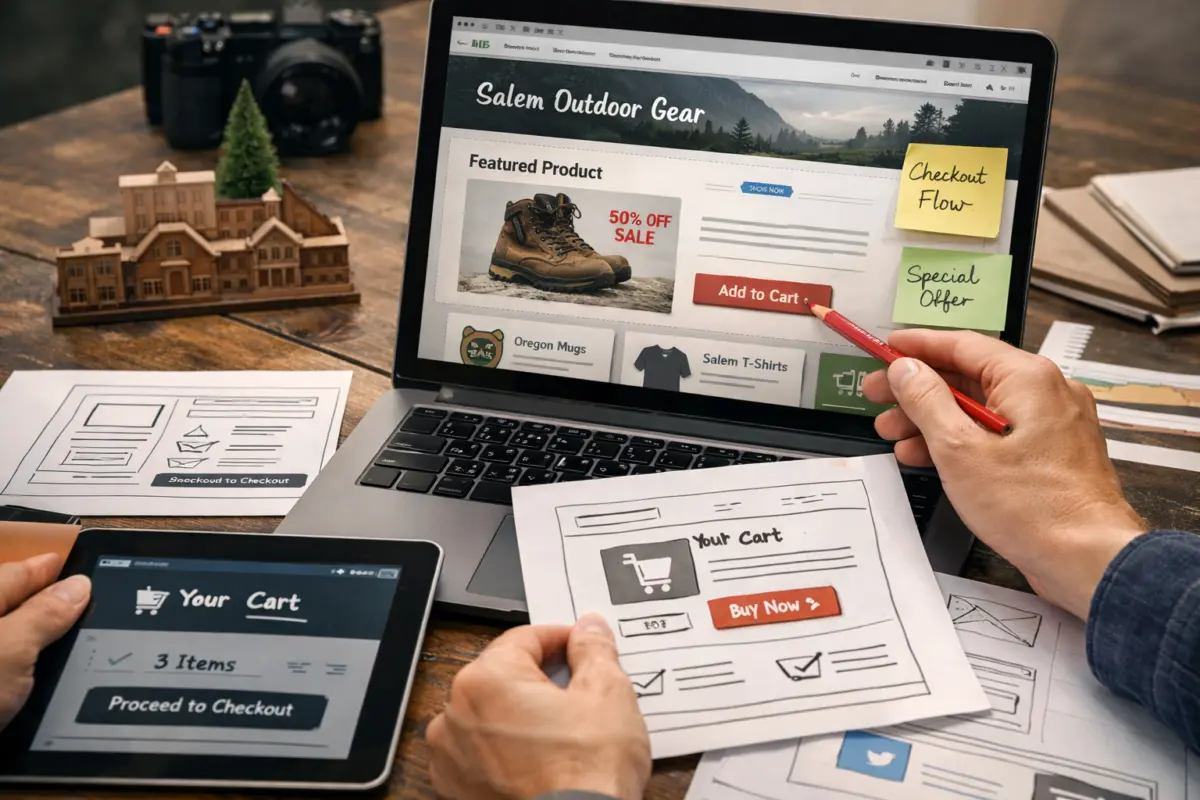
Out-of-scope dependencies can block a launch, so ask who owns them. Inventory integrations, PIM or ERP feeds, shipping carrier rate tables, and payment gateway constraints often need sign-offs or configuration work that falls outside design. Good agencies identify these early and set a content and systems readiness checklist.
- Validate platform fit using your catalog size, variant complexity, and integration list.
- Require a migration spreadsheet for URL mapping, templates, and redirects.
- Demand tracking QA before staging goes live.
- Plan for rollback if checkout metrics or events fail in testing.
Choose a Salem agency for e-commerce web design using KPI-proof proposals, not aesthetics
The fastest way to waste budget is to hire for “looks good” instead of “measurably improves orders.” A Salem ecommerce agency should provide a KPI-first proposal that ties deliverables to conversion, speed, and Salem-area visibility. You should also expect transparency about baselines, measurement, and post-launch optimization.
Ask for a portfolio format that proves outcomes on ecommerce flows. Ideal examples show before/after conversion rates, improvements in cart or checkout completion, and changes in ranking or organic visibility tied to category and product pages. If the portfolio is only homepages and brand pages, the agency may not understand transaction UX.
Your proposal should include a clear process. For example, it should outline an audit, UX wireframes, template build, tracking QA, staging QA, launch plan, and a post-launch CRO roadmap. Each stage should name who provides what assets and how approvals happen.
Risk controls matter too. Timeline assumptions should reflect content readiness like product photos, copy, and shipping policies. Your agency should describe rollback or remediation steps if testing shows issues. Also require a “what we will not do” section, like launching without performance QA or adding tracking only after the site is live.
| What to verify in the proposal | What “good” looks like |
|---|---|
| Conversion targets | Clear baselines and lift goals tied to PDP, cart, or checkout |
| Speed targets | Core Web Vitals measurement plan for category, PDP, and checkout |
| Local visibility plan | Taxonomy-mapped local pages and internal linking strategy |
| Measurement confidence | Event naming, GA4 validation steps, and reporting method |
| Post-launch CRO scope | Specific experiments like PDP layout and cart messaging tests |
This approach is how you evaluate bids fairly. If one agency gives a low price but skips tracking QA or local taxonomy mapping, it may look cheaper until you see the conversion and SEO plateau.
Common reasons ecommerce stores underperform after redesigns in Salem, Oregon
Underperformance usually comes from missing the ecommerce-specific conversion mechanics. A redesign can improve visuals and still fail if product discovery, PDP persuasion, cart clarity, or checkout reliability do not improve. Many issues only show up after launch when traffic arrives but orders stay flat.
One major cause is mobile-first neglect. Product information blocks that are readable on desktop become cramped on mobile. Variant selectors can be hard to use, and checkout fields may be too small or too confusing, increasing drop-off.
Another frequent problem is performance regression. Agencies add scripts, sliders, and multiple third-party tools without re-checking LCP and INP. In ecommerce, even small delays can reduce add-to-cart rates, because shoppers compare options and move on quickly.
Navigation and filters also cause failures. If categories are organized around internal labels, shoppers may not find the right products. Filters that create dead ends or unclear compatibility choices frustrate users and push them out before checkout.
Structured data gaps can reduce discoverability. If product schema, breadcrumbs, and category relationships are missing or inconsistent, search engines may not interpret your catalog well. Another weakness is weak retention mechanics, like missing abandoned cart and browse recovery flows.
Finally, tracking vanity metrics can fool you. Traffic can rise while orders do not, because event tracking fails or events get misnamed. Require ecommerce event validation before you declare success.
To avoid these, treat your redesign like a storefront system. Test key paths in staging, validate GA4 events, and compare funnel metrics pre- and post-launch for Salem-specific categories and top PDPs.
Expect ROI you can measure, and compare bids using ecommerce KPI math
ROI in ecommerce design means measurable revenue impact, not just design approval. You should evaluate changes using metrics like revenue per visitor, conversion rate, average order value, cart and checkout completion rate, and repeat purchase rate. When the agency can tie design work to those metrics, you can judge whether the investment is worth it.
Boost Salem Sales with E-Commerce
Turn browsers into buyers with a Salem-focused WooCommerce site from eDesignerz. Get free SEO months with new projects!
When you compare bids, ask them to define baselines and lift targets. For example, they should explain what they expect to improve for PDP-to-cart conversion and begin-checkout-to-purchase conversion. They should also describe how performance improvements connect to engagement and how local SEO improvements connect to qualified visits from Salem-area searches.
Measurement setup should be part of the cost, not an optional add-on. Confirm they plan GA4 ecommerce events, plus any necessary cross-device attribution considerations based on your current setup. For Core Web Vitals, require reporting that shows before/after performance on real pages.
Timeline expectations should include dependencies like product assets, shipping policy input, and any platform integrations. A proper build often requires audit and wireframe time, template creation, and staging QA for both UX and tracking. Compressing too much usually increases risk for checkout reliability and data quality.
Your bid comparisons should also include measurement confidence. Ask who validates event instrumentation and how results will be reported after launch. The best agencies will share an experiment plan, not just a dashboard view.
- Ask for baseline metrics you can verify in GA4.
- Require a KPI dashboard plan with event definitions and owners.
- Compare post-launch CRO hours and which pages they’ll test first.
- Demand a data validation checklist for launch week.
Use this Salem e-commerce checklist to ask what to do before you hire
You should treat the first meeting like a requirements workshop for conversion and local visibility. The best question is not “what do you do?” but “what will you change on my storefront, and how will you prove it moved orders?” Use the checklist below to force clarity on categories, product pages, local SEO deliverables, measurement, and CRO.

Start with store structure. Ask how they will structure categories and filters to match how Salem shoppers decide. Then require a test plan for filter usability, so filters reduce effort instead of creating dead ends.
Next, push for specific PDP and checkout modules. Ask what modules they’ll implement, like shipping and returns trust blocks, variant UX improvements, and FAQ sections. Also ask how they will reduce checkout friction with guest checkout, promo field placement, and clear error handling.
Then require local SEO deliverables that connect to ecommerce taxonomy. Ask how they will implement location-aware metadata without keyword stuffing. Also ask how they will build internal links from local intent pages to the correct categories and top products, and what schema they’ll add.
Finally, confirm they will handle GA4 events and performance reporting, and that they have a post-launch CRO roadmap. Ask for the specific experiments they’ll run, such as PDP layout tests and cart messaging tests. Also ask for a launch safety plan covering staging test coverage and rollback triggers.
- Request a storefront UX module list for categories, PDPs, cart, and checkout.
- Ask for taxonomy mapping evidence that links store structure to Salem search behavior.
- Confirm GA4 ecommerce event coverage for view item, add to cart, begin checkout, and purchase.
- Demand Core Web Vitals measurement on staging and after launch.
- Get a CRO experiment roadmap with hypotheses and expected KPI movement.
- Require a launch safety plan including rollback conditions and QA owners.
Platform- and compliance-aware ecommerce design planning for Salem, Oregon businesses
Designing ecommerce for Salem also means planning for privacy, accessibility, and clear policies that reduce buyer hesitation. When consent and analytics settings break tracking or confuse users, conversions can drop. When accessibility is ignored, keyboard and screen-reader issues can prevent shoppers from completing purchases.
Your agency should build consent-aware analytics behavior so tracking works responsibly without undermining conversion tracking. While rules can vary by your marketing setup, the core principle is to avoid dark patterns and ensure consent controls are understandable and properly connected to analytics behavior. If you run paid campaigns, misaligned consent design can also affect campaign measurement and ROI visibility.
Accessibility basics matter for ecommerce. Ensure readable contrast, clear focus states on buttons and links, and keyboard navigability for PDP elements and checkout forms. These improve usability for all customers and reduce friction for people using assistive technology. They also reduce the chance of form errors that can lead to cart abandonment.
Shipping and returns information must be integrated where shoppers decide. Put your policies into product pages, cart, and checkout help areas, not only in a distant policy page. Unclear or hard-to-find policies create uncertainty and increase disputes, which then harms your brand trust and repeat orders.
One nuance is “region-agnostic” content risk. If your help text or policy language does not match your actual Salem and Oregon fulfillment reality, you can cause confusion. That confusion becomes a conversion problem, not just a compliance issue. The safest approach is to align policy copy and support messaging with your real shipping zones and customer support process.
Frequently asked questions about e-commerce web design in Salem, Oregon
How much does e-commerce web design cost in Salem, Oregon?
Pricing varies based on catalog size, platform choice, and whether you need a full rebuild or a lighter template update. It also depends on integration scope, like shipping rates, inventory feeds, and payment gateways. Local SEO scope matters too, because taxonomy-mapped location-aware pages take planning and template work. Most agencies quote after a storefront audit and product/asset review, so expect the final cost to differ by your requirements.
In Salem, Oregon, many projects also include tracking QA and post-launch CRO hours. You should ask what is included for GA4 ecommerce events validation, Core Web Vitals measurement, and how many experiments are planned in the first 60 to 90 days. Ask for an itemized proposal so you can compare apples to apples.
How fast can I get e-commerce web design in Salem, Oregon?
Timelines depend on content readiness, platform complexity, and approval speed. A common range for a storefront rebuild with template work and migration planning is several weeks to a few months. If your product catalog has many variants, or you need integrations like shipping rate tables and inventory feeds, the schedule can extend.
Ask your agency to break the timeline into audit, UX, build, staging QA, and launch prep. Also ask what would shorten the timeline, such as using existing approved product photography or limiting the number of new template types. A reliable partner will explain dependencies, not just give a target date.
What’s included in an ecommerce store rebuild vs a theme update?
A rebuild usually covers storefront UX changes across categories, product pages, cart, checkout, and retention flows. It also includes migration planning, template recreation, and tracking QA, plus local SEO deliverables tied to ecommerce taxonomy. A theme update is often narrower, focusing on design presentation while leaving key funnel mechanics mostly unchanged.
If your conversion issues are in product discovery or checkout friction, a rebuild is more likely to move revenue. If the site is already strong in those areas, a theme update plus targeted UX modules might be enough. Your agency should diagnose where the conversion leak is before recommending scope.
Will the redesign help my current conversion rate or just improve the look?
A redesign should improve conversion when it targets PDP persuasion, checkout friction, and category navigation. The agency should provide baseline metrics and a plan for measuring changes like PDP engagement, add-to-cart rate, and purchase completion rate. If success is defined as “visual improvements,” the redesign may not fix the revenue problem.
Require that they outline which pages and modules will change and how those changes connect to specific funnel KPIs. After launch, you should measure results against your pre-launch baseline and run CRO experiments if targets are not hit.
E-Commerce Web Design Experts in Salem
Turn Salem Visitors into Loyal Customers
Boost your Salem e-commerce sales with tailored WooCommerce design, local SEO, and mobile-first UX that reduces checkout friction and increases conversions. Request a free consultation to get a custom quote and start growing your online business today.
29+ Years of Experience • Custom WooCommerce Stores • Local SEO & Optimization
What platform should I choose for my Salem store—Shopify or WooCommerce?
Choose based on your inventory scale, integration needs, and internal resources for maintenance. Shopify can be a strong fit when you want a streamlined admin experience and faster deployment of ecommerce storefront features. WooCommerce can work well when you have custom content or specific plugin needs, but app and script management must be disciplined to protect performance.
Your agency should evaluate your current stack, migration constraints, and SEO and structured data requirements. Ask for case studies that match your product complexity and fulfillment model, not just broad “we do ecommerce” examples.
How do you structure categories and filters to match purchase intent?
You map categories to how shoppers decide, then build filters around real decision points like compatibility, size, brand, price range, or use case. The goal is that a shopper can refine without hitting empty results or confusing combinations. A good agency tests filter usability and ensures filters work across mobile layouts.
Ask how they will validate your filter set, such as reviewing analytics for filter interactions and adjusting based on real behavior. Also ask how they avoid “organizational” categories that feel logical internally but do not match how Salem customers search and browse.
Can you improve my Salem-area SEO without keyword stuffing local pages?
Yes. The agency should create intent-based location-aware pages that earn trust through product relevance and clear navigation, not repetitive text. Clean metadata and internal linking should support location context while keeping copy natural.
They should also use taxonomy mapping so local pages connect to your categories and products. That reduces thin content issues and helps search engines understand your catalog relationships.
Do you handle GA4 ecommerce event tracking and Core Web Vitals reporting?
A strong ecommerce web design partner should instrument and QA GA4 ecommerce events for the full funnel, including view item, add to cart, begin checkout, and purchase. They should validate events in staging before launch and confirm they still fire after migration and consent settings are in place. For performance, they should report Core Web Vitals changes on key storefront pages.
Ask what the event naming plan looks like and how they verify event quality. You should also ask whether they provide dashboards that show funnel KPIs and performance metrics together.
What local SEO signals matter most for ecommerce businesses serving Salem, Oregon?
The most useful signals are location-aware metadata, internal links to service or shipping zones, and structured data that clarifies your storefront structure. You also need local-intent landing pages that map to categories and use cases rather than standalone thin pages. This helps Salem-area shoppers find relevant products faster.
Ask your agency how they connect ecommerce taxonomy to Salem search behavior through content and linking. You should also expect schema coverage like product and breadcrumbs, plus clean store and organization details.
What’s the biggest mistake that causes cart or checkout abandonment after a redesign?
The biggest mistake is changing checkout mechanics without testing reliability and clarity for mobile shoppers. That includes broken payment flows, unclear shipping and returns expectations, or checkout forms that are harder to complete than before. Tracking issues also play a role, because teams may not notice the real drop-off point.
Ask how they test checkout end-to-end in staging on mobile devices. You should also require a launch safety plan with rollback triggers if checkout completion or key events fail.
Conclusion: demand Salem-specific conversion UX and local visibility you can measure
e-commerce web design Salem OR should be judged on storefront conversion and Salem-area visibility, not aesthetics alone. The right plan improves product discovery, product page persuasion, cart and checkout completion, and post-purchase retention. It also strengthens local organic exposure by connecting taxonomy and location-aware signals to how people actually search in Salem and nearby communities.
When you compare agencies, insist on KPI proof, platform competency, tracking QA, performance-safe execution, and a post-launch CRO roadmap. If a proposal skips event instrumentation validation, Core Web Vitals testing, or taxonomy mapping for local visibility, treat it as a red flag.
Next step: request a website audit or consultation, then compare proposals against a single standard. Ask every vendor for (1) a measurement plan, (2) taxonomy and local visibility deliverables, (3) the PDP and checkout UX modules they will implement, and (4) an experiment roadmap they will run after launch. That approach keeps you in control and ensures you fund changes that boost orders for Salem, Oregon.
Updated November 2026
BOOST YOUR SALES ECOMMERCE WEB DESIGN
Transform your Salem store with a fast, local-focused WooCommerce site that drives conversions and grows your revenue.