
AEO Best Practices help your content win as a “direct answer,” not just as a ranked page. Answer engines extract the clearest claim, summarize it, and often cite the source. They also disambiguate when a question has multiple meanings. If your page is hard to extract or inconsistent, you may rank yet fail to be chosen. In 2026, answers are shaped by structured signals, entity relationships, and trust signals too. So you need more than one tactic; you need a repeatable approach that makes your best information easy to select.
Map questions to answerable content units
To optimize for answer engines, start by mapping each question to a specific content unit. The goal is simple: give the engine a self-contained block that answers the query. Then the engine can extract and present that block with less guesswork. AEO Best Practices begin with selection, not formatting.
First, identify the question set you want to win. Use what people actually ask in search and support workflows. Then group them by intent and nuance. Next, match each question to the best content unit type, such as a definition, procedure, comparison, or troubleshooting section. This matters because answer engines prefer direct completeness over “maybe it’s somewhere in the article.”
Use an answerability test before you edit. Can a reader find the core claim in 5–20 seconds? Does it resolve the question without extra context or extra navigation? If you need two different sections to understand the answer, you risk fragmented extraction. A strong answer unit stands alone and still fits inside the wider page.
Choose the content format based on what the user is likely trying to decide or do. A “what is” question fits a definition with boundaries. A “how do I” question fits a numbered steps block with assumptions. A “which should I choose” question fits a comparison with selection criteria. A “why isn’t this working” question fits diagnosis steps that isolate likely failure modes. When you align format to the question type, extraction becomes more reliable.
There is also a nuance most teams miss: answer extraction favors stable language. It prefers clear subject-verb-object structure. It may avoid clever phrasing that changes meaning across sentences. If your answer depends on a metaphor or a long story, the engine may not trust the extracted summary. Meanwhile, marketing copy often adds ambiguity, which can lower selection confidence.
For prioritization, start with your highest-intent questions. These are the ones where you already provide the most accurate coverage. Then broaden to adjacent variants. A common tradeoff is scope creep: you may add more topics, but not more answer clarity. Instead, add dedicated units for key decision points, even if the page already covers the topic broadly.
Structure pages for extraction, verification, and citation
You increase answer selection when your pages are structured for extraction and verification. Answer engines look for text they can quote or summarize cleanly. They also look for supporting context that helps them validate the claim. That means your layout has to “hold up” when only a small slice is extracted.
Use a scannable hierarchy so the engine can locate the answer unit fast. Put clear headings above each answer block. Then add a short intro summary near the top of the relevant section. That summary should restate the question terms naturally. Do not rely on an image or a collapsed widget to carry the real answer.
Write answer-ready sections with a lead sentence that states the conclusion. After that, add 2–4 supporting sentences that explain why. Keep the logic contiguous within the block. If you force the engine to stitch clues from distant paragraphs, the extracted answer can become incomplete or incorrect.
Citation-friendliness also matters. Place definitions, steps, and key facts in the body where citations can reliably reference them. If you hide the main facts in tables, the engine may still extract them, but format variance can reduce confidence. If you must use a table, repeat the decision criteria in plain sentences beneath it. That improves extractability and verification.
AEO Optimization Strategies
LET YOUR CONTENT BE CHOSEN.
Maximize your chances of being featured as a direct answer on search engines. Our expert team specializes in creating optimized content and websites that attract attention and generate leads. Don't miss out on potential customers - let's discuss your project today!
29+ Years of Experience Custom Solutions Satisfaction Guaranteed
Include brief disambiguation when multiple interpretations exist. For example, if a term can mean two different things in your domain, add a sentence like: “If you mean X, follow these steps; if you mean Y, follow those steps.” This helps the engine choose the correct answer path. A common mistake is giving a single answer for two scenarios, which creates internal ambiguity.
When publishing in a WordPress-like workflow, use a small implementation checklist. Keep paragraph length tight around the answer. Avoid duplicate near-identical sections that differ only by wording. Ensure your most important facts appear before long distractions. Finally, confirm that your heading hierarchy matches the logical structure of the answer unit. That reduces extraction drift across crawls.
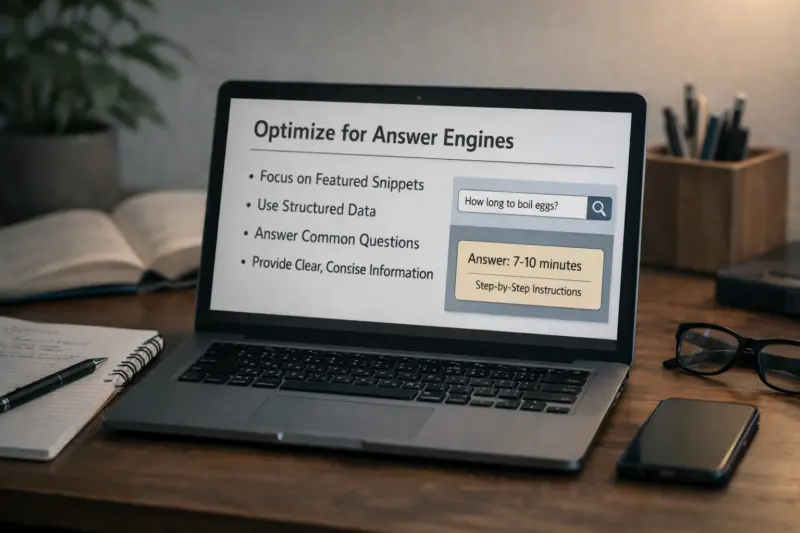
Convert topical coverage into entity-rich answers
Topical breadth rarely wins on answer engines unless it becomes entity-rich and evidence-backed. Entity coverage means the answer includes the key concepts, tools, constraints, and audience details that the summary should mention. When those entities are clear, the engine can present a more complete and verifiable response.
Define the entities your answers must name. For example, when explaining a method, include the method name, the inputs, and the outputs. When discussing a process, name the actors and the required conditions. If geography affects applicability, name the scope explicitly. This supports disambiguation and reduces the chance that the engine chooses a mismatched snippet.
Handle question variants inside the same page when they share a common answer core. For instance, if the question appears as “How do I do X” and also as “How does X work,” you can cover both with one strong definition plus a short procedure. This reduces fragmentation across thin pages. It also helps the engine select one coherent answer block rather than picking partial fragments from multiple URLs.
Evidence scaffolding is how you make answers safer to extract. When you make a claim, add boundaries like “when it applies” and “when it does not.” Then include brief examples that demonstrate correctness. These details give the engine context for verification and help it avoid overgeneralizing. The tradeoff is you must stay precise. Vague statements feel comprehensive but often extract poorly.
Be careful with the granularity trap. A page that covers everything may still fail as an answer if it does not clearly handle a specific scenario. In that case, consider a dedicated section for a specific decision point. For example, “baseline steps” is not enough if users really want the “first decision” step. That separate unit becomes more extractable.
Trust also shows up in how consistently you use terminology. Use the same term across headings, body text, and summaries. If you introduce aliases, define them once. Then keep using the same preferred label. This is a practical trust layer. It aligns with how answer engines avoid conflicting extracts and improves the chance that your page is treated as a reliable source.
Choose answer units that match “what to do next”
Answer engines often select content that helps the user move forward immediately. So your best AEO Best Practices focus on next-step clarity inside each answer unit. That means the content should include a clear outcome, not just background.
Use direct-answer units for straightforward questions. These include a conclusion, a short explanation, and the smallest necessary context. Keep the scope tight so the extracted summary answers the question fully. For example, a direct-answer unit might define a concept and state the “if and only if” conditions that determine correctness.
Use how-to units for step-based intents. These should list steps in a logical order and include prerequisites. Add “what to check” points so the user can validate each stage. Include brief error handling for common mistakes. If your steps depend on assumptions, state them up front so the answer engine can extract the right path.
Use comparison units for “which one” intents. Present tradeoffs as criteria, not marketing slogans. Include requirements, constraints, and pros/cons tied to those criteria. Then add a short selection guide that summarizes the deciding factors. This format works well because the engine can extract the key differentiators into a compact summary.
Use troubleshooting units for failure modes. These sections should isolate likely causes and propose diagnosis steps. Start with the most common failure mode, then show how to confirm or rule it out. Add a final “if it’s still not working” path that points to the next action. The edge case is when multiple causes overlap. In that case, include a brief note about checking dependencies first.
Avoid mixing multiple intents inside one answer block. If a section tries to define, instruct, and compare at once, the engine may extract only the easiest part. Instead, use signposting through subheadings. Keep each sub-section aligned to one answerable task. Then add a short “next step” line that fits the unit’s purpose without changing the intent.

Fix misconceptions that reduce answer visibility
Many teams think AEO is only about adding structured data or aiming for snippets. That belief leads to brittle results. Answer engines decide answers from many signals, including content clarity and evidence strength. In other words, structured data can help, but it rarely replaces answer-ready writing.
It is also common to assume “longer is better.” However, long pages often dilute the core claim. Answer engines prefer concise scope with clear boundaries. A shorter block that states the conclusion and supports it can outperform a massive guide that buries the answer. Therefore, write for extraction first, then expand where it increases verification.
Heading strategy is another frequent issue. Generic headings like “Overview” and “Details” do not map to answerable sub-questions. Instead, write headings that describe the decision or concept precisely. This helps the engine locate the snippet that truly resolves the question. It also helps readers confirm quickly that the extracted summary will be accurate.
Single-source brittleness can also hurt. If your FAQ contradicts your main body, answer engines may avoid selecting your text. Even small inconsistencies can reduce confidence. Maintain one source of truth per concept. If you update a definition in the body, update it everywhere else that mentions the same rule.
A common edge case is when multiple answers appear to apply. For example, two methods might both work under different constraints. If you do not include disambiguation, the engine may pick the “wrong” branch. Add a short conditional statement that clarifies which scenario matches the question context. That improves selection confidence and reduces wrong-answer citations.
Finally, watch for extraction failures caused by format. If the core answer appears only inside images, the engine may skip it. If key facts appear only inside dynamic widgets, the engine may not see them consistently. For best results, ensure the answer block exists in plain body text. Then you can use media for illustration, not for the actual claim.
Optimizing for answer engines is crucial for your content's visibility.
Effective AEO strategies enhance your chances of being selected as a featured answer.
Is Your Website Ready to Dominate Search Results?
Get Your Free Website ConsultationValidate AEO impact with an evidence loop
Optimizing for answer engines requires measurement that matches how answers appear. Ranking and clicks do not always correlate with answer selection. Your goal is to confirm whether your intended answer unit gets extracted and presented. That means using an evidence loop, not guessing.
Start with an evaluation method tied to question queries. Collect the top questions you want to win. Then observe where your page appears in answer presentations and whether your page is cited. When available, use analytics tools that report query-level insights. Even without perfect data, you can still measure “answer presence” by manual review.
Run sampling-based testing. Pick a small set of target questions and inspect how the answer engine frames the response. Compare the extracted text with your intended answer block. If the engine summarizes a different sentence than the one you wrote, restructure the block. Often, a clearer lead sentence or better disambiguation fixes the issue.
Use change control to iterate safely. Adjust one variable at a time. For example, first rewrite the lead sentence of the answer block. Then update the heading wording. After that, add a short boundary sentence. This prevents you from “improving” multiple factors and losing track of what worked.
Be aware of evaluation bias. A page can rank well yet never become the cited answer. In that case, you should not only chase rank. You should make the answer unit more extractable and more verifiable. Look for why your claim might be harder to trust than competing sources.
In 2026, keep update discipline for time-sensitive rules. If your answers rely on changing policies, definitions, or operational constraints, update the content. Then document what changed inside your editorial notes. That supports consistency and helps reduce contradiction across sections. Consistency improves the chance that answers remain stable enough for repeated selection.

Adapt answer strategies by content type and audience context
AEO Best Practices vary by content type because the “best answer” unit differs by user stage. A beginner often needs definitions and prerequisites. An advanced reader often needs constraints, edge cases, and decision criteria. When you tailor answer units to audience context, you reduce mismatch risk.
Segment your audience by what they already know. For beginners, use plain-language definitions and clear next steps. Add a short “what this means in practice” sentence. For advanced readers, include assumptions, boundaries, and failure modes. Also, add references to evidence that supports the constraints you state. That improves extractable confidence.
Plan scenario coverage instead of topic coverage. For each target intent, list 2–3 realistic scenarios. Then ensure each scenario has an answerable section or subsection. For example, if the question involves a decision, include separate scenario guidance for “typical case,” “limited data,” and “exception case.” This helps prevent the granularity trap that leaves your page too broad.
Content type also changes where extraction happens. Evergreen guides should include direct-answer blocks near the top of the relevant section. Documentation or knowledge base pages should include step blocks and troubleshooting checklists in plain text. Service-oriented pages should include scope, prerequisites, and “what to expect” outcomes where readers need them most. The tradeoff is that you must avoid promotional fluff inside the answer unit.
If geography affects applicability, add an applicability anchor section. Only include locations you can support with real constraints and actual differences in practice. For example, if rules differ by region in your domain, name the scope and clarify when each rule applies. If no geography differences exist, keep the scope industry-wide. That avoids false specificity and confusion in extracted answers.
Finally, tie every change back to answer-unit quality. Use the same core framework: map the question, pick the right unit, make it extractable, and validate selection. Then expand coverage only when you have evidence that the intended answer block is being used. That keeps your AEO work focused and compounding.
Frequently Asked Questions About AEO Best Practices
What does AEO mean compared to SEO?
AEO focuses on being selected as the source for an answer, not just ranking a page. SEO often measures visibility through results ranking. AEO, however, depends on extraction and citation behavior, so the best-written answer block matters most.
How do I write an answer engine–friendly paragraph without sounding robotic?
Lead with the conclusion in the first sentence, then add supporting sentences that keep the logic in one place. Use natural language, but keep meaning stable across the paragraph. If you add boundaries or conditions, write them in plain “if this, then that” form.
What’s the best AEO format for “how to” questions?
Use a step sequence with prerequisites and an explicit outcome. Each step should be short and should include what to check. Add a brief troubleshooting line for the most common failure mode so the answer stays usable when things go wrong.
Should I rely on structured data for AEO, or is it optional?
Structured data can help make content easier to interpret, but it does not replace answer clarity. The engine still needs extractable text that clearly states the claim and its boundaries. If your answer is ambiguous, structured signals rarely fix that.
How can I optimize a page when multiple questions are competing on the same URL?
Separate each intent into distinct answer blocks with clear subheadings. Make each block stand alone so extraction does not mix contexts. Then ensure each block has its own lead sentence, evidence, and disambiguation when needed.
Why do my answers get featured sometimes but not consistently?
Inconsistency often comes from unstable extracts, conflicting wording across sections, or changing question intent. Updates can also shift what engines consider the best answer. If the core answer appears only in one part of the page, small edits can change what gets extracted.
How do I know which section to optimize for the direct answer?
Choose the section that fully resolves the question without requiring other pages. Then test extractability by checking whether the core claim is obvious within seconds. Rewrite the lead sentence and headings until the answer unit can stand alone.
What should I do when my content is accurate but too complex for direct extraction?
Rewrite for extractability by reducing ambiguity and splitting the content into scenario-based units. Add a short disambiguation sentence for closely related meanings. Then move the core decision criteria into plain body text near the top of the section.
How do I measure AEO Best Practices results in 2026?
Measure answer presence by sampling target questions and checking whether your page is cited. Compare the extracted snippet to the answer block you intended. Then iterate with one change at a time and reassess answer selection, not only rankings.
Can I optimize for answer engines if I’m a small site with limited content?
Yes. Focus on high-intent gaps where your page can be the most complete and clear answer. Consolidate thin pages into scenario-based sections. Then strengthen evidence density inside each answer unit so extractability improves quickly.
REQUEST A FREE WEBSITE CONSULTATION
Transform your website to effectively engage answer engines and boost visibility. Let us help you implement AEO Best Practices with a custom strategy tailored for your business.
SCHEDULE A CONSULTATIONConclusion
AEO Best Practices are about making your content easy to extract, easy to verify, and clear enough to cite. Build a decision path that maps questions to answerable content units. Then structure each page so the engine can reliably grab the right “core claim” with supporting context.
Strengthen entity and evidence clarity, and make disambiguation part of your answer blocks. Choose the right unit type for the user’s next step, whether that is a direct answer, a procedure, a comparison, or a troubleshooting path. Finally, validate impact with an evidence loop that checks extraction and cited presence.
Practical next step: audit one of your pages for answerability, then redesign one key section into an extractable answer unit. After you update it, re-check the same target questions and confirm the extracted text matches your intended answer. You can also compare multiple content unit approaches for your top intents before you expand coverage further.
If you want a reference point for how Google thinks about information quality and clarity, see the Search Quality Rater Guidelines and Google’s Search Essentials. For structured explanation of answer and snippet behavior concepts, you can also reference Search Engine Optimization (SEO) starter guide from Google Developers. If you publish in WordPress, review WordPress.org documentation to ensure your content is rendered consistently in the places your audience reads it.
Updated September 2026