
If customers can’t find you when they search for the services you offer nearby, you lose revenue—so the goal is simple: improve your visibility in local search and turn that visibility into calls, bookings, and store visits. This guide focuses on Local SEO Techniques for Business Success, including practical steps for Google Business Profile, local listings, location-relevant content, and measurement. Local SEO isn’t a one-time setup; it’s an ongoing system that builds trust in local results and helps the right buyers choose you. You’ll learn what to fix first, what to publish next, and how to measure progress in a way that connects to business outcomes.
Build a local SEO roadmap tied to revenue, not just rankings
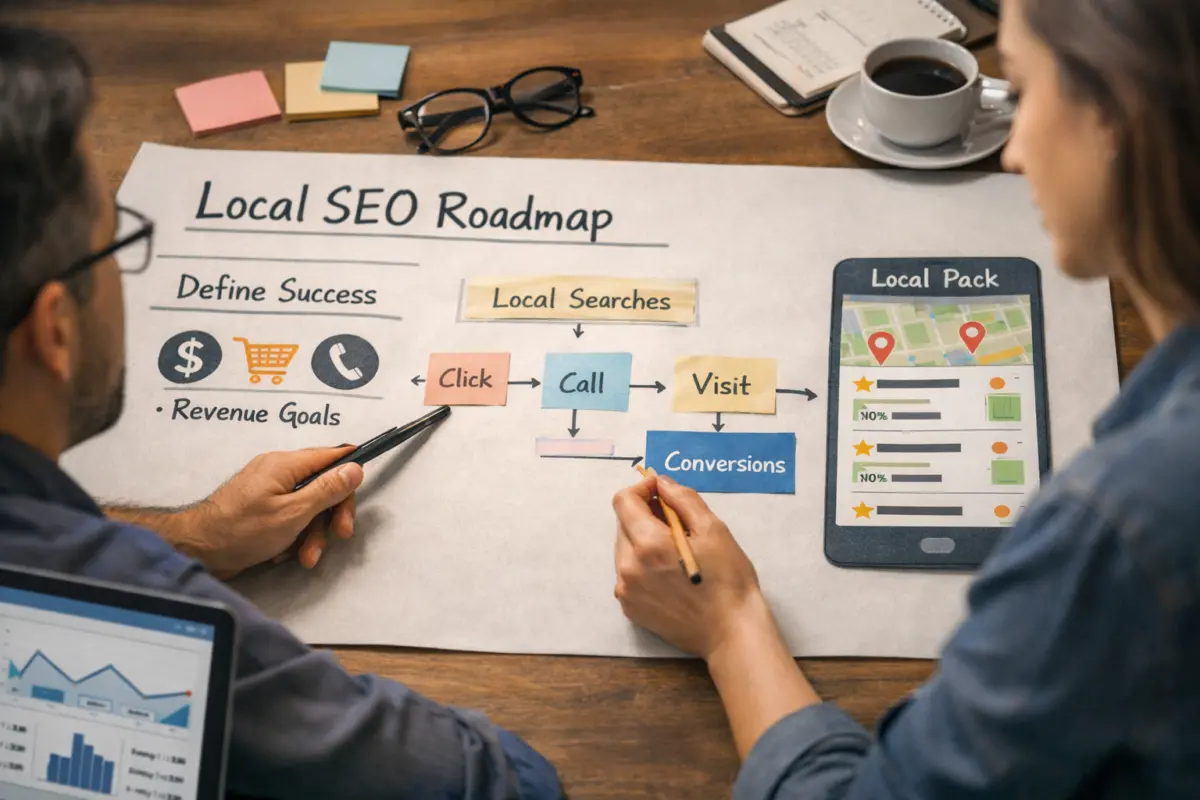
Start by defining what “success” means for your business, then work backward from the local searches that produce those actions. “Local pack” visibility matters, but it’s only valuable if the user’s next step is profitable—calling, booking, requesting directions, or submitting a form that qualifies.
- List your revenue actions (pick 1–3 primary outcomes). Examples: phone calls that become booked jobs, online appointment requests, quote form submissions, or in-store visits for walk-ins.
- Map each outcome to local search intent. For instance, “near me” queries often lead to calls or directions, while “service + city” searches may lead to forms or bookings—your landing pages should match that behavior.
- Set success metrics that reflect qualified demand. Focus on call/conversion rate, direction requests, booking starts, and lead quality (e.g., % of forms that result in an appointment), not only impressions.
- Choose primary local landing pages based on how your customers actually search. Use one dedicated page per core service you sell (and per major service area if you truly serve multiple cities/regions). Avoid creating a page for every neighborhood without proof—thin pages dilute results and waste maintenance time.
- Prioritize fundamentals before content expansion. Fix data consistency, Google Business Profile health, and landing-page alignment first; only then scale content and local assets.
- Match the query with the offer and constraints. If you target “emergency” searches, your page must clearly communicate availability and response reality (e.g., hours, coverage area, and how quickly customers can reach you). “Rank first” fails when the page doesn’t reduce buyer uncertainty.
Optimize your Google Business Profile to win local pack visibility
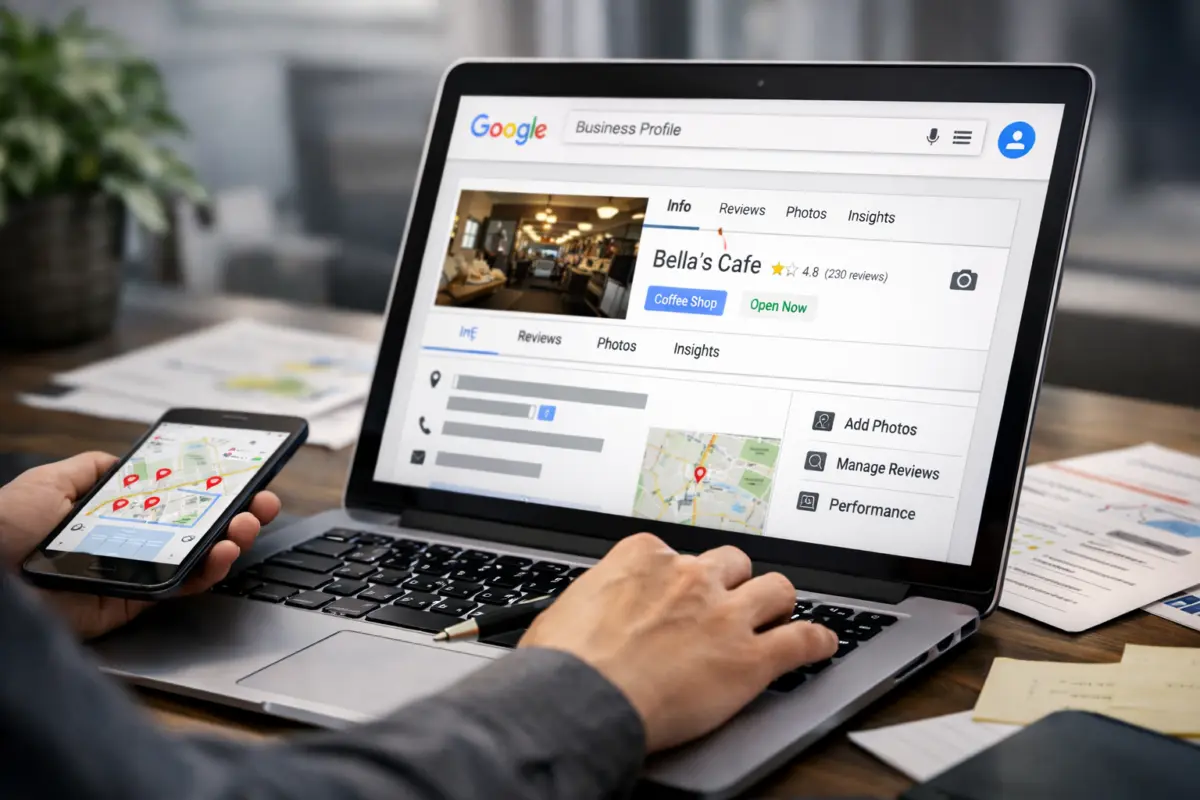
Your Google Business Profile (GBP) is often the fastest path to local pack traffic because it combines visibility and trust signals in one place. You’re not just filling out fields—you’re building decision-making support for the person ready to choose a provider.
- Set categories with intent. Choose a primary category that best matches your main service, then add relevant secondary categories that reflect what customers search for. Don’t add categories just because they sound “valuable”—they can misalign traffic and hurt conversions.
- Complete core details: services list, business description (written for buyers, not for bots), products (if applicable), attributes, and accurate hours/holiday hours.
- Use photos to improve click-through and confidence. Upload professional exterior/interior shots, team photos, service examples, and short “proof” images (e.g., completed projects, tools/vehicles in action, or before/after where appropriate). Keep an update cadence (for many businesses, monthly or quarterly is enough) and prioritize images that reduce uncertainty.
- Publish GBP updates that support local intent. Post about seasonal demand, service availability, new offerings, or local events you actually participate in. Each update should clarify what a buyer gets when they contact you.
- Build reviews that convert. Request reviews shortly after a successful service when the customer is most satisfied. Respond to every review with a specific, helpful reply that references what they experienced and what happens next.
- Handle address and service area correctly. Use the address only when you serve customers from that location. If you operate by appointment or come to customers, consider a service-area setup that matches your coverage and hides your address when appropriate—misconfiguration can harm trust and compliance.
Edge cases matter. If you manage multiple locations, confirm each GBP is tied to the correct physical location, and check for duplicates before making changes—duplicate profiles can confuse both users and local ranking systems.
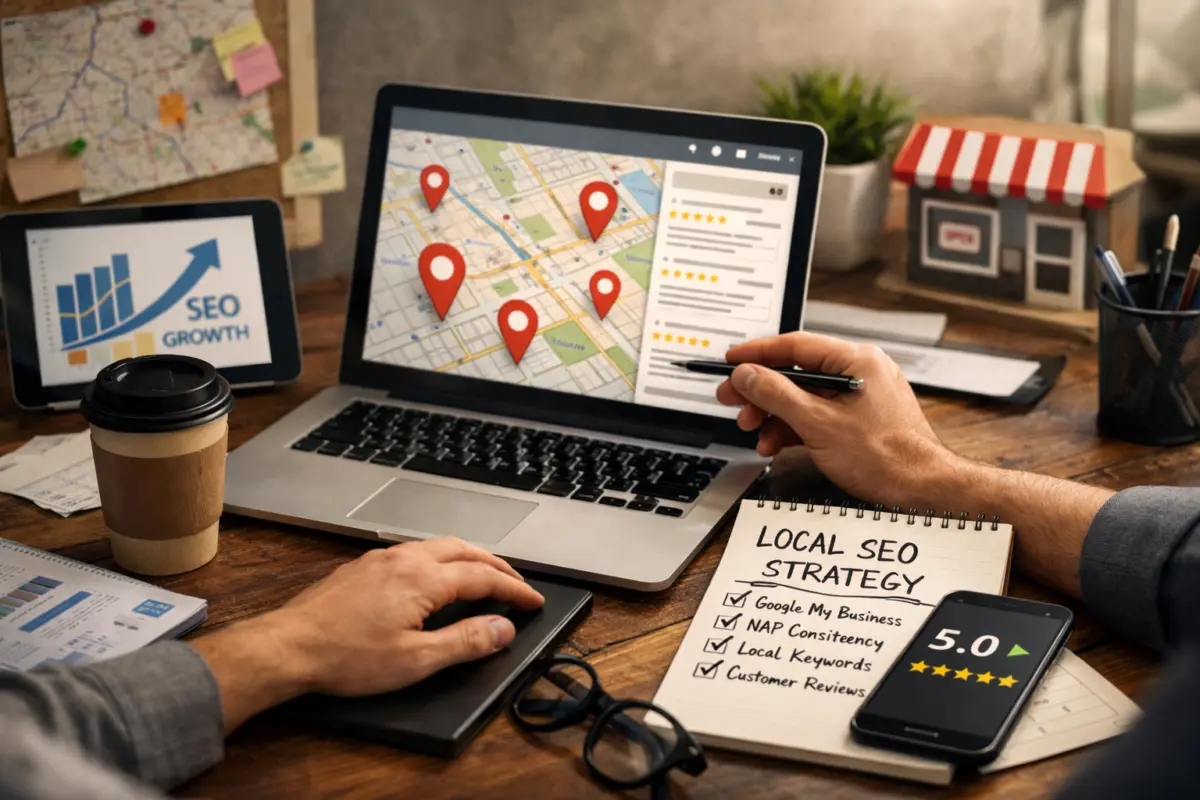
For official guidance on profile and visibility policies, use Google’s documentation on representing your business on Google: Google Business Profile guidelines.
Use local citations and business listings to create consistent trust signals
Local citations are online references to your business name, address, and phone number (often abbreviated as NAP). They help create consistency across the web; consistency makes it easier for local systems to understand who you are, where you operate, and how customers should reach you.
- What counts as a citation: directory listings, local business platforms, chamber pages, industry associations, and partner directories—anything that shows your NAP (or a close equivalent) reliably.
- Completeness vs accuracy: completeness is “filled out”; accuracy is “correct.” You want both, but accuracy is non-negotiable because errors can create buyer friction and confusion.
- Consistency checklist: the same business name format, identical phone number, matching address formatting (including suite/unit), and a stable website URL used across major listings.
- Choose your source of truth (your preferred NAP as shown on your website and GBP).
- Audit existing citations by searching your business name + city and checking top directories where customers in your service category expect to find you.
- Standardize formatting. Example: “Suite 200” vs “Ste. 200” can split records—pick one format and use it consistently.
- Avoid phone mismatches. If you use tracking numbers, keep them consistent by location and map them carefully to the landing page and the GBP phone field.
- Handle changes without resetting progress. For renames, moves, or phone changes, update the listings in the order that reflects your highest-impact sources first (GBP and your primary directory partners), then roll out updates to smaller listings.
- Correct duplicates. If two listings represent the same location, consolidate or correct them to prevent competing signals.
A common misconception is that “more directories” always helps. In practice, irrelevant or inaccurate listings can dilute your trust signals. Build coverage where customers and local partners in your category actually use those sources.
Turn location-relevant content into a lead engine for real buyers
Local SEO content works best when it mirrors how people decide and when they need answers. Your content should reduce uncertainty about fit, coverage, pricing approach (at least generally), and proof of results in the areas you serve.
Plan content around purchase journeys, not just keyword clusters. Create pages that help buyers decide now, not pages that merely “contain the city name.”
Boost Local Search Impact with Expert Web Solutions
Unlock Local Success with a Custom WordPress Site
Boost local SEO with a fast, mobile-friendly website designed to convert visitors. Our WordPress experts build tailored sites that increase local visibility and support your Google Business Profile.
29+ Years of Experience • Custom WordPress Development • Free SEO Support
- Service pages that sell: clearly explain the service, what’s included, what it costs “in general terms” (or what affects price), and how customers start the process.
- Service + area pages only when justified: use them when there’s distinct demand, unique proof, or coverage clarity you can support with real information (projects, testimonials, or operational details).
- Neighborhood and FAQ-style content: answer the questions people ask before they call (turnaround, scheduling, what to prepare, common problems you solve).
- Comparison-style pages: “Why choose X vs Y” helps buyers who are comparing options and are ready to book after they understand the tradeoffs.
- Define “local relevance” in proof terms. Add local proof: projects completed in the area, testimonials that mention the service area, team experience serving local customers, and coverage boundaries stated plainly.
- Stop location pages from becoming thin. A new location page is justified when you have enough unique proof and service details to avoid repeating the same template.
- Use schema only where it adds clarity. When you publish structured contact and business information, ensure it matches what appears on the page and is appropriate for your business type. Don’t add markup just to “add SEO.”
- Distribute content locally. Earn mentions through community engagement, partner collaborations, and local media outreach tied to real assets (guides, project showcases, or expert commentary).
For broader guidance on structuring content and answering user intent, see Google’s Search Essentials: Search Essentials.
Links help signal credibility, but local link building is most effective when the source is contextually tied to your city/region and your real-world relationships. The goal isn’t link volume; it’s editorial relevance and local trust.
- High-value local link sources: local media that features your expertise, partner websites that list preferred vendors, chambers and association pages, and community sponsorship or event participation pages.
- Smaller-team tactics: offer a local guide, publish a case study tied to a regional problem, or contribute practical expert commentary that partners can reference.
- Brand mentions: even unlinked mentions can support recognition, and when you can, request improved attribution to ensure the mention points back to the most relevant service page.
An important nuance for multi-location businesses: don’t funnel every link to the homepage. If your partners mention a specific location or service area, make sure the attribution aligns with the correct location page (or a service page that genuinely matches what was featured).
Measure what’s working and improve your local funnel
Local SEO should improve business outcomes, not just dashboards. The measurement system needs to connect local search visibility to what your team actually fulfills—calls, form submissions, direction requests, and booked appointments.
- Track the outcomes you care about. Use call tracking carefully (especially with multiple locations), and monitor form submissions and appointment bookings by landing page.
- Join GBP insights with website behavior. GBP performance can show how users interact with your profile; Search Console and landing page analytics show whether those visitors match the promise and convert.
- Diagnose using a “then adjust” loop. If GBP impressions rise but conversions don’t, tighten your landing-page alignment, update offers, and improve calls to action. If conversions rise but impressions stall, revisit categories, services, and local proof.
- Prioritize fixes by impact. Start with listing accuracy, then on-page match to the offer, then review velocity and response quality.
- Account for seasonal changes. Update holiday hours and availability language, and create temporary landing content for short-lived campaigns or events only when it maps to real demand.
Don’t overreact to small week-to-week swings. Search behavior varies; focus on trends and validate changes over enough time to see whether conversions stabilize.
Common mistakes that stall local growth for businesses
Most local businesses don’t struggle because they “don’t do SEO.” They struggle because they do the wrong things in the wrong order—or they treat local presence like a set-and-forget checklist.
- Inconsistent NAP and outdated hours: a wrong phone number or stale holiday hours can kill conversions even if rankings improve.
- Duplicate GBP listings: duplicates split signals and confuse customers.
- Reviews that aren’t managed: unresponded reviews reduce trust and can lower conversion from profile visits.
- Website pages that don’t match the search: a “service + area” page that doesn’t show relevant proof or coverage clarity frustrates buyers.
- Thin location pages and keyword stuffing: if pages repeat the same copy without unique proof, users bounce—and it becomes hard to improve performance.
- “More listings” thinking: irrelevant directories and mismatched data can create noise instead of trust.
Fix fundamentals first. When your GBP, citations, and landing-page intent align, the content and authority work you add later has a clearer path to compounding results.
Options for local SEO execution: DIY setup, templates, or managed services
You can improve Local SEO in-house, with freelancers, or through managed services—but your best option depends on how many locations you have, how mature your current listings are, and how often you can maintain GBP and content.
| Execution option | Best for | What to watch | Typical outputs |
|---|---|---|---|
| DIY | Single location, small budgets, and someone internally who can maintain GBP/citations | Work that never gets repeated (reviews, updates, audits) and inconsistent tracking | GBP optimization, citation cleanup, basic local content updates |
| Freelancer | One-off needs like GBP setup, citation audits, or landing-page content rewrites | Fragmented ownership and lack of ongoing QA | Targeted improvements with documentation and handoff |
| Managed Local SEO | Multiple locations, higher competition, and need for consistent QA and reporting | Agencies that only do directory submissions instead of GBP, content, and performance optimization | Ongoing GBP management, review strategy support, local content + measurement |
What “good” looks like no matter the option: a clear scope, transparent reporting tied to business outcomes, and a documented process for GBP, citations, content, and QA.
LOCAL SEO STRATEGIES THAT DRIVE REAL BUSINESS RESULTS
Rank higher in local searches and turn clicks into customers with expert website design, SEO, and Google Business Profile optimization by eDesignerz.
START YOUR FREE CONSULTATIONIf you run WordPress and need support for SEO foundations that complement local efforts, review resources like WordPress SEO for Local Businesses and practical tooling guidance such as search engine optimization wordpress.
Local SEO for multi-location businesses and business groups
Multi-location SEO succeeds when you separate what’s shared (brand) from what’s unique (local proof and conversion paths). The biggest risk is cannibalization—where location pages compete with each other—or duplicates that fragment trust signals.
- Centralize brand assets (company mission, non-location-specific policies), but avoid duplicating every page across locations.
- Create unique location proof. Each location page should include locally relevant testimonials, service coverage details, and recent photos tied to that location.
- Govern Google Business Profile ownership. Assign clear responsibility for GBP updates, review responses, and category/services changes per location.
- Prevent duplicates. Before editing, verify each location has one correct GBP entity and that ownership/verification is consistent.
- Interlink location pages carefully. Connect each location page to the services it actually offers, plus a central “how to contact us” page. Avoid forcing one location to inherit authority from unrelated services.
- Handle overlapping service areas honestly. If two locations serve the same neighborhoods, clarify boundaries and routing (which location handles which appointments) so buyers aren’t confused.
For operational clarity, think of local SEO as a conversion system: the location page should tell a buyer, “Here’s where we serve, how to reach us, and what you can expect next.”
Local SEO in major US metros: how to adapt without losing focus
Competition usually rises as metro size increases and the number of businesses offering similar services grows. That means you’ll often need stronger local proof and sharper conversion pages—without turning your website into a city-by-city template machine.
- Use metro pages only when demand supports them. If you don’t have credible service coverage and proof for a specific metro, don’t publish a “thin city” page.
- Strengthen local proof aligned to the metro. Emphasize the services people in that metro actually buy and add proof that reflects local activity (testimonials, project examples, partnerships).
- Keep a nationwide baseline. Fundamentals like GBP, core service pages, and citation accuracy should stay consistent; metro-specific work should layer on proof and refinement where needed.
- Communicate boundaries if you serve certain neighborhoods but not others. Buyers need clarity, and so do local ranking systems.
A practical approach is to avoid “city-hopping content.” Publish fewer pages with real proof, then iterate: if a metro page doesn’t generate calls or bookings, improve the offer and proof before creating additional pages.
Frequently Asked Questions About Local SEO Techniques for Business Success
How much does Local SEO cost for a local business?
Local SEO pricing varies based on competition in your area, the number of locations you manage, the current health of your Google Business Profile and citations, and how much new content or landing-page work is required. DIY costs are mainly your time plus tools, while freelancers and managed services usually charge monthly for implementation and reporting. Expect costs to range widely, and the most accurate way to know your budget is to request a scoped audit and a proposal based on your business goals.
How long does it take to see results from Local SEO?
Most businesses see early improvements in visibility or profile engagement in a matter of weeks, but meaningful lead and booking growth often takes longer, especially in competitive metros. Timelines depend on listing accuracy cleanup, review velocity, landing-page alignment, and how quickly you can publish useful local content and earn authority signals. Track leading indicators (GBP performance and landing-page conversions) first, then evaluate final outcomes like booked appointments over a few months.
Do I need separate location pages for each city or neighborhood?
You typically need separate location pages only when you can support them with distinct proof, clear service coverage boundaries, and enough unique content to be genuinely helpful. If multiple cities share the same service process, proof, and coverage, a strong service page plus a clearly scoped service-area approach may convert better than thin location templates. If you do add pages, avoid repeating the same text with only the city name changed.
What should I prioritize first: my website or my Google Business Profile?
For most local businesses, prioritize Google Business Profile fundamentals first because it directly influences visibility in the local pack and drives high-intent clicks. Then align your website: ensure your top local landing pages match what users see on your profile and that the page makes it easy to book or call. If your GBP is solid but your site doesn’t answer the buyer’s immediate questions, conversions will stall.
Make sure your business shows up where it matters most. eDesignerz crafts tailored websites and local SEO strategies that turn nearby searches into real customers. Get expert guidance that drives calls, bookings, and visits today.
Get Your Free Website ConsultationHow do I handle multiple locations with one website without confusing Google?
Use distinct location pages that include unique local proof (photos, testimonials, and service details) and clearly route users to the right appointment or contact flow. Avoid duplicate or near-duplicate pages that differ only by city name, and ensure each Google Business Profile is tied to the correct location. Keep internal navigation straightforward so users land on the location page that matches what they searched.
Can I use paid ads while I work on Local SEO?
Yes, paid ads can complement Local SEO by capturing demand while you improve organic visibility and conversion paths. Use ads to test offers and landing-page clarity, but avoid using ads as a substitute for fixing incorrect hours, weak GBP, or mismatched landing pages. When you coordinate campaigns with your local conversion pages, you can reduce customer friction and learn what messaging works.
Conclusion: turn local visibility into a repeatable business system
Local SEO Techniques for Business Success come down to a repeatable sequence: keep GBP and citations accurate, build landing pages that match local intent, publish location-relevant proof that earns trust, and strengthen local authority through mentions and links. Measure outcomes tied to revenue, adjust based on what users actually do, and treat maintenance as part of the strategy—reviews, updates, and QA don’t stop after launch. If you’re ready to act, start with a local presence audit of your Google Business Profile, your key citations, and your top landing pages, then build a 30/60/90-day plan that focuses on the highest-impact fixes first.
Updated November 2026