
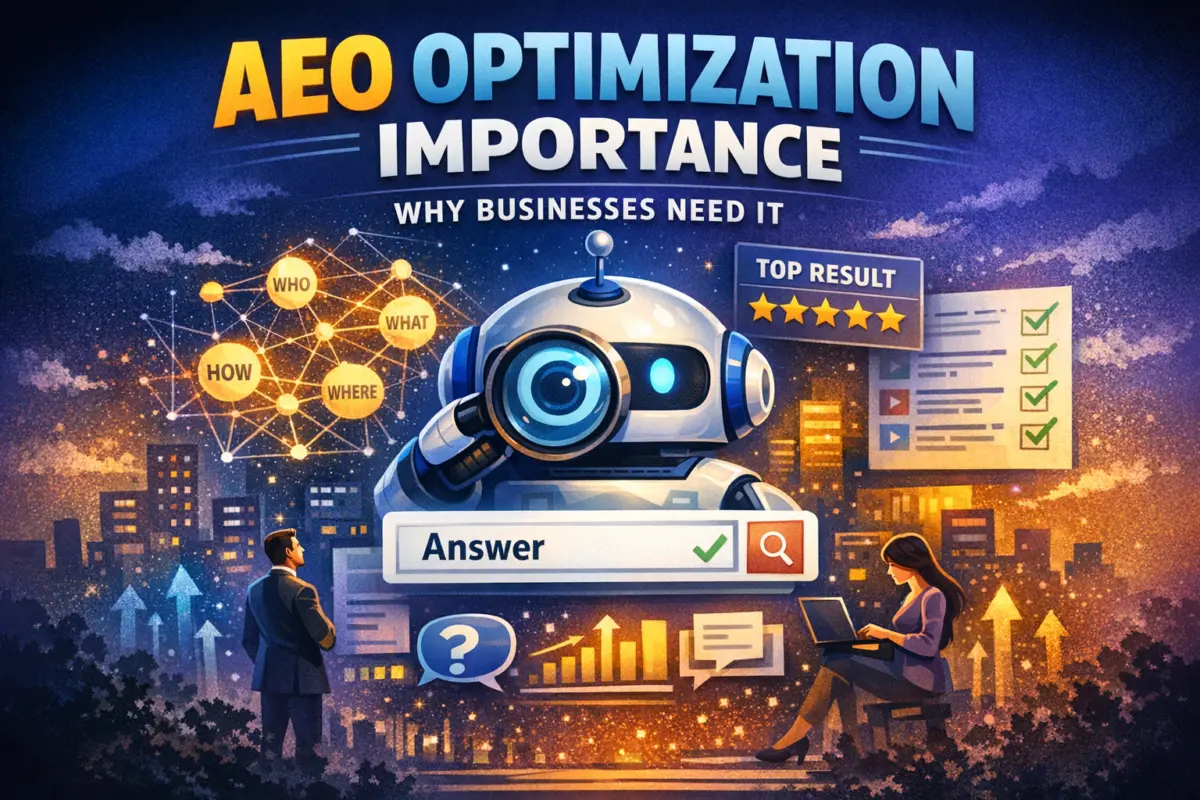
Most businesses need AEO Optimization Importance because customers now find answers through AI summaries and answer engines, not just through ranked links. Brand visibility depends on whether your content is selected, summarized, or cited. This affects qualified leads, sales conversations, and trust in your expertise.
Answer Engine Optimization (AEO) focuses on being the “source of record” inside an answer. It is close to SEO, but the goal is different. Instead of earning a top URL, you earn an answer segment that helps a person decide. That is why AEO Optimization Importance is now a board-level marketing topic for many teams.
This guide explains how answer engines decide what to say. It also covers the role of structured data, content clarity, and authority. You will get a practical 30–90 day plan, measurement ideas, and guidance on when to hire an AEO specialist.
How answer engines turn content into usable answers
Answer engines choose content that can be summarized accurately for a specific question. This is the core business reason AEO matters. Your website must be “answer-ready,” not only “keyword-relevant.”
Most systems follow a similar high-level flow. First, they discover and index web pages and other sources. Next, they match content to the user’s intent, then select passages that can be used. Finally, they present an answer through excerpts, synthesis, and citations or attribution.
That selection process differs from classic ranking. Traditional SEO often rewards pages that match a query and build authority for a URL. AEO adds an extra step. Your content must also be extractable. It must contain clear definitions, steps, and evidence that an answer system can safely reuse.
Practically, consider a services business with a page like “How our process works.” A traditional approach aims for that page to rank. A strong AEO approach also ensures the page contains clearly labeled stages, plain-language explanations, and proof points. Then the system has more usable material when it summarizes your process.
Meanwhile, tradeoffs exist. Some answer experiences reduce direct clicks. Even when CTR is lower, you can still win through brand lift and more qualified inquiries. For many businesses, the goal becomes assisted performance, not only landing page traffic.
For reference on how search systems evaluate quality and relevance at a high level, see Google Search Central: Creating helpful, reliable, people-first content — it aligns with the idea that answer engines prefer content that is clearly useful and trustworthy.
What makes AEO different from traditional SEO measurements
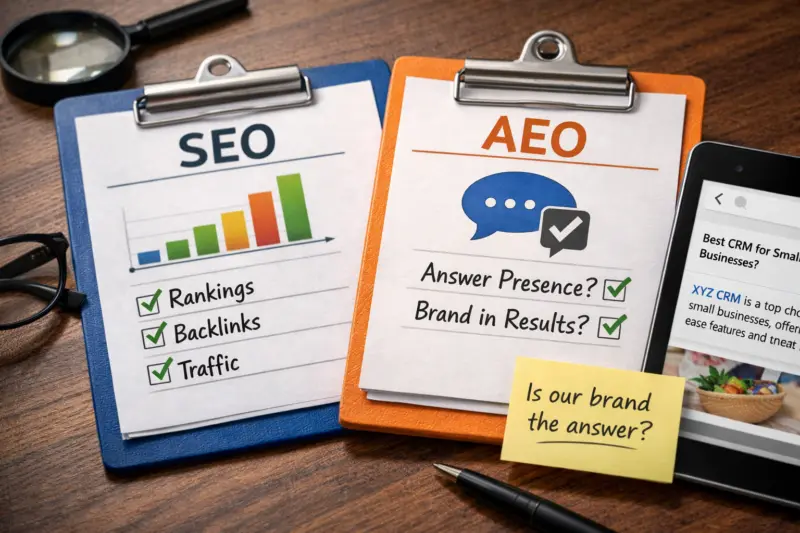
Traditional SEO measures rankings and link-level visibility. AEO measures whether your brand becomes part of the answer. That shift changes both how you plan work and how you judge results.
With SEO, you can often track progress by monitoring keyword positions. You also track click-through rates to specific URLs. With AEO, the success signal is whether your content is selected for answer outputs. That selection may appear as a cited source, a featured excerpt, or an attribution in a synthesized response.
In addition, the “unit of value” changes. SEO optimizes a page. AEO optimizes answer segments inside a page. That means you should expect improvements in clarity, structure, and trust signals. You should also expect overlap with technical SEO, because the system still needs to crawl and understand your pages.
Here is a realistic business scenario. A buyer searches for “which option is best” and gets an AI-generated comparison. If your site has an organized comparison section with clear criteria, it is more likely to be used. Even if you do not rank #1 for a keyword string, you can still earn citations when your content matches the question’s structure.
However, a common misconception blocks progress. Some teams assume that ranking guarantees answer inclusion. That is not always true. Answer engines can prefer content that is more extractable, more consistent, and more reliable for synthesis, even when another page ranks higher.
You also need to avoid measuring only clicks. Instead, track downstream outcomes. Examples include branded search growth, demo requests, quote submissions, and sales enablement usage. Then connect AEO work to commercial results.
Why content clarity becomes a selection factor for AI summaries
Clear content helps answer engines extract the right facts without guessing. That is why content clarity is central to AEO Optimization Importance. If your page is fuzzy, your brand will be easier to omit or replace.
Answer systems favor content that is easy to interpret. That means explicit definitions, consistent terminology, and unambiguous claims. It also means you separate facts from sales language. When your content makes decision criteria obvious, it supports synthesis.
Clarity also helps human reviewers. Many answer systems rely on models trained to follow instructions and patterns. Still, they need grounding sources. If your page provides short summaries that accurately reflect the longer text, it becomes more “readable” for both machines and people.
Get Foundat the Answer
Boost your brand’s visibility in AI-powered search results with expert AEO strategies from eDesignerz. Request your free website consultation today.
Practical application starts with rewriting key sections. Add a short definition near the top of each relevant page section. Use headings that reflect questions customers ask in a buying journey. Then include step-by-step explanations where steps actually exist. In “what to expect” sections, be specific about inputs, outputs, and decision checkpoints.
Tradeoffs matter. If you oversimplify, you may reduce trust. Some buyers want details about process, timelines, or requirements. If you only provide vague reassurance, an answer engine may still summarize your competitors because their content looks more complete.
A common mistake is stuffing multiple services or variations into one page without clear boundaries. Answer systems synthesize across sources. If your content contradicts your other pages, it can lower confidence. That can prevent your brand from being cited in a synthesized answer.
For broader guidance on structuring content for usefulness, Google Search Central: Helpful content updates is a useful read. It reinforces that quality and clarity often beat clever tactics.
How structured data supports answer inclusion without replacing quality
Structured data helps answer engines interpret what your content means. It can improve the odds of being selected, but it does not fix weak content. For most businesses, structured data and clarity must work together.
Structured data is a way to label information using a consistent vocabulary. When the labels match your visible content, systems can more confidently map fields like organization details, services, FAQs, and product or offering attributes. That supports extraction and synthesis in answer experiences.
Start with schema types that fit your business pages. Organization schema can support brand identity and contact consistency. Service or FAQ-style content can align with question-and-answer sections when that content is truly present. If you have internal process content, make sure the page itself contains the labeled information you want interpreted.
Practical application should be template-based. For example, if you publish service pages, implement structured data across the same layout. Then ensure each service page updates the same fields with accurate, specific values. Also align your schema content with on-page text. If your structured data claims a scope you do not explain on the page, you risk mismatch.
Edge cases exist. If your business changes offerings often, stale schema becomes risky. Answer engines prefer reliable sources. They may ignore pages with inconsistencies or outdated details, even if schema is present.
Another nuance: schema can make content easier to parse, but it cannot replace original proof. If your page lacks evidence, structured data cannot create trust. That is why authority signals still drive whether your brand is selected for synthesis.
For technical grounding on schema and validation practices, consult Schema.org and follow the guidance for selecting schema types that match on-page content. Also use official validation tooling as part of your workflow.
Authority signals that increase the chance your brand is cited
Answer engines prefer sources they can trust for synthesis. Authority is not only backlinks. It is also consistency, depth, and proof that your content is grounded in reality.
In AEO terms, authority supports citation and selection. When a system summarizes multiple sources, it tries to reduce risk. It favors pages that show expertise, corroborate claims, and stay consistent with the rest of your site.
That is why content maintenance matters. If one page says one process step and another page describes a different process, the system may avoid your brand. Similarly, if your pricing ranges or requirements change and your pages do not, your content becomes less reliable for answer generation.
Practical proof types include documented processes, case studies, and original guidance. If you share a step-by-step method, show what happens in each phase. If you publish outcomes, describe scope, context, and constraints. Then update those pages when your workflow changes.
A common misconception is that “more content” equals more authority. In practice, thin pages block synthesis. Answer systems need enough context to summarize responsibly. If your page has surface-level wording and no decision details, it may be skipped for brevity or safety reasons.
Real-world scenario: a local service provider that publishes many location pages often faces authority dilution. If those pages repeat the same generic text, answer systems may treat them as low-confidence duplicates. Instead, each page should add unique process details, local proof, or team experience relevant to that service area.

This aligns with the idea that trust is built through helpful, reliable information, as emphasized in Google Search Central: Evaluating page experience and content and related documentation on quality. The core lesson remains the same: clarity and reliability influence selection.
OPTIMIZE FOR ANSWER ENGINES WIN MORE QUALIFIED LEADS
Get a custom website designed to capture AI-powered search answers. Enhance content clarity and structured data with eDesignerz to increase lead conversions and grow your business.
REQUEST A FREE CONSULTATIONWhere to start with an AEO roadmap for the next 30–90 days
Start by mapping customer questions to the pages that can answer them clearly. Then make those pages answer-ready with structure, proof, and extractable wording. This is the fastest path to AEO Optimization Importance for most teams.
First, identify your highest-value question clusters. Focus on “how it works,” “what it includes,” “what it requires,” and “how to choose.” These align with commercial investigation behavior because users want to compare options and reduce risk before reaching out.
Next, audit your existing pages for answer readiness. Look at headings, definitions, and step coverage. Then check whether your page includes criteria buyers expect. For example, a comparison page should list evaluation factors, tradeoffs, and decision guidance. A “process” page should include stages, inputs, outputs, and who does what.
Practical implementation priorities often include three tasks. One is improving clarity on top pages. Another is adding or refining structured data on the templates you control. The third is creating proof blocks that support synthesis, like documented checklists and process timelines.
Measurement must be planned early. You can track visibility signals like impressions in answer-style results when available. You can also track citation proxies through branded search lift and the volume of inquiries that mention topics from your content. Then connect those leads to conversion quality, not just volume.
A tradeoff is that measurement can be imperfect. Some systems do not reveal exactly which passage was used. That is why you need a mix of indicators. Combine search visibility trends, branded demand, and downstream conversions.
Finally, governance keeps results stable. Assign an owner for content freshness. Then set a review cadence for pages that answer time-sensitive questions. When content stays accurate, answer engines keep trusting it.
Misconceptions that prevent AEO work from producing visible results
Many AEO efforts fail because teams chase the wrong mechanism. They treat AEO like a small technical tweak. In reality, AEO is a system-wide readiness effort focused on clarity, trust, and extractability.
Myth one is that AEO is only adding schema. Structured data can help, but it cannot create answer-ready content. If your page reads like marketing copy, an answer system may summarize competitors instead. Therefore, content clarity and authority must come first.
Myth two is that ranking #1 means you will appear in answers. Answer inclusion depends on passage quality, extractability, and trust for synthesis. A page can rank for a query yet be excluded from answer outputs if it is not suitable for summarization.
Misconception three is that AI-written summaries automatically help. If your content is promotional or ambiguous, AI may rewrite it in a way that omits your brand. It might also blend you with competitors. That can weaken your ability to become the cited source of record.
A common mistake is ignoring contradictions across your site. If your process differs by location page, or your scope changes by service page, you create synthesis risk. Answer systems attempt to reconcile information. If reconciliation fails, your brand can lose selection confidence.
Edge cases also matter. If you operate in a context where claims can become outdated quickly, your pages need refresh governance. Oversimplifying complex requirements can reduce trust too. Buyers often want nuance, not slogans.
Build vs buy approaches for AEO optimization execution
You can build AEO capabilities in-house, or you can augment them with external experts. The right choice depends on your content maturity, developer resources, and measurement needs. Many teams use a hybrid model.
Internal optimization works best when you already have a strong content operation. Your team can define question clusters, update pages, and maintain structured data templates. It also helps when you have reliable subject-matter expertise and a workflow for content review.
Augmenting with a consultant or agency is often faster when you need a specialized audit. For instance, they can map answer gaps, propose schema strategies, and create a prioritized roadmap. They can also help set a measurement plan that ties AEO work to commercial outcomes, not vanity metrics.
Productized tools can support execution. Examples include schema validation and content gap workflows. These tools help you avoid technical mistakes. However, tools rarely measure answer inclusion directly, because answer engines control that experience. Therefore, tools should be support, not a complete strategy.
A practical decision framework is simple. If you can publish and update quickly, start with internal work and add external support for audits. If you have limited developer capacity, prioritize template work and structured data validation through a specialist. If you need measurement design, bring in an analyst early.
BOOST YOUR VISIBILITY BE SELECTED BY AI
Optimize your website content for Answer Engine Optimization and capture new leads from AI-powered search results. Let eDesignerz help make your brand the trusted source in AI summaries.
Tradeoffs exist in both directions. Building in-house may take longer, but it creates lasting capability. Buying execution can speed up impact, but you must verify deliverables you can validate.
Also, keep expectations realistic. AI answer placement is not guaranteed. Your goal is to improve inputs that increase selection and trust.
When hiring an AEO specialist is worth the cost
You should consider hiring an AEO specialist when your site complexity or content gap is too large for your team. You may also need them when measurement planning is missing. A good specialist improves your odds of being selected for answer experiences.
Typical roles include an AEO strategist, a structured data or technical SEO specialist, and a content strategist or editor. If measurement is weak, a measurement analyst helps connect visibility signals to lead outcomes. Many agencies combine these roles, while some consultants focus on one area.
Best-fit scenarios include complex websites with many templates, many service variations, or multi-location complexity. It also fits when you have competing claims across pages. Another fit is when your content is old and needs modernization for clarity and proof.
Before you commit, ask for a concrete methodology. Request an answer-gap map for your high-value customer questions. Ask how they plan to translate that map into page changes and template schema. Then ask how they will measure results in a way that matches your business goals.
Require deliverables you can validate. Examples include a prioritization model for the next 30–90 days, a schema strategy aligned to page templates, and a content clarity framework. Also ask how they handle freshness governance, since answer engines prefer reliable information.
A key nuance is risk management. Avoid contracts that promise guaranteed AI answer placement. Instead, focus on improving content readiness, structured data accuracy, and proof quality. Those inputs are controllable.
For a baseline on how to evaluate quality and reliability in search systems, Google Search Central: Search quality rater guidelines can be a helpful reference point for understanding the direction of quality signals.
How to map AEO work to real business goals
AEO work should tie to buyer decision moments, not just to “being visible.” When you align answers to how customers investigate options, you can connect AEO to qualified demand. This also helps justify marketing budget internally.
Start by mapping question clusters to the buying journey. Early moments include definitions and “what is this” guidance. Middle moments include comparisons like “which option is better for my situation.” Later moments include “what it includes,” “requirements,” and “what to expect.” Then align your content and page structure to each stage.
Because clicks may not always increase, measure assisted performance. Look for branded search lift after AEO updates. Track more specific leads that reference topics from your answer-ready pages. Also connect content usage in sales conversations to improved close rates, where you can measure it.
Practical example types for commercial investigation include service selection pages, comparison guides, implementation explainers, and onboarding pages. Each should include clear decision criteria. They should also include proof like documented processes and realistic expectations. When buyers can understand choices quickly, your team gets better leads.
A nuance many teams miss is that overshooting buyer maturity can hurt. Too much technical depth early can reduce comprehension. Answer engines may still extract facts, but users may not trust the recommendation. Therefore, match detail level to the decision moment.
Finally, make sure your answers reflect what you actually deliver. If your content says you handle something, your intake process should match it. That consistency protects trust, which is what answer engines reward.
Frequently asked questions about AEO Optimization Importance
What is Answer Engine Optimization (AEO) in plain business terms?
Answer Engine Optimization (AEO) is the practice of making your content more likely to be selected and summarized by AI-driven answer systems. In business terms, it means your pages are built to provide clear, extractable information for specific questions. Instead of only targeting ranked URLs, you target answer inclusion and attribution.
How is AEO different from SEO if we already optimize for rankings?
SEO often focuses on ranking pages for search queries. AEO focuses on earning selection for answer outputs that may include excerpts, synthesis, and citations. You still need technical SEO basics, but you also need “answer-ready” structure and trust signals.
Do we need structured data for AEO to work?
Structured data helps answer engines interpret your content, especially for organizations, services, and FAQ-style answers. However, it does not replace clarity, proof, and consistency. If your content is not extractable or reliable, schema alone usually will not create answer inclusion.
MASTER ANSWER ENGINE OPTIMIZATION NOW
Make sure your website content is answer-ready with expert AEO optimization. At eDesignerz, we create clear, structured, and optimized WordPress sites designed to get cited in AI-powered answers—driving qualified leads and business growth.
What kinds of content get selected in AI-powered answers?
Answer engines tend to use content that is clear, well-structured, and supported by evidence. Examples include definitions, step-by-step process sections, comparison pages with explicit criteria, and pages with documented proof. Also, content that avoids contradictions across your site has higher selection odds.
How do answer engines handle outdated information on our site?
Answer engines may surface stale information if your pages have not been updated. That can happen when your content still matches the query pattern but no longer reflects current reality. The practical fix is a freshness governance process, with owners and review dates for key answer pages.
Can AEO improve conversions if AI answers reduce clicks?
Yes, because conversions often depend on trust and intent, not only immediate clicks. You can see improved outcomes through branded search lift, more qualified inquiries, and stronger sales conversations referencing your guidance. Track downstream KPIs, not only traffic.
What does AEO Optimization Importance cost?
Costs vary based on your site size, number of templates, content gaps, and how much new content you need. Pricing can also change based on whether you need structured data implementation, a content clarity overhaul, or ongoing governance. Most teams get the best estimate through an audit and a scoped roadmap, since the work depends on complexity.
What is the timeline to see results from AEO work?
Timelines vary by initiative type. Content clarity updates can show early signals in weeks, while template-level structured data changes may take longer to reflect in answer experiences. Authority and proof-building often takes multiple months, so expect a phased outcome over 30–90 days and beyond.
How do we find question topics that matter for our customers?
Use a mix of customer support themes, sales input, and keyword or query research focused on question-style needs. Then group topics by decision stage, like definition, comparison, requirements, and onboarding. Finally, map each question group to the page that can answer it most clearly today.
Is it worth hiring an AEO specialist or should we train our SEO team instead?
Training can work if your team already has strong content operations and developer support. Hiring is often worth it when you need a specialized audit, schema strategy by template, or measurement design tied to revenue outcomes. Choose based on capability gaps and how quickly you need results.
What are the most common mistakes businesses make when starting AEO optimization?
Common mistakes include treating AEO as only schema work, building thin pages without proof, and letting contradictions exist across similar pages. Another mistake is using vague language that does not support safe summarization. Finally, teams often fail to measure downstream outcomes when clicks drop.
How long does it take to see results from AEO work?
Short-term signals can appear within 30–60 days when you improve clarity on top pages. More consistent answer inclusion usually requires 60–120 days of content updates, template improvements, and freshness governance. If you also need authority building and new proof assets, the timeline can extend further.
Conclusion: earning selection in answer experiences is the new visibility goal
AEO Optimization Importance comes from being used in the answers your customers, not just from ranking links. Many journeys begin with AI-generated responses and answer-style SERPs. That means your content must be answer-ready, trustworthy, and structured for extraction.
The practical path is clear. Improve content clarity on pages that map to buyer questions. Add structured data where it matches visible content. Then strengthen authority with proof, consistency, and freshness governance. Finally, measure success through commercial outcomes like branded demand and qualified conversions.
If you want the fastest progress, audit your highest-value pages for answer gaps. Build a 30–90 day roadmap around those gaps and template improvements. And if you lack time, developers, or a measurement framework, consult an AEO specialist for an audit and execution plan.
Updated November 2026
Make Your Website an Answer Engine Magnet
Boost Your Brand’s Visibility with Expert AEO Optimization
Stand out as the trusted answer source with eDesignerz. Our custom WordPress and SEO services ensure your content is clear, structured, and optimized to be featured in AI answers—driving qualified leads and business growth.
Get Your Free Website Consultation29+ Years Experience • Custom SEO & WordPress • Satisfaction Guaranteed