

If you want more calls, directions, and map clicks from local searches, you need AI that improves relevance, accuracy, and conversion—not just keyword matching. The best AI strategies for optimizing local search results turn your real business data into consistent Google Business Profile updates, location-ready content, and review-driven improvements you can measure. In 2026, AI can draft, analyze, and automate parts of local marketing faster, but it will not replace the fundamentals. You still win when hours, services, categories, and reviews are correct, consistent, and clearly tied to what customers search for.
This guide shows a practical decision path: what to feed AI, what outputs to trust, and which metrics to track so you know what moved the needle. You will also learn how to avoid common “AI mistakes” that create inconsistent listings or thin location pages. Finally, you will see how the workflow changes for single-location businesses, service-area companies, and multi-location brands.
Build an AI workflow that improves local visibility without breaking local ranking fundamentals
To optimize local results with AI, you need a workflow that keeps your business facts correct while improving the work you do every week. The goal is to strengthen your local pack and map presence by refining what search engines can match and what customers can act on. That means your AI outputs must support relevance signals like categories, services, and locations, and conversion signals like calls and directions.
In practice, the workflow has six stages. First, you intake source data such as your Google Business Profile details, service catalog, website location pages, and competitor observations from publicly visible listings. Second, AI drafts improvements like category/attribute coverage checklists, FAQ expansions, post ideas, and review response variations. Third, a human validates accuracy using your source-of-truth files. Fourth, you publish changes in your website and Google Business Profile, then monitor results. Finally, you iterate based on what improved leads versus what only improved impressions.
Optimization in local search means more than rankings. You want Google Business Profile to show for the right intents and encourage actions such as calls, form submissions, appointment requests, and driving directions. AI can help by turning your service list into clearer on-profile descriptions and by mapping common customer questions into better FAQs that match local intent. It can also help you spot when review themes and service-page messaging do not align.
A key tradeoff is speed versus risk. AI can draft quickly, but local search punishes inaccurate business details. If an AI model “fills in” hours or services you did not approve, you can create mismatches across listings. That can reduce trust and lead to fewer clicks, even if the content looks polished.
A useful real-world scenario is a remodeling contractor with two service areas. The business sees strong website traffic but weak map calls. AI can audit whether categories and service descriptions match the exact service phrases customers mention in reviews, then draft updated FAQs for each service area page. A human then confirms the final service scope before publishing, keeping your data grounded.
The deeper nuance is the “trust layer.” Treat your verified business data as a boundary that AI cannot cross. Require that every proposed change has an explicit source, such as your service catalog or your existing page text. A common misconception is that AI “learns your business” after a few prompts. In reality, models generate plausible text, so you must constrain outputs and run human QA gates.
Use AI to audit local search signals and prioritize fixes that move the needle
You can use AI to audit local search signals by consolidating what you already have and finding gaps that block Google from matching your business to local needs. A strong audit identifies inconsistencies in your Google Business Profile, website, citations, and review coverage. It then prioritizes changes that likely increase map visibility and the chance a searcher converts.
The first step is data consolidation. Pull your current Google Business Profile fields, your site pages that target services and locations, and your major citation profiles from your listing management tools or manual exports. Then add a competitor set by collecting a short list of top local businesses that appear in the same map results. AI can summarize competitor strengths such as service coverage depth, FAQ completeness, and review response patterns from publicly visible pages.
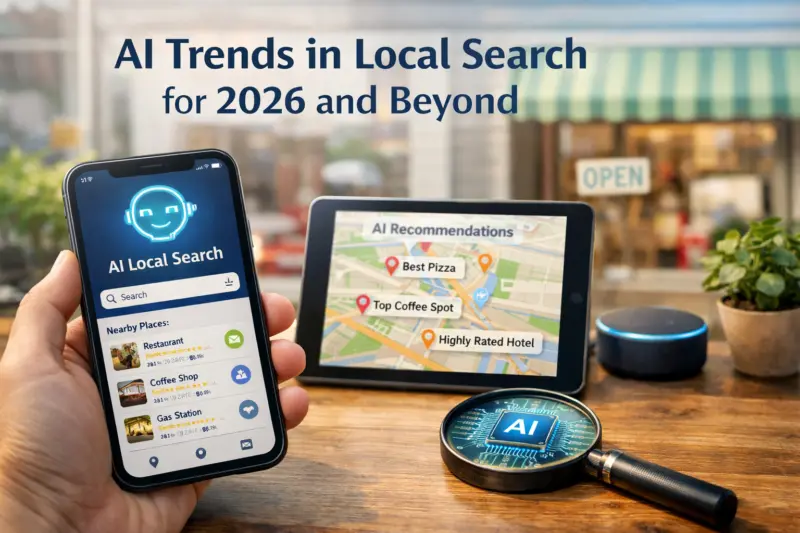
AI audits should cover categories and attributes, service coverage, location relevance, structured data readiness, internal page targeting, and review/reply completeness. It can also flag missing or mismatched schema markup on key pages, such as missing business contact properties. But you should not blindly follow AI findings. Verify category and service claims against your actual service catalog and what you already display on your website.
Local SEO Meets AI Innovation.
Boost Your Local Search with Smart Solutions.
Harness the power of AI to optimize your Google Business Profile and drive more local traffic. At eDesignerz, we create tailored strategies that enhance visibility and conversions for your business.
Custom Plans to Fit Your Needs 2 Months of Free SEO with New Websites
Prioritization becomes easier when you separate “relevance impact” from “conversion impact.” Relevance fixes help Google match you to the right queries, like correcting categories or aligning service names with how customers describe them. Conversion fixes help clicks turn into leads, like improving your primary service page clarity and your Google Business Profile call-to-action readiness. Effort and risk matter too, because citation changes can take time and sometimes require manual follow-up.
A common mistake is acting on false positives. AI might notice that competitors mention a keyword phrase and recommend you add it. But that phrase might not be a category you should target, or customers might not search for it in your market. To verify, cross-check with Google Search Console queries on your site and compare with what your Google Business Profile insights show for views and actions.
For deeper accuracy, build a validation loop using query intent. If the competitor page targets “emergency plumbing,” make sure you actually offer emergency service and that your messaging matches your real operating hours. This prevents AI from helping you chase signals you cannot fulfill, which can hurt reviews and conversion. A related topic that supports this audit is on-page SEO best practices, because your site pages must back up what your profile claims.
Generate location-specific content and Google Business Profile updates using AI grounded in real services and local intent
AI can create location-specific content that supports local search when it is grounded in your real services and the questions customers ask. The best outputs help Google understand your coverage and help customers decide faster. That is true for location landing pages, service-area copy, and Google Business Profile updates like posts and Q&A.
Start by defining content types that local search actually uses. These include location landing pages, neighborhood or service cluster pages, update posts, Google Business Profile Q&A support, and FAQ expansions on service pages. AI should draft each item from your service catalog, approved brand voice, and existing website text. If you have distinct proof points like process photos, licensing details, or before-and-after examples, AI can help structure them into readable sections.
Next, use source-backed prompting. Require the model to pull only from your provided material and to cite which section of your documents supports each claim in its draft. For local intent, incorporate jurisdiction names and “nearby” phrasing naturally where it fits your service context, such as “serving Denver-area homeowners” or “installation for local commercial spaces.” Do not stuff repeated location terms. Instead, write like a helpful local operator who knows the main concerns customers bring.
For Google Business Profile execution, AI can draft posts, attribute descriptions, and review response templates for your team to approve. It can also suggest Q&A answers based on recurring review themes. The practical application is simple: you review each draft, confirm facts like services and business hours, then publish on a controlled schedule.
There is an important tradeoff for regulated or niche services. AI might suggest claims that sound persuasive but are not appropriate for your situation. For example, a medical clinic should avoid overpromising outcomes. In those edge cases, use a policy checklist for what staff can say. Keep a human sign-off step for anything that could be interpreted as a guarantee or medical/legal advice.
A common misconception is that every location page needs a unique keyword. Instead, each page should include unique, useful information. If you lack unique proof for a specific town, consider a service-area page approach where you explain coverage and link to relevant service details. This helps avoid thin pages that confuse both users and search engines.
Turn review volume and review text into a compounding growth engine with AI-assisted analysis
AI can help you turn reviews into a compounding growth engine by revealing patterns in what customers praise, what they struggle with, and what questions they still ask. Local search responds to review quantity and recency signals, but the bigger win is using review language to improve your services, website content, and Google Business Profile messaging. When your messaging matches customer reality, leads rise without chasing gimmicks.
Operationally, build a review workflow that includes systematic collection and consistent replies. Then run AI-assisted analysis on your review text after you have enough samples to see themes. AI can extract recurring topics such as responsiveness, cleanliness, workmanship quality, pricing clarity, or “on-time arrival.” It can also identify pain points that your current FAQs do not address, like delays in permits or the need for clearer estimates.
Once you have themes, apply them to conversion assets. Update service pages with the reasons to choose you that customers actually wrote about. Expand FAQs using the same phrasing customers use, but keep it accurate and specific. Coach staff with approved messaging for common situations, so responses and conversations match the experience your customers describe.
To measure impact, track more than stars. Monitor response rate, changes in sentiment themes over time, and conversion shifts from updated pages. For example, if reviews mention “transparent pricing,” measure form completions or calls on your pricing-focused service page after publishing revisions. Also watch whether Google Business Profile actions increase alongside review volume.
A deeper nuance is review integrity and risk. AI should not suggest incentivizing reviews or using manipulative tactics. If you use automation to reply, keep the tone authentic and grounded in what the customer said. A common mistake is replying too generically, which reduces the value of your responses for both users and brand trust.
Real-world scenario: a vehicle repair shop sees many “they diagnosed the problem fast” comments but their service page still focuses only on general repairs. AI can summarize recurring diagnostic praise and draft FAQ answers about inspection steps and how estimates work. After staff approves the content, the site better matches review-driven intent, improving call and appointment rate.
Local search often depends on trust signals created by consistent business details. AI can strengthen that trust by cleaning and standardizing citations, especially your NAP data: name, address, and phone number. When citations conflict, Google may hesitate, and users can get the wrong contact info.
A data hygiene workflow starts with unifying your source-of-truth records. Create a master dataset that includes exact NAP formatting, business hours, service names, categories, and site URLs used on your website. Then use AI to detect duplicates, inconsistent address formatting, and spelling differences in service or business names across citation sources. The practical output is correction batches you can submit with clear priorities.

For prioritization, define “must fix now” items. Fix conflicts that directly affect contactability, like different phone numbers or mismatched street addresses. Also fix categories that change how you appear in local results, especially if your primary categories are missing or wrongly mapped. Less urgent issues can go into a “monitor” queue because some aggregators take time to update.
Multi-location businesses need stronger governance. Use a centralized master data approach where each location has a verified record. Then distribute updates through controlled templates with change logs. AI can help spot cross-location drift, such as a template accidentally copied from one location’s hours to another’s profile.
A deeper edge case appears with franchise or brand requirements. Some locations must follow strict brand naming rules, even if older listings used different variants. In these cases, reconcile to the authoritative source, then update or suppress changes that create new inconsistencies. The common mistake is “ping-pong edits,” where you correct one site, then another conflicting listing forces a different correction later.
This hygiene work pairs well with guidance on nonprofit website SEO strategy-like governance concepts, but you should keep it local and operational. The same principle matters: data quality and consistency are ongoing tasks, not one-time fixes. AI helps you run the checks faster, so your human team can focus on approvals.
Compare realistic AI approaches for local search improvement: DIY, assisted tooling, and expert-led systems
Choosing an AI approach for local search depends on your team’s capacity, your tolerance for publishing risk, and how many locations you must manage. There are realistic paths that range from DIY workflows to expert-led implementations with QA layers. The best fit is the one that keeps your data grounded while improving output quality.
A DIY workflow works well for single-location businesses. You can use AI for drafting review replies, building FAQ variations, and running audits on exported citation and profile data. You still need spreadsheets, checklists, and human approvals. The tradeoff is that DIY can become heavy on manual verification, which slows iteration.
Semi-managed tooling is useful when you want faster audits and draft support without giving up control. This category includes tools that summarize citations, suggest category coverage gaps, and produce content outlines from your existing site. The limitation is that outputs can be generic or based on incomplete data. You must still check claims and confirm category fit against your service list.
Expert-led systems fit multi-location brands or businesses with limited internal time. Agencies or consultants often design end-to-end workflows that include audits, governance, drafting, publishing, and reporting. The tradeoff is cost, and you should require transparency around how the system grounds outputs and how QA is enforced. Ask whether the workflow logs source material for each draft and whether it flags uncertainty.
In-house systems make sense for scale. You can build data pipelines from master records and automate audits across locations. AI supports drafting, but the governance layer prevents drift. The deeper nuance is grounding: evaluate whether any AI solution can cite your data sources, restrict changes to approved fields, and prevent hallucinated business details.
A common misconception is that “more AI” always wins. If your QA process is weak, automation can amplify mistakes across many profiles. For local search success, the highest ROI often comes from consistent data hygiene and review-driven content updates, not from more frequent posting.
Avoid common traps that waste effort when using AI for local search results
The biggest waste of time comes from optimizing for the wrong outcome or trusting outputs that do not match your real business. AI makes it easy to generate content and changes quickly, so you must stay disciplined about conversion paths and accuracy. When local visibility increases but leads do not, the gap usually sits between what Google shows and what customers can do.
One trap is focusing only on rankings while ignoring calls, forms, and direction requests. If your Google Business Profile looks strong but your landing page does not clearly confirm service availability, visitors may bounce. Balance relevance and conversion by ensuring your service pages answer the questions users expect from the profile summary. This also aligns with on-page SEO best practices for matching user intent to the page they land on.
Another trap is trusting AI-generated business facts. AI might propose updated hours or add services you never offer. Even small mismatches can reduce trust and cause user frustration. Make a rule that no field that affects contactability or services can be published without verification against your source-of-truth documents.
Thin or templated location pages are also common failures. If every page repeats the same structure and swaps only the town name, users and search engines see little value. Instead, include unique elements such as service-specific FAQs, proof points that reflect your real workflow, and locally relevant coverage context. If you cannot support a location with unique value, use a service-area strategy instead.
TAKE CONTROL WITH AI STRATEGIES
Transform your local search results and maximize customer engagement with our expert website design and AI-driven solutions tailored for your business needs.
Also avoid spamming Google Business Profile updates or review replies. AI can generate many posts, but posting cadence should match your capacity to respond to questions and follow up on leads. A practical rule is to set a realistic publishing schedule and keep your tone consistent with your brand voice.
The deeper insight is “measurement mismatch.” You might see higher impressions but fewer calls because categories no longer match the same intent, or the page experience does not deliver what users expect. Diagnose by comparing Google Business Profile actions with website conversion metrics after each change batch. Also watch whether the updated profile content matches the services you want to sell.
Tailor AI strategies by geography and operating model for local business growth
Local search execution differs by operating model because customers experience your services differently. Single-location businesses typically aim to convert map visitors directly, while service-area businesses must clarify coverage without relying on storefront signals. Multi-location brands need governance to keep each profile accurate and unique.
For a single-location business, prioritize Google Business Profile completeness, conversion-focused landing pages, and review-driven content themes. AI can draft service descriptions, improve FAQ sections, and generate response templates based on recurring review language. The goal is simple: map visitors should see a clear fit, then land on a page that confirms details and answers their top questions.
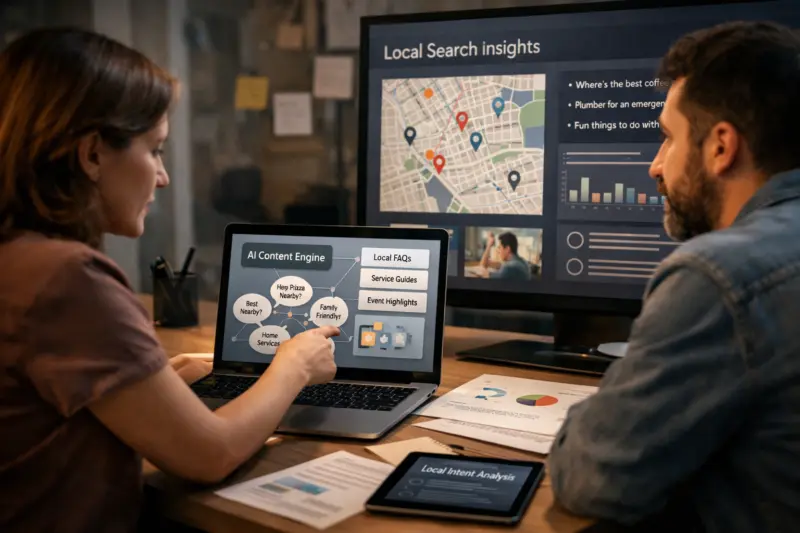
For service-area businesses, location pages can still help, but non-location-page tactics often perform better. You should use service pages that clearly state what you do, where you serve, and what to expect. AI can help refine coverage language and draft FAQs that address scheduling and service process concerns without inventing a storefront address. When a profile includes addresses incorrectly, prioritize citation and NAP hygiene before content expansion.
For multi-location operations, governance is the strategy. Use master templates with validated local inputs so each location page includes unique proof and FAQs. AI can help detect duplicate content drift across locations and propose batch edits for review response variations. But you must implement duplication checks and manual QA gates, or AI will replicate the same errors across every profile.
A deeper edge case is expanding into new towns. AI can draft new pages quickly, but relevance depends on real service capacity and evidence. If your team cannot deliver in the new area, or your proof points do not fit, those pages will likely underperform. Treat expansions like a capacity-driven decision, then use AI to create content that reflects your true ability to serve.
Combine AI outputs with a measurement loop that proves ROI for local visibility
AI only helps if you connect actions to results with a measurement loop. That loop turns drafting and audits into measurable improvements for local visibility and lead generation. In 2026, local SEO results can fluctuate, so your process must include baselines, controlled changes, and clear attribution signals.
Start with a KPI stack that matches local actions. Use Google Business Profile insights to track calls, direction requests, and profile views. Track local pack or map visibility where tools provide it, and monitor rankings for your key services by location. On your site, measure conversion rate by landing page so you can see whether profile traffic leads to inquiries.
Then design experiments that change one variable at a time. Pick a baseline period, apply a focused batch, and measure after enough time for indexing and user behavior to normalize. For example, update only categories and primary service descriptions first, then measure profile actions before publishing new location content. If you change everything at once, you will not learn what actually caused the improvement.
To log attribution, record which AI workflow you used and what you changed after human approval. Capture the exact pages and profile fields updated, plus the review themes incorporated. This makes it easier to repeat what works and stop what does not. It also supports internal reporting if you manage marketing across teams.
Governance matters in measurement too. Add a QA checklist for new drafts, then run periodic audits so content does not drift out of sync with your service catalog. A common mistake is over-attributing results to AI changes during seasonal demand swings or competitor promotions. Balance your interpretation by comparing your action timeline with changes in impressions and conversions, not just one metric.
If you need a framework for how search engines evaluate information quality signals, review resources from Google Search Central and Google Business Profile help. These resources support the idea that accuracy and clarity matter across profile and site content.
How do I use AI to improve my Google Business Profile without risking inaccurate info?Use AI only for drafting fields, then require human QA against your master business record. Provide the model a verified dataset that includes your exact hours, address rules, and service catalog. For any proposed change, confirm it with your existing website and listing documentation before publishing.
Also restrict AI to non-critical suggestions where possible, like FAQ wording or post themes, and keep critical fields like phone number and address strictly controlled. This reduces the risk of inconsistent local ranking signals caused by mismatched business facts across profiles.
What data should I feed an AI system for local SEO audits in 2026?Feed your AI audit inputs from sources you already trust and can export. Include Google Business Profile fields, your website service and location pages, citation exports, and your review content themes. Add Search Console query data for the pages you want to improve, so AI recommendations match real user searches.
To benchmark competitors, collect a short set of top local competitors’ visible profile details and public pages. Use AI to summarize patterns, then validate recommendations with your own facts and search query intent.
Can AI help me choose the right primary and secondary categories for local search?Yes, AI can help by mapping your services to the categories that best fit what you actually do. Give the model your service catalog and your current category selections, then ask it to propose category coverage gaps based on that data. Still validate against your Google Business Profile category behavior and what you can support.
A useful check is to compare category proposals with how your customers describe you in reviews. If a category suggests a service you never mention or provide, treat it as a mismatch.
How do AI-driven review responses affect rankings and conversions?Review responses can improve conversions by building trust and answering implied customer questions. AI can draft responses that reflect the customer’s specific experience, but you should approve final text to keep it authentic. Track response rate and profile actions like calls and direction requests after you publish improved replies.
For rankings, the effect is indirect. Better relevance and a stronger customer experience can improve engagement signals that correlate with visibility, especially when responses address repeated concerns found in reviews.
Is AI-generated location content likely to hurt my rankings if it’s too templated?It can, because templated pages often add little user value and can create content duplication across locations. AI should not just swap town names inside the same structure. Instead, require unique content elements such as service-specific FAQs, proof points, and locally relevant coverage context tied to real operations.
If you cannot support uniqueness for a town, prefer a service-area approach that explains coverage without forcing thin pages. This keeps quality higher and reduces the chance of weak pages dragging overall local performance.
What are the safest ways to automate citation corrections with AI?The safest approach is to automate detection and batching, not blind publishing. Use AI to standardize NAP formatting, detect duplicates, and generate correction lists, then have a human review each proposed change set. Submit corrections only after verifying with your master dataset.
Batch updates by priority, focusing first on contactability conflicts like phone number and address mismatches. Track which listing providers take longer to update and set rules for “must fix now” versus “monitor and follow up.”
How can I scale AI local SEO across multiple locations while keeping each page unique?Scale with governance: use master templates that lock the structure, then fill in validated local inputs such as location-specific proof, FAQs, and service emphasis. AI should draft variations only from those local inputs and your approved brand voice. Add duplication checks so the same paragraphs do not repeat across locations.
Keep a centralized master data process and change logs so edits do not create cross-location drift. This approach supports consistency without sacrificing uniqueness, which is crucial for local relevance.
Which is better: AI tools that draft content or an agency that runs the workflow end-to-end?AI drafting tools are best when you have internal oversight and can do accurate review and publishing checks. They help speed up content and reduce manual work, but they still require human QA and measurement discipline. An agency or expert-led system can work better when you need end-to-end governance across audits, publishing, and reporting.
Choose based on your team’s capacity to verify facts and manage the publish-monitor-iterate cycle. Also evaluate whether any solution can show grounding in your data and include clear QA steps.
How do I measure whether AI strategies for local search are actually generating leads?Measure both visibility and outcomes. Track Google Business Profile actions like calls and direction requests, then connect those to website conversions on the specific landing pages that match your updates. Use a baseline and compare results after controlled change batches.
For stronger attribution, log what the AI workflow produced and what you published after approval. This helps you tie changes like profile description edits, FAQ updates, or citation batches to measurable lead lifts rather than to general seasonality.
How long should I wait to see results after making AI-assisted local SEO changes?It depends on what you changed. Google Business Profile edits and content updates may start affecting actions in days, but full visibility shifts can take weeks as systems recrawl pages and update local index signals.
Citation corrections often take longer across sources, so measure after enough time for updates to propagate. If results are mixed, avoid changing multiple variables at once and review your category alignment and landing page match first.
Recap AI-driven local search optimization with a practical next-step plan
The main idea is simple: AI helps local businesses execute faster and smarter, but local search success still depends on accurate data, clear relevance, and a conversion-focused experience. When AI is used as a drafting and analysis copilot, it can improve your Google Business Profile, strengthen your local pages, amplify review insights, and clean up citations. In 2026, that execution advantage often matters as much as any individual tactic.
Use the actionable path: audit → prioritize → create or optimize (Google Business Profile, local pages, reviews, and citations) → measure → iterate with governance. This keeps your work grounded and prevents the common failure mode where AI increases effort but not lead flow. The deeper lesson is that you win when every change has a purpose tied to a real customer question and a measurable local action.
If you want a fast start, run a local search signal audit and identify 2–3 high-impact gaps. Then implement one AI-assisted workflow with human QA, such as a review theme update plus a matching service-page FAQ expansion. Set your KPIs before publishing so you can prove ROI with calls, directions, and conversion changes rather than vanity metrics.
Finally, compare your options in a realistic way: DIY versus assisted tooling versus expert-led systems. Use the same grounding rule for each choice—AI should draft from your verified data and flag uncertainty. And remember this practical reminder for 2026: treat AI as a copilot, not an authority for business facts.
Updated September 2026
BOOST YOUR LOCAL VISIBILITY
OPTIMIZE YOUR
LOCAL SEARCH STRATEGY
Unlock the potential of AI-driven optimization for your Google Business Profile and website with our expert web design and development services that attract local customers and increase conversions.
REQUEST A FREE CONSULTATION
Expertise in Local SEO and Custom Website Solutions
Feed your AI audit inputs from sources you already trust and can export. Include Google Business Profile fields, your website service and location pages, citation exports, and your review content themes. Add Search Console query data for the pages you want to improve, so AI recommendations match real user searches.
To benchmark competitors, collect a short set of top local competitors’ visible profile details and public pages. Use AI to summarize patterns, then validate recommendations with your own facts and search query intent.
Can AI help me choose the right primary and secondary categories for local search?Yes, AI can help by mapping your services to the categories that best fit what you actually do. Give the model your service catalog and your current category selections, then ask it to propose category coverage gaps based on that data. Still validate against your Google Business Profile category behavior and what you can support.
A useful check is to compare category proposals with how your customers describe you in reviews. If a category suggests a service you never mention or provide, treat it as a mismatch.
How do AI-driven review responses affect rankings and conversions?Review responses can improve conversions by building trust and answering implied customer questions. AI can draft responses that reflect the customer’s specific experience, but you should approve final text to keep it authentic. Track response rate and profile actions like calls and direction requests after you publish improved replies.
For rankings, the effect is indirect. Better relevance and a stronger customer experience can improve engagement signals that correlate with visibility, especially when responses address repeated concerns found in reviews.
Is AI-generated location content likely to hurt my rankings if it’s too templated?It can, because templated pages often add little user value and can create content duplication across locations. AI should not just swap town names inside the same structure. Instead, require unique content elements such as service-specific FAQs, proof points, and locally relevant coverage context tied to real operations.
If you cannot support uniqueness for a town, prefer a service-area approach that explains coverage without forcing thin pages. This keeps quality higher and reduces the chance of weak pages dragging overall local performance.
What are the safest ways to automate citation corrections with AI?The safest approach is to automate detection and batching, not blind publishing. Use AI to standardize NAP formatting, detect duplicates, and generate correction lists, then have a human review each proposed change set. Submit corrections only after verifying with your master dataset.
Batch updates by priority, focusing first on contactability conflicts like phone number and address mismatches. Track which listing providers take longer to update and set rules for “must fix now” versus “monitor and follow up.”
How can I scale AI local SEO across multiple locations while keeping each page unique?Scale with governance: use master templates that lock the structure, then fill in validated local inputs such as location-specific proof, FAQs, and service emphasis. AI should draft variations only from those local inputs and your approved brand voice. Add duplication checks so the same paragraphs do not repeat across locations.
Keep a centralized master data process and change logs so edits do not create cross-location drift. This approach supports consistency without sacrificing uniqueness, which is crucial for local relevance.
Which is better: AI tools that draft content or an agency that runs the workflow end-to-end?AI drafting tools are best when you have internal oversight and can do accurate review and publishing checks. They help speed up content and reduce manual work, but they still require human QA and measurement discipline. An agency or expert-led system can work better when you need end-to-end governance across audits, publishing, and reporting.
Choose based on your team’s capacity to verify facts and manage the publish-monitor-iterate cycle. Also evaluate whether any solution can show grounding in your data and include clear QA steps.
How do I measure whether AI strategies for local search are actually generating leads?Measure both visibility and outcomes. Track Google Business Profile actions like calls and direction requests, then connect those to website conversions on the specific landing pages that match your updates. Use a baseline and compare results after controlled change batches.
For stronger attribution, log what the AI workflow produced and what you published after approval. This helps you tie changes like profile description edits, FAQ updates, or citation batches to measurable lead lifts rather than to general seasonality.
How long should I wait to see results after making AI-assisted local SEO changes?It depends on what you changed. Google Business Profile edits and content updates may start affecting actions in days, but full visibility shifts can take weeks as systems recrawl pages and update local index signals.
Citation corrections often take longer across sources, so measure after enough time for updates to propagate. If results are mixed, avoid changing multiple variables at once and review your category alignment and landing page match first.
Recap AI-driven local search optimization with a practical next-step plan
The main idea is simple: AI helps local businesses execute faster and smarter, but local search success still depends on accurate data, clear relevance, and a conversion-focused experience. When AI is used as a drafting and analysis copilot, it can improve your Google Business Profile, strengthen your local pages, amplify review insights, and clean up citations. In 2026, that execution advantage often matters as much as any individual tactic.
Use the actionable path: audit → prioritize → create or optimize (Google Business Profile, local pages, reviews, and citations) → measure → iterate with governance. This keeps your work grounded and prevents the common failure mode where AI increases effort but not lead flow. The deeper lesson is that you win when every change has a purpose tied to a real customer question and a measurable local action.
If you want a fast start, run a local search signal audit and identify 2–3 high-impact gaps. Then implement one AI-assisted workflow with human QA, such as a review theme update plus a matching service-page FAQ expansion. Set your KPIs before publishing so you can prove ROI with calls, directions, and conversion changes rather than vanity metrics.
Finally, compare your options in a realistic way: DIY versus assisted tooling versus expert-led systems. Use the same grounding rule for each choice—AI should draft from your verified data and flag uncertainty. And remember this practical reminder for 2026: treat AI as a copilot, not an authority for business facts.
Updated September 2026
BOOST YOUR LOCAL VISIBILITY
OPTIMIZE YOUR
LOCAL SEARCH STRATEGY
Unlock the potential of AI-driven optimization for your Google Business Profile and website with our expert web design and development services that attract local customers and increase conversions.
REQUEST A FREE CONSULTATION
Expertise in Local SEO and Custom Website Solutions
Review responses can improve conversions by building trust and answering implied customer questions. AI can draft responses that reflect the customer’s specific experience, but you should approve final text to keep it authentic. Track response rate and profile actions like calls and direction requests after you publish improved replies.
For rankings, the effect is indirect. Better relevance and a stronger customer experience can improve engagement signals that correlate with visibility, especially when responses address repeated concerns found in reviews.
Is AI-generated location content likely to hurt my rankings if it’s too templated?It can, because templated pages often add little user value and can create content duplication across locations. AI should not just swap town names inside the same structure. Instead, require unique content elements such as service-specific FAQs, proof points, and locally relevant coverage context tied to real operations.
If you cannot support uniqueness for a town, prefer a service-area approach that explains coverage without forcing thin pages. This keeps quality higher and reduces the chance of weak pages dragging overall local performance.
What are the safest ways to automate citation corrections with AI?The safest approach is to automate detection and batching, not blind publishing. Use AI to standardize NAP formatting, detect duplicates, and generate correction lists, then have a human review each proposed change set. Submit corrections only after verifying with your master dataset.
Batch updates by priority, focusing first on contactability conflicts like phone number and address mismatches. Track which listing providers take longer to update and set rules for “must fix now” versus “monitor and follow up.”
How can I scale AI local SEO across multiple locations while keeping each page unique?Scale with governance: use master templates that lock the structure, then fill in validated local inputs such as location-specific proof, FAQs, and service emphasis. AI should draft variations only from those local inputs and your approved brand voice. Add duplication checks so the same paragraphs do not repeat across locations.
Keep a centralized master data process and change logs so edits do not create cross-location drift. This approach supports consistency without sacrificing uniqueness, which is crucial for local relevance.
Which is better: AI tools that draft content or an agency that runs the workflow end-to-end?AI drafting tools are best when you have internal oversight and can do accurate review and publishing checks. They help speed up content and reduce manual work, but they still require human QA and measurement discipline. An agency or expert-led system can work better when you need end-to-end governance across audits, publishing, and reporting.
Choose based on your team’s capacity to verify facts and manage the publish-monitor-iterate cycle. Also evaluate whether any solution can show grounding in your data and include clear QA steps.
How do I measure whether AI strategies for local search are actually generating leads?Measure both visibility and outcomes. Track Google Business Profile actions like calls and direction requests, then connect those to website conversions on the specific landing pages that match your updates. Use a baseline and compare results after controlled change batches.
For stronger attribution, log what the AI workflow produced and what you published after approval. This helps you tie changes like profile description edits, FAQ updates, or citation batches to measurable lead lifts rather than to general seasonality.
How long should I wait to see results after making AI-assisted local SEO changes?It depends on what you changed. Google Business Profile edits and content updates may start affecting actions in days, but full visibility shifts can take weeks as systems recrawl pages and update local index signals.
Citation corrections often take longer across sources, so measure after enough time for updates to propagate. If results are mixed, avoid changing multiple variables at once and review your category alignment and landing page match first.
Recap AI-driven local search optimization with a practical next-step plan
The main idea is simple: AI helps local businesses execute faster and smarter, but local search success still depends on accurate data, clear relevance, and a conversion-focused experience. When AI is used as a drafting and analysis copilot, it can improve your Google Business Profile, strengthen your local pages, amplify review insights, and clean up citations. In 2026, that execution advantage often matters as much as any individual tactic.
Use the actionable path: audit → prioritize → create or optimize (Google Business Profile, local pages, reviews, and citations) → measure → iterate with governance. This keeps your work grounded and prevents the common failure mode where AI increases effort but not lead flow. The deeper lesson is that you win when every change has a purpose tied to a real customer question and a measurable local action.
If you want a fast start, run a local search signal audit and identify 2–3 high-impact gaps. Then implement one AI-assisted workflow with human QA, such as a review theme update plus a matching service-page FAQ expansion. Set your KPIs before publishing so you can prove ROI with calls, directions, and conversion changes rather than vanity metrics.
Finally, compare your options in a realistic way: DIY versus assisted tooling versus expert-led systems. Use the same grounding rule for each choice—AI should draft from your verified data and flag uncertainty. And remember this practical reminder for 2026: treat AI as a copilot, not an authority for business facts.
Updated September 2026
BOOST YOUR LOCAL VISIBILITY
OPTIMIZE YOUR
LOCAL SEARCH STRATEGY
Unlock the potential of AI-driven optimization for your Google Business Profile and website with our expert web design and development services that attract local customers and increase conversions.
REQUEST A FREE CONSULTATION
Expertise in Local SEO and Custom Website Solutions
The safest approach is to automate detection and batching, not blind publishing. Use AI to standardize NAP formatting, detect duplicates, and generate correction lists, then have a human review each proposed change set. Submit corrections only after verifying with your master dataset.
Batch updates by priority, focusing first on contactability conflicts like phone number and address mismatches. Track which listing providers take longer to update and set rules for “must fix now” versus “monitor and follow up.”
How can I scale AI local SEO across multiple locations while keeping each page unique?Scale with governance: use master templates that lock the structure, then fill in validated local inputs such as location-specific proof, FAQs, and service emphasis. AI should draft variations only from those local inputs and your approved brand voice. Add duplication checks so the same paragraphs do not repeat across locations.
Keep a centralized master data process and change logs so edits do not create cross-location drift. This approach supports consistency without sacrificing uniqueness, which is crucial for local relevance.
Which is better: AI tools that draft content or an agency that runs the workflow end-to-end?AI drafting tools are best when you have internal oversight and can do accurate review and publishing checks. They help speed up content and reduce manual work, but they still require human QA and measurement discipline. An agency or expert-led system can work better when you need end-to-end governance across audits, publishing, and reporting.
Choose based on your team’s capacity to verify facts and manage the publish-monitor-iterate cycle. Also evaluate whether any solution can show grounding in your data and include clear QA steps.
How do I measure whether AI strategies for local search are actually generating leads?Measure both visibility and outcomes. Track Google Business Profile actions like calls and direction requests, then connect those to website conversions on the specific landing pages that match your updates. Use a baseline and compare results after controlled change batches.
For stronger attribution, log what the AI workflow produced and what you published after approval. This helps you tie changes like profile description edits, FAQ updates, or citation batches to measurable lead lifts rather than to general seasonality.
How long should I wait to see results after making AI-assisted local SEO changes?It depends on what you changed. Google Business Profile edits and content updates may start affecting actions in days, but full visibility shifts can take weeks as systems recrawl pages and update local index signals.
Citation corrections often take longer across sources, so measure after enough time for updates to propagate. If results are mixed, avoid changing multiple variables at once and review your category alignment and landing page match first.
Recap AI-driven local search optimization with a practical next-step plan
The main idea is simple: AI helps local businesses execute faster and smarter, but local search success still depends on accurate data, clear relevance, and a conversion-focused experience. When AI is used as a drafting and analysis copilot, it can improve your Google Business Profile, strengthen your local pages, amplify review insights, and clean up citations. In 2026, that execution advantage often matters as much as any individual tactic.
Use the actionable path: audit → prioritize → create or optimize (Google Business Profile, local pages, reviews, and citations) → measure → iterate with governance. This keeps your work grounded and prevents the common failure mode where AI increases effort but not lead flow. The deeper lesson is that you win when every change has a purpose tied to a real customer question and a measurable local action.
If you want a fast start, run a local search signal audit and identify 2–3 high-impact gaps. Then implement one AI-assisted workflow with human QA, such as a review theme update plus a matching service-page FAQ expansion. Set your KPIs before publishing so you can prove ROI with calls, directions, and conversion changes rather than vanity metrics.
Finally, compare your options in a realistic way: DIY versus assisted tooling versus expert-led systems. Use the same grounding rule for each choice—AI should draft from your verified data and flag uncertainty. And remember this practical reminder for 2026: treat AI as a copilot, not an authority for business facts.
Updated September 2026
BOOST YOUR LOCAL VISIBILITY
OPTIMIZE YOUR
LOCAL SEARCH STRATEGY
Unlock the potential of AI-driven optimization for your Google Business Profile and website with our expert web design and development services that attract local customers and increase conversions.
REQUEST A FREE CONSULTATION
Expertise in Local SEO and Custom Website Solutions
AI drafting tools are best when you have internal oversight and can do accurate review and publishing checks. They help speed up content and reduce manual work, but they still require human QA and measurement discipline. An agency or expert-led system can work better when you need end-to-end governance across audits, publishing, and reporting.
Choose based on your team’s capacity to verify facts and manage the publish-monitor-iterate cycle. Also evaluate whether any solution can show grounding in your data and include clear QA steps.
How do I measure whether AI strategies for local search are actually generating leads?Measure both visibility and outcomes. Track Google Business Profile actions like calls and direction requests, then connect those to website conversions on the specific landing pages that match your updates. Use a baseline and compare results after controlled change batches.
For stronger attribution, log what the AI workflow produced and what you published after approval. This helps you tie changes like profile description edits, FAQ updates, or citation batches to measurable lead lifts rather than to general seasonality.
How long should I wait to see results after making AI-assisted local SEO changes?It depends on what you changed. Google Business Profile edits and content updates may start affecting actions in days, but full visibility shifts can take weeks as systems recrawl pages and update local index signals.
Citation corrections often take longer across sources, so measure after enough time for updates to propagate. If results are mixed, avoid changing multiple variables at once and review your category alignment and landing page match first.
Recap AI-driven local search optimization with a practical next-step plan
The main idea is simple: AI helps local businesses execute faster and smarter, but local search success still depends on accurate data, clear relevance, and a conversion-focused experience. When AI is used as a drafting and analysis copilot, it can improve your Google Business Profile, strengthen your local pages, amplify review insights, and clean up citations. In 2026, that execution advantage often matters as much as any individual tactic.
Use the actionable path: audit → prioritize → create or optimize (Google Business Profile, local pages, reviews, and citations) → measure → iterate with governance. This keeps your work grounded and prevents the common failure mode where AI increases effort but not lead flow. The deeper lesson is that you win when every change has a purpose tied to a real customer question and a measurable local action.
If you want a fast start, run a local search signal audit and identify 2–3 high-impact gaps. Then implement one AI-assisted workflow with human QA, such as a review theme update plus a matching service-page FAQ expansion. Set your KPIs before publishing so you can prove ROI with calls, directions, and conversion changes rather than vanity metrics.
Finally, compare your options in a realistic way: DIY versus assisted tooling versus expert-led systems. Use the same grounding rule for each choice—AI should draft from your verified data and flag uncertainty. And remember this practical reminder for 2026: treat AI as a copilot, not an authority for business facts.
Updated September 2026
BOOST YOUR LOCAL VISIBILITY
OPTIMIZE YOUR
LOCAL SEARCH STRATEGY
Unlock the potential of AI-driven optimization for your Google Business Profile and website with our expert web design and development services that attract local customers and increase conversions.
REQUEST A FREE CONSULTATION
Expertise in Local SEO and Custom Website Solutions
It depends on what you changed. Google Business Profile edits and content updates may start affecting actions in days, but full visibility shifts can take weeks as systems recrawl pages and update local index signals.
Citation corrections often take longer across sources, so measure after enough time for updates to propagate. If results are mixed, avoid changing multiple variables at once and review your category alignment and landing page match first.
Recap AI-driven local search optimization with a practical next-step plan
The main idea is simple: AI helps local businesses execute faster and smarter, but local search success still depends on accurate data, clear relevance, and a conversion-focused experience. When AI is used as a drafting and analysis copilot, it can improve your Google Business Profile, strengthen your local pages, amplify review insights, and clean up citations. In 2026, that execution advantage often matters as much as any individual tactic.
Use the actionable path: audit → prioritize → create or optimize (Google Business Profile, local pages, reviews, and citations) → measure → iterate with governance. This keeps your work grounded and prevents the common failure mode where AI increases effort but not lead flow. The deeper lesson is that you win when every change has a purpose tied to a real customer question and a measurable local action.
If you want a fast start, run a local search signal audit and identify 2–3 high-impact gaps. Then implement one AI-assisted workflow with human QA, such as a review theme update plus a matching service-page FAQ expansion. Set your KPIs before publishing so you can prove ROI with calls, directions, and conversion changes rather than vanity metrics.
Finally, compare your options in a realistic way: DIY versus assisted tooling versus expert-led systems. Use the same grounding rule for each choice—AI should draft from your verified data and flag uncertainty. And remember this practical reminder for 2026: treat AI as a copilot, not an authority for business facts.
Updated September 2026
OPTIMIZE YOUR LOCAL SEARCH STRATEGY
Unlock the potential of AI-driven optimization for your Google Business Profile and website with our expert web design and development services that attract local customers and increase conversions.
REQUEST A FREE CONSULTATION