

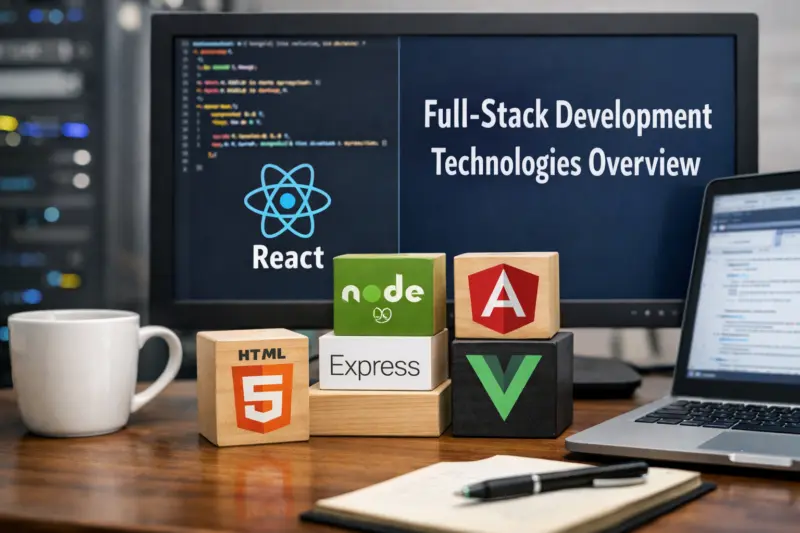
Full-stack development is the practice of building a complete app: UI, backend, data, security, and the tools to ship it. The stack is the set of technologies that make those layers work together, and that is where full-stack development technologies become real. The right choices depend on your app’s constraints, your team’s strengths, and how much operational overhead you can handle in 2026. This guide gives you a practical way to map the work, compare options, and avoid common stack mistakes.
You will see a clear architecture map across the request lifecycle and data flow. Then you will learn how teams choose frontend, backend, databases, and integration patterns that stay stable as the product evolves. You will also get a decision path to run a small technology spike and validate outcomes. As a result, you can move from “technology curiosity” to a stack you can actually maintain.
This is for web app builders who want a confident plan, aspiring full-stack developers who want structure, and team leads aligning engineering standards. It also suits engineers who already ship code but want fewer integration surprises. Throughout the article, tradeoffs matter more than “best stack” lists. That is the difference between a hobby prototype and a production-ready full-stack system.
Contents
- 1 Full-stack architecture map explains the layers behind every working app
- 2 Frontend technologies shape user experience and backend API design
- 3 Backend platforms and APIs define your service boundaries and scaling model
- 4 Data layer technologies determine correctness, performance, and change safety
- 5 Authentication and authorization tooling protects users and your API contracts
- 6 A decision path helps you choose Full-Stack Development Technologies that fit real constraints
- 7 Common misconceptions derail full-stack stacks more than technical limitations do
- 8 Comparisons of full-stack approaches help you pick a delivery shape that matches your team
- 9 Edge cases like retries, idempotency, and schema drift decide whether production stays stable
- 10 Developer workflow and maintainability tooling keep a full-stack system easy to change
- 11 What technologies do I need to learn to build full-stack applications in 2026?
- 12 Which full-stack language pair is best for beginners trying to ship a real app?
- 13 How do I keep frontend and backend API contracts from breaking as the app evolves?
- 14 What’s the difference between a monolith backend and microservices from a technology perspective?
- 15 Do I need an ORM, or should I use raw SQL for data access?
- 16 How should authentication work across frontend sessions and backend APIs?
- 17 What observability tools should a full-stack developer set up before going to production?
- 18 How do I choose between REST and GraphQL for my full-stack project?
- 19 What are the most common security issues in full-stack apps, and how do I prevent them?
- 20 What should be included in a technology spike for evaluating a full-stack stack?
- 21 Full-stack technology success comes from contracts, operations, and a validated learning loop
Full-stack architecture map explains the layers behind every working app
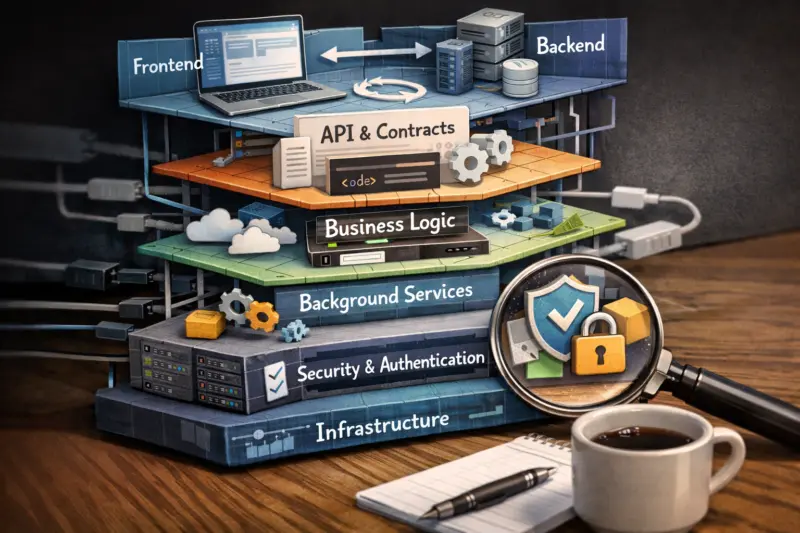
Full-stack development technologies span more than frontend and backend code. They also include contracts, background work, security checks, and operational tooling. If you treat the stack as a few languages, you miss the real integration risk.
A practical architecture map starts with the UI layer and ends with the data layer. Between them, you have the API layer, authentication and authorization, and cross-cutting concerns like logging and error handling. The request lifecycle ties it together. A user action hits the frontend, which calls an API, which validates inputs, applies business rules, and persists data.
Then the system returns a response that the UI renders into the next state. In most apps, part of that work happens asynchronously. For example, sending emails, processing payments, generating reports, and indexing content often runs in background jobs. That means your full-stack technology overview must cover queues and worker patterns, not just web servers.
Where does the frontend “end”? It depends on your rendering approach. With server-rendered apps, the backend can produce HTML for the first load. With single-page apps, the browser renders most views and relies heavily on API responses. Some teams use a backend-for-frontend model so each client gets tailored responses.
Deeper nuance shows up in contracts. Stack choice includes API schema versioning, error formats, and validation splits. For example, you can share type definitions between client and server to reduce runtime drift. You can also define a strict error taxonomy so the UI knows what to display. A common mistake is changing DTO shapes without updating client logic or tests.
Real-world scenario: imagine a “checkout” flow. The UI needs fast form feedback, but the backend must enforce every rule. The data layer must support transactions or safe write patterns. Meanwhile, a worker should handle receipt generation after the payment is confirmed. If your technology map skips any of these layers, the flow breaks when you add scale or failures.
Frontend technologies shape user experience and backend API design
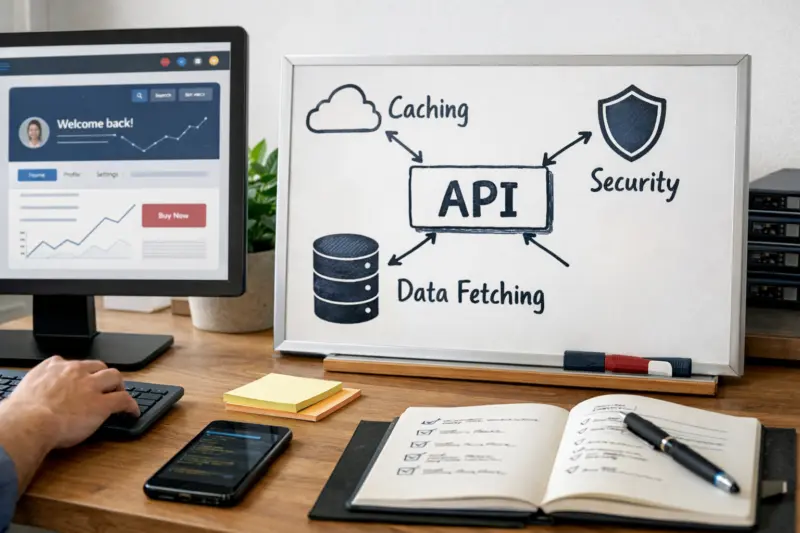
Frontend technologies decide how users interact with your app and how your backend must respond. They influence caching, data fetching, security handling, and even how errors surface. That is why frontend choices should come with clear API contract expectations.
Most modern UIs are component-based. Frameworks help you compose views and reuse stateful widgets. However, the important part is state management and how it aligns with API data. If your UI uses a state library, you also need predictable query keys and invalidation rules so data updates feel correct.
Rendering mode matters too. Client-side rendering loads a minimal shell and fetches data after startup. Server-side rendering can improve initial load and SEO-friendly pages. Hybrid approaches mix both, often for dashboards where the first paint should be quick, but subsequent interactions remain client-driven.
Data fetching strategy is another key decision. Some teams request data per view. Others prefetch and batch calls. Caching then becomes an architectural feature. A practical frontend approach defines what gets cached, for how long, and when to invalidate. That directly affects backend API shape, including pagination and filtering semantics.
Security and correctness sit on the client as well. You must handle auth tokens carefully, validate user input before submission, and avoid unsafe rendering. You also need good failure handling, like timeouts and retry behavior that does not duplicate writes.
API contract alignment reduces “works on my machine” bugs. If you share types derived from OpenAPI or JSON schema, you catch mismatches early. You also reduce fragile mapping code in the client. A common edge case is when the server changes a field name but the UI still expects the old shape, causing silent UI failures.
Related topics worth studying include contract testing and schema evolution. Those ideas connect frontend state and backend releases in a stable way. For practical learning, think about your current UI needs first. Then design backend responses that match the UI’s caching and error display patterns.
Backend platforms and APIs define your service boundaries and scaling model
Backend platforms and API styles determine how your app enforces rules and how it scales under load. They also decide where your complexity lives. A good backend design makes features easier, not harder, to ship.
Backend responsibilities include routing, request validation, authentication and authorization, business logic, and error handling. Frameworks provide many of these building blocks. Still, you must choose consistent patterns for validation and error responses. If validation errors look different across endpoints, the frontend becomes complex and inconsistent.
Architecture choices affect boundaries. Some teams build a monolith web framework first. Others split into a modular monolith with clear internal modules. Microservices are an option too, but they shift operational work into deployment, monitoring, and data consistency management. In 2026, many teams start with a modular approach and split only where clear domains justify the overhead.
API styles also shape developer experience. REST works well when your resources are stable and your clients can cache effectively. GraphQL can help when clients need flexible query shapes. However, GraphQL adds schema governance and query cost concerns. It also changes caching strategies compared with resource-based REST patterns.
Concurrency patterns matter in backend platforms. A thread-based server model behaves differently from an event-loop model. Worker-based async job systems also play a role. These choices affect scaling behavior and operational tuning. A deeper nuance is where async boundaries live. For example, you may handle long tasks in a queue and keep API request lifetimes short.
Practical application: consider a file upload feature. Your backend must validate file type and size, create a safe storage record, and return a status quickly. Then workers can process the file and update metadata later. If you try to do everything in the API request, timeouts and partial failures become common.
Tradeoffs and limitations are unavoidable. A service boundary that is too granular increases network calls. A boundary that is too coarse increases coupling and makes testing harder. Common mistakes include mixing business rules into controllers or forgetting idempotent patterns for retryable operations.
Data layer technologies determine correctness, performance, and change safety
Data layer technologies are the foundation for correctness and performance in full-stack development. They decide how you store, query, and evolve data safely. In practice, the database choice changes how you implement features.
Relational databases are common when you need strong consistency and structured relationships. Document stores can fit flexible data models and rapid iteration. There are also in-between options and extensions that support hybrid use cases. Selection drivers include query complexity, team expertise, and how often your schema changes.
Schema strategy is more than creating tables. You need migrations, indexing plans, and careful schema evolution so old clients do not break. Indexes also tie directly to performance and cost. A deeper nuance is compatibility between releases. If you add a new field, older versions should still function. If you rename or remove fields, you need a deprecation path.
Data access patterns matter too. ORMs help speed up development and reduce boilerplate. Query builders can give more control while still offering safety. Direct SQL can maximize performance and precision but requires more discipline. A common edge case is the N+1 query pattern, where loops trigger many small queries and degrade performance quickly.
Consistency deserves special attention. Transactions help keep related changes correct in relational systems. Eventual consistency patterns can work for many cases but require careful design. For user-facing correctness, you must decide what “truth” means when reads happen during concurrent writes.
Caching adds more complexity. Cache invalidation can become the hardest part of scaling data access. Race conditions can also show up when concurrent updates produce unexpected outcomes. For example, two requests may both assume a record is in a certain state. Your write logic must prevent unsafe transitions.
Practical scenario: a reservation system. You must prevent overbooking. That means either using transactions, locking strategies, or safe constraint-based writes. If you rely only on application-level checks, concurrent requests can slip through.
schema drift can harm the full-stack experience. If your generated DTOs or ORM models fall behind the real database, runtime errors increase. Keeping schema and type generation in sync reduces those failures. That is one reason teams treat data contracts as first-class artifacts.
Authentication and authorization technologies keep users safe and define who can do what. They are not just login screens. They also shape API behavior, error messages, and audit trails.
First, understand authentication versus authorization. Authentication answers “who is this user?” Authorization answers “what are they allowed to do?” Many bugs happen when developers handle one but forget the other. A user can be authenticated yet still over-privileged, which leads to data exposure.
Security tooling must cover session or token approaches. Sessions can store state server-side and often work well with CSRF protections. Token-based approaches can support stateless APIs but require careful handling of token storage and refresh logic. In both cases, you should enforce authorization on every protected endpoint, not only on the UI.
Defense-in-depth covers common web risks. You must prevent XSS by escaping untrusted content and using safe rendering patterns. You must mitigate CSRF when using cookie-based sessions. You also need protection against injection issues by using parameterized queries and safe query construction.
Secrets management is part of the full-stack stack too. You should keep environment configuration in secure secret stores. You should also avoid exposing keys in frontend builds. Structured logging can support investigations by recording auth outcomes and request metadata.
Secure API practices include rate limiting and input validation. Validation belongs both at the API boundary and where domain rules apply. A practical tradeoff is strictness versus flexibility. Overly strict validation can break older clients. Overly loose validation increases bug risk and makes your security review harder.
testing authorization failure modes pays off early. For example, ensure a “user” role cannot access an “admin” endpoint even if the client calls it directly. Common mistake: relying on frontend route guards. Route guards improve UX, but they do not enforce security.
Real-world scenario: a multi-tenant app. Each request must enforce tenant scope. If your authorization code forgets tenant checks in one endpoint, data leakage can occur. Automated tests that include tenant context help catch that edge case.
For authoritative background, see the OWASP guidance on common web risks via OWASP Top Ten. For secure cookies and CSRF context, review OWASP CSRF. For general platform guidance, the session and authentication docs from your framework often provide the safest implementation patterns.
A decision path helps you choose Full-Stack Development Technologies that fit real constraints
Choosing a stack is a process, not a list. A good decision path starts from product constraints and ends with a validated integration plan. If you follow it, you reduce painful rework later.
First, define your product constraints. Examples include expected traffic, latency sensitivity, compliance needs, and how often data changes. Then map those constraints to architecture needs. If your app needs heavy background processing, you must evaluate queues and worker tooling early.
Next, shortlist candidates by integration fit. Look for ecosystem compatibility across frontend, backend, and data access. Also check how teams will test and deploy each choice. Hiring and skill availability matter too. A stack with a strong job market can reduce team risk.
Then validate operational requirements. Observability support is a major factor. You need logs, metrics, and tracing hooks that work with your framework and deployment environment. You also need reliable migrations and safe rollback plans. Most teams underestimate this until production incidents force hard decisions.
Compatibility checks should include schema and type sharing feasibility. If you want shared types, verify your tooling can generate and version them. Also confirm that your deployment model matches your runtime. A mismatch here often causes slower release cycles.
Tradeoffs must be explicit. Faster iteration can come with higher operational risk. Portability can reduce lock-in but adds complexity. Monolith simplicity can limit scaling needs, while distribution complexity can support independent scaling later.
Finally, run a small technology spike. Keep it safe. Implement one narrow user journey, like creating and viewing a resource. Also test failure recovery, like retries on transient errors and safe write behavior. Measure outcomes beyond benchmarks. Track debuggability, onboarding time, and how quickly the team resolves integration issues.
spikes reveal contract drift risk early. If you cannot keep schema, validation, and error handling consistent across layers, the stack will hurt later. A common mistake is building a demo without realistic failure scenarios. Include simulated network interruptions and concurrent writes.
Common misconceptions derail full-stack stacks more than technical limitations do
Many full-stack problems come from misconceptions, not from “bad” technologies. When you align your stack to real workflows, you avoid most integration failures. When you do not, even strong tools produce brittle systems.
A common mistake is choosing by language familiarity. Preference matters, but integration boundaries matter more. If the backend framework and frontend state tool do not mesh well with your API style, you will spend weeks on mapping and retries. The same issue happens when team testing workflows do not fit the stack.
Another misconception is treating the frontend as “just UI.” In reality, the UI is part of your security posture and data correctness. If you skip contract testing, you get runtime mismatches. If you do not handle auth states carefully, users face confusing failures after token expiration.
Database assumptions also go wrong. Not every database supports the same migration workflow, indexing strategy, or transaction behavior. If you move from one model to another without redesigning consistency logic, you may ship correctness bugs. Indexing and query patterns also affect performance in ways demos often hide.
Teams also underestimate operational tooling. Logging, metrics, and tracing setup can look like “extra.” However, they determine how fast you debug production issues. Without them, small failures turn into long outages. Over time, this reduces developer velocity more than any initial setup cost.
no single framework solves cross-cutting concerns. You still need to implement authorization, error taxonomy, rate limiting, and auditability. A common misconception is that framework defaults are enough. Defaults help start, but they rarely fit your exact domain rules.
Real-world scenario: a team ships endpoints quickly. Later, they discover error response shapes vary across routes. The frontend must guess what went wrong. That guesswork increases support tickets and slows feature work. Standardizing error handling and input validation early prevents this.
Comparisons of full-stack approaches help you pick a delivery shape that matches your team
Full-stack development technologies can be grouped by delivery approach and integration style. Each approach changes where complexity lives and how releases happen. Picking the right shape matters as much as picking the right libraries.
One common category is a traditional server-rendered web app with a backend framework. This often simplifies initial load and reduces client complexity. However, interactive features can grow heavy if you push too much logic into templates. Still, it can work well for content-heavy apps and admin dashboards.
Another category is a single-page app with a separate API backend. This split can support rich UX and clear separation. Yet it introduces API contract drift risk. It also requires careful caching and auth flow planning to avoid broken sessions and stale data.
A third category is hybrid or BFF-style architecture. Backend-for-frontend sends different response shapes to different clients. This can reduce client complexity and improve performance. However, it adds more endpoint logic and may increase code duplication if you do not keep shared domain rules in one place.
An API-first approach with shared schema and type generation focuses on contracts. It helps teams evolve safely when multiple clients exist. It also can speed up integration tests. The tradeoff is upfront governance around schema evolution and documentation.
Deployment shape follows the approach. A server-rendered app can deploy as a single unit. A split frontend plus API backend needs coordinated releases. Multi-service setups require more orchestration and monitoring. In 2026, edge splits and serverless functions are common additions, but they still require observability and consistent auth handling.
Integration style choices also matter. Resource-based REST tends to align with predictable caching. GraphQL governance can become complex but helps with flexible reads. OpenAPI schema workflows can standardize validation and documentation.
migration paths are part of the stack. You may start server-rendered and later adopt an API-driven SPA. Or you may evolve from REST to schema-first workflows. Teams need versioning and backward compatibility so old clients still work.
Edge cases like retries, idempotency, and schema drift decide whether production stays stable
Real full-stack systems fail in specific ways, and the stack must handle them. Retries, timeouts, and concurrent writes can turn small bugs into outages. Designing for those edge cases early is a key part of a full technology overview.
Start with safe retries and idempotency. When a client retries a request after a network issue, your backend must avoid double writes. Idempotency keys help for operations like “create order” or “submit payment intent.” If you lack idempotency, duplicate side effects become a common and expensive failure mode.
Then handle failure recovery for background jobs. Workers may process tasks twice if queues retry on errors. Your job logic must be idempotent too. Also consider partial failure patterns, like updating the record but failing to send a notification. Your system should know how to resume safely.
Observability is another edge case multiplier. Distributed requests need correlation IDs. If you log without correlation metadata, debugging becomes guesswork. Tracing helps you connect frontend actions to backend spans and worker events. Structured logs also support building useful dashboards and alerts.
Performance pitfalls show up through serialization and database access patterns. Over-fetching on the client can lead to large payloads and slower rendering. Under-fetching can cause repeated API calls. N+1 query patterns often start small, then explode when data grows.
Testing strategy must reflect these risks. Unit tests prove small functions. Integration tests confirm that API routes, auth, and data access work together. End-to-end tests can catch contract breaks but must remain stable. If tests rely on brittle UI selectors, they slow releases.
schema drift and type drift are subtle. Schema drift happens when the database evolves but generated types or DTOs do not. Type drift happens when shared types do not match runtime serialization. You can reduce both with schema-first workflows and contract tests. A common mistake is relying on runtime errors to detect drift, which can hit users.
Real-world scenario: an API change adds a required field. If the frontend deploy lags behind the backend, older clients break. Versioning and backward compatible schema evolution prevent that. Also consider feature flags for gradual rollouts.
Developer workflow and maintainability tooling keep a full-stack system easy to change
Maintainability comes from workflow tooling, not just code quality. A full-stack technology set should include linting, testing, CI, docs, and security scans. These tools help your team ship reliably as the app grows.
Tooling starts with consistent formatting and linting. Static checks catch common bugs early. Next comes build systems and CI pipelines. Good CI runs unit tests, integration tests, and contract checks on every change. It also ensures that environment configuration is reproducible across local, staging, and production.
Environment parity reduces surprises. If local and staging differ in database settings, auth configuration, or feature flags, bugs become harder to reproduce. Instead, teams should mirror configuration via secure environment variables and repeatable deployment steps.
API documentation improves developer experience. When you generate docs from your schema, you reduce mismatched expectations. Changelogs also matter for safe evolution. Contract testing can catch breaking changes before deploy. This is where schema-first workflows can pay off.
Security tooling must be part of the workflow. Static analysis can detect unsafe patterns. Dependency vulnerability scanning can warn about known issues. Secrets scanning can prevent accidental key leaks in commits. These tools reduce risk without slowing every engineer’s judgment.
tooling shapes architecture speed. If schema changes require manual updates across many code paths, refactoring becomes scary. If you automate schema generation and type updates, teams can evolve endpoints more confidently. A common mistake is skipping contract automation and treating docs as optional.
Practical application: when adding a new API endpoint, generate schema, update shared types, run contract tests, and include authorization cases. Also update any worker processing logic if the endpoint triggers background work. This keeps the full-stack system consistent.
For secure coding practices, see OWASP Cheat Sheet Series. It offers practical guidance that maps well to full-stack security categories like input validation and XSS prevention.
What technologies do I need to learn to build full-stack applications in 2026?
To build full-stack apps, learn technologies for five layers: frontend UI, backend/API, data storage, authentication and authorization, and testing plus deployment. Frontend learning should include a component framework and a state or data fetching approach. Backend learning should include request validation, error handling, and a clear API style. Data storage learning should cover migrations, indexing, and safe consistency patterns.
Which full-stack language pair is best for beginners trying to ship a real app?
The best pair depends on your team skills and ecosystem fit, not on a universal “best” language combination. Pick languages that align with mature tooling for testing, schema generation, and debugging. Also evaluate hiring availability if you plan to grow as a developer. Finally, choose based on how your preferred libraries handle auth, data access, and background jobs.
How do I keep frontend and backend API contracts from breaking as the app evolves?
Use schema-driven workflows such as OpenAPI or JSON schema and generate types or client code when possible. Add contract tests that fail when response shapes change unexpectedly. Version endpoints carefully and keep backward-compatible fields during rollouts. Also standardize error response formats so the frontend can react consistently.
What’s the difference between a monolith backend and microservices from a technology perspective?
A monolith backend usually shares one deployment unit, which can simplify testing and debugging. Microservices split features into multiple deployable services, which increases operational complexity. Microservices also increase data consistency challenges and require clearer API boundaries. Choose microservices only when scaling, team boundaries, or domain separation justify that added complexity.
Do I need an ORM, or should I use raw SQL for data access?
An ORM can speed development and reduce boilerplate, especially for common CRUD operations. Raw SQL can offer more control and sometimes better performance for complex queries. A practical decision depends on your team’s comfort level, query complexity, and maintainability goals. Many teams mix approaches, using an ORM for most work and raw SQL for performance-critical paths.
How should authentication work across frontend sessions and backend APIs?
Authentication can use sessions or tokens, and your choice should match your app’s architecture. With cookie-based sessions, use CSRF protections and enforce auth on the API boundary. With token-based auth, plan token refresh and ensure tokens never become exposed through unsafe storage patterns. In all cases, authorization checks must be enforced on the backend, not just the frontend.
What observability tools should a full-stack developer set up before going to production?
Set up logs, metrics, and traces that connect requests across the frontend, backend, and workers. Use correlation IDs so you can follow one user action through the entire system. Add dashboards for key flows and alerts for error rate and queue backlogs. Also ensure structured logs include relevant context like user or request IDs.
How do I choose between REST and GraphQL for my full-stack project?
Choose REST when you have stable resource shapes and want predictable caching and tooling. Choose GraphQL when clients need flexible query selection and you can govern schema changes well. Evaluate caching complexity, schema governance overhead, and developer experience for your team. Both can evolve safely, but GraphQL needs extra attention to query cost and schema versioning.
What are the most common security issues in full-stack apps, and how do I prevent them?
Common issues include XSS, CSRF, broken authorization, and weak input validation. Prevent XSS by escaping untrusted content and using safe rendering patterns. Prevent CSRF when using cookie sessions by applying CSRF defenses and correct request validation. Prevent broken authorization by enforcing permissions on every protected API route and testing role failure modes.
What should be included in a technology spike for evaluating a full-stack stack?
A technology spike should implement one narrow user journey end to end, from UI through API to data changes and any background jobs triggered by the flow. Include integration checks for auth, validation, and error handling so you can see contract behavior in practice. Test failure recovery by simulating timeouts and retries. Success should include clear debugging signals, safe change paths, and realistic maintainability patterns for your team.
Full-stack technology success comes from contracts, operations, and a validated learning loop
A Full-Stack Development Technologies overview is not a list of tools. It is a map of contracts and responsibilities across UI, API, data, security, and operations. When those parts align, features become easier to build and safer to change.
Start your stack decisions with constraints, not with preferences. Then choose based on integration fit, observability, testing ergonomics, and maintainability. Finally, validate your assumptions via a small technology spike that covers failure modes, not just happy paths.
Watch for recurring pitfalls like contract drift, missing authorization tests, and underbuilt observability. Also avoid skipping data consistency thinking, especially around retries and concurrent writes. If you want a stack you can grow through releases, focus on stable schemas, predictable errors, and safe operational patterns.
For next steps, audit your current setup against the criteria in this guide. Draft a shortlist of technologies that fit your integration needs. Then plan a proof-of-concept plan for your next feature, with contract tests, auth checks, and realistic failure simulations baked in from day one.
Updated September 2026