

You can prove whether voice search optimization is working by tracking outcomes from discovery to conversion, not by waiting for “voice-only” reports. This is where Voice Search Analytics becomes practical: you turn blended signals into a measurable funnel, then validate that changes improve real business results. In 2026, measurement is less about perfect query visibility and more about repeatable definitions, reliable instrumentation, and decision rules you can trust.
Contents
- 1 Define “optimization success” for voice journeys before you measure anything
- 2 Build a voice measurement framework that turns signals into decisions
- 3 Choose KPIs that reflect each step of the voice funnel
- 4 Instrument your analytics stack to track voice-like journeys reliably
- 5 Run a 2026 optimization feedback loop using holdouts and decision rules
- 6 Avoid common mistakes that make voice reporting look wrong
- 7 Compare measurement options and pick the minimum viable program
- 8 Handle local intent, ambiguous questions, and blended journeys
- 9 Frequently Asked Questions About Voice Search Analytics: Measure Your Optimization Success
- 9.1 How can I measure voice search results if I don’t get “voice” query data in Search Console?
- 9.2 What KPIs best show that voice optimization is working for a local business?
- 9.3 Should I track calls as the main conversion for voice search analytics?
- 9.4 Why does my voice traffic look stable even after content improvements?
- 9.5 How do I know whether an assistant is answering my question without sending users to my site?
- 9.6 What’s the difference between voice SEO improvements and voice search analytics success?
- 9.7 How long should I wait before concluding that voice analytics shows improvement?
- 9.8 What’s the best way to instrument conversational FAQ pages so voice performance is measurable?
- 9.9 How do privacy changes in 2026 affect voice search measurement and attribution?
- 9.10 Can voice search analytics help with content strategy beyond SEO rankings?
- 10 Use the outcomes checklist to measure voice optimization success with confidence
Define “optimization success” for voice journeys before you measure anything
Optimization success means your voice-driven traffic leads to outcomes you care about, such as calls, bookings, or qualified form submissions. If you track only visibility or only engagement, you can miss the real impact on revenue. A voice assistant can answer directly and still create value, so your measurement needs to follow the full customer path.
Start by mapping the voice-search funnel: discovery, intent-match, action, and conversion. Discovery is when your brand or content appears for an assistant response or related results. Intent-match is when the landing experience satisfies the question and moves users forward. Action is the step that turns attention into behavior, like requesting directions, starting a call, or submitting a form. Conversion is what your business defines as success.
Then set baselines and time horizons. Voice journeys often show up later, and platforms change how they surface answers over time. Use pre/post windows that cover at least several weeks, and adjust for seasonal demand, local events, and campaign timing. Also expect attribution gaps: many voice journeys start on mobile, but conversions may occur after a later text session.
Operationally, define what “voice” means in your reporting. It can include spoken queries routed through voice assistants, mobile voice features, or on-site voice transcription flows. Keep this definition consistent across tracking. A common mistake is treating “mobile search” as the same thing as “voice,” which can inflate perceived progress.
Build a voice measurement framework that turns signals into decisions
A useful Voice Search Analytics framework converts raw signals into decisions you can repeat. It should include instrumentation, data collection, normalization, reporting, and an optimization loop. If any step is missing, your team ends up debating charts instead of improving performance.
Start with an instrumentation checklist. You need conversion events, key micro-actions, and context fields like device category and geography where relevant. Then collect data from analytics, call tracking, and Search Console-style visibility reporting when available. Normalize event naming so “phone_click” means the same thing across pages, campaigns, and devices.
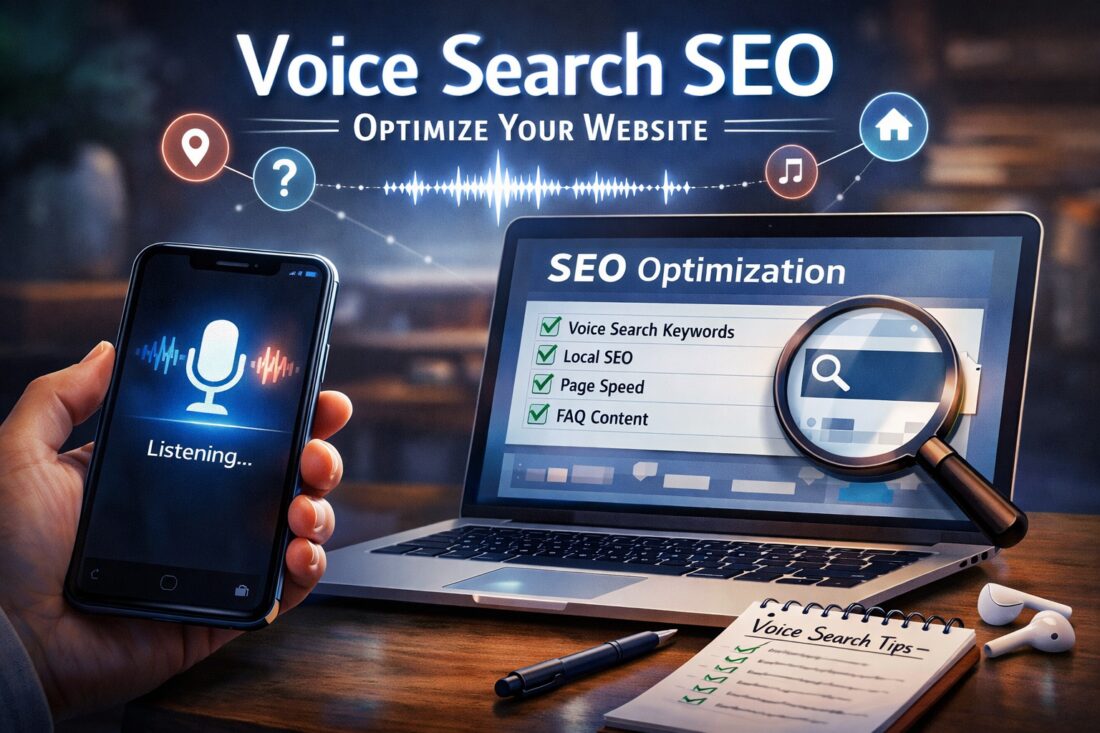
Next, map voice intent proxies to the content that answers questions. For example, FAQ-style pages work differently than service landing pages. If a user asks about hours, pricing, or “how long,” you should tie those questions to pages that answer them clearly. Analytics should tell you which intent cluster lands on which asset, and how often each asset leads to the next step.
Validate signals with triangulation. Do not rely on one metric, like click rate, to judge voice success. Compare multiple indicators such as call starts, direction requests, FAQ engagement, and branded search lift after changes. If only one indicator moves, you may be seeing noise, personalization effects, or tracking gaps.
A practical edge case is when the assistant answers directly and users never visit your site. In that scenario, conversion clicks may drop while calls or branded searches rise. Another nuance is model-driven answer behavior: assistants may satisfy the question without sending traffic, so your “success” must include indirect outcomes.
Finally, set criteria for acting. Use minimum sample sizes per segment before drawing conclusions. When voice-related segments are sparse, widen intent clusters or expand the time window before you change content. This prevents overfitting to a few observations that will not hold up in future periods.
Choose KPIs that reflect each step of the voice funnel
Pick KPIs by funnel stage so you can see where optimization actually improves the journey. Voice performance is not one number. It is a sequence of signals from discovery to intent-match to action and conversion.
Use a KPI set that covers discovery, intent-match engagement, action rates, and conversion outcomes. For discovery, use visibility proxies such as relevant query impressions or SERP feature exposure where your tools provide it. For intent-match, measure on-site behavior linked to answering the spoken question, like FAQ interaction, time on the exact answer area, and form starts. For action, track call starts, direction requests, and high-intent button clicks. For conversion, measure booked jobs, qualified leads, or completed forms.
Define KPIs precisely to prevent misreads. “Engagement” should mean a consistent event, not a vague session metric. Separate CTR-like metrics from on-site click-through, since users may not click at all when assistants answer fully. Also ensure calls and forms are both labeled with the same intent routing logic so you can compare outcomes fairly.
Report KPIs in views that match how you optimize. Segment by landing page type, intent cluster, device category, geography, and branded vs non-branded discovery when possible. If you serve a local market, also segment by service area pages, since voice questions like “near me” often route to different URLs than general questions.
A real-world scenario helps: a repair business adds an FAQ section for “diagnostic fee” and “what to expect.” Discovery impressions may stay flat, but intent-match engagement and call starts rise. That pattern is common because voice answers often increase clarity rather than traffic volume. A common mistake is chasing higher impressions alone, which can miss conversion improvements.
Be cautious about bots and crawling behavior. FAQ pages may be indexed and crawled differently, which can distort engagement metrics when crawlers trigger events. If you record micro-conversions, filter out bot traffic and validate event integrity before you optimize based on it.
Instrument your analytics stack to track voice-like journeys reliably
You measure voice outcomes best when your stack captures conversions and context, not only sessions. Instrumentation should connect intent pages to actions like calls, bookings, and qualified form submissions. Then add the context that helps you interpret why people behaved that way.
Start with event and conversion tracking. Track form submits, phone clicks, “request directions,” and booking confirmations as first-class conversion events. Add micro-events for intent pages, like expansion of a relevant FAQ, clicking a “learn more” answer block, or starting an estimate flow. For local businesses, call tracking matters because it can capture calls initiated from multiple pages and campaigns.

Capture voice-like context using referral and device patterns. Many voice journeys arrive from mobile, and your referral data can hint at assistant-driven discovery. Track patterns like “landing page came from search,” device category, and geography when you have it. These signals do not prove voice specifically, but they help you interpret segments that likely include voice behavior.
When client-side capture is limited, rely on server-side logging or enhanced reporting. Consent mode, ad blockers, and browser privacy features can reduce event visibility. If your organization can implement it, server-side instrumentation reduces reliance on client scripts. Still, plan for missing UTMs, broken referrer chains, and dynamic rendering issues.
A helpful validation step compares your measurement to known changes. For example, when you update a pricing page or add a new service FAQ, you should see consistent movement in the related events. You should also sanity-check with visibility signals from Search Console-style reporting to confirm you did not break indexing or tracking.
Tradeoffs exist. More instrumentation means more maintenance and more event taxonomy decisions. If you track too many events, you will not act on them. Choose the minimum set that supports funnel decisions, then expand based on what the data reveals.
Run a 2026 optimization feedback loop using holdouts and decision rules
Voice Search Analytics should power an optimization loop that tests changes and measures impact with guardrails. In 2026, you need more than “watch the dashboard” because assistant behavior and browser privacy can change what you . Your loop should hypothesize, implement, measure, learn, and iterate.
Use change windows or holdout logic to reduce over-attribution. If you update five pages at once, you will not know what drove results. Isolate variables where possible, such as updating one intent cluster’s FAQ block or changing structured data for one service page. Then compare the impacted pages against a similar set that did not change during the same window.
Prioritize changes using evidence strength. If a service page shows strong intent-match engagement but weak conversions, fix the conversion path first. Examples include clearer pricing explanation, stronger “next step” CTAs, and friction reduction in forms. If discovery proxies are down but intent-match engagement looks healthy, focus on content coverage and structured elements that help assistants and crawlers understand the page.
Combine quantitative and qualitative evidence to resolve conflicts. If engagement rises but conversions do not, use call notes, customer support transcripts, and recorded questions to identify where the experience fails. A common edge case is that the assistant provides enough information to reduce clicks, but people still call. In that case, conversion volume might be stable even when site engagement fluctuates.
Set decision rules for contradictory signals. For example, “impressions up but intent-match engagement down” can mean your content no longer matches the spoken question. “Engagement up but conversion flat” can mean the page answers the question but does not drive the action people want, like calling or booking. Decide which stage you will improve next based on which KPI cluster changed.
Avoid common mistakes that make voice reporting look wrong
Many teams think voice measurement is unreliable because they measure the wrong thing in the wrong way. The fix is not to abandon Voice Search Analytics. The fix is to remove misconceptions that distort the funnel.
One major mistake is treating analytics as “voice-only” reporting. In most setups, you will never see a perfect list of spoken queries that produced an assistant response. Your measurement must infer voice impact through proxies, behavior, and conversions. If you demand exact voice query logs, you will delay improvements until the data becomes available.
Another mistake is overfitting to small samples. Voice queries are often a fraction of total search behavior. When sample sizes are low, random swings can look like a trend after one website update. Use minimum thresholds per intent cluster, and widen the window before you declare wins or failures.
Teams also confuse long-tail query volume with voice intent strength. Conversational phrasing can correlate with voice behavior, but it does not guarantee that users want the same action. A nuance many guides miss is that personalization and model answer behavior can change click behavior without changing brand demand.
Do not ignore page-to-intent alignment. A common scenario is updating content to rank for a question, but the page does not actually answer it at the moment the user needs clarity. People may read, scroll, or bounce, but they will not convert if they cannot find pricing, availability, or the right service next step quickly.
Finally, be careful with “engagement” metrics that reward the wrong outcome. Some assistants answer immediately, so users do not visit your site. Your success may show up as branded search lift, increased calls, or more qualified lead volume later.
Compare measurement options and pick the minimum viable program
You can measure voice optimization success at different levels, depending on your traffic and technical maturity. The best approach matches your goals and tool access. Start with the minimum viable program, then expand as your measurement confidence grows.
Category one uses search and visibility proxies when direct voice query reporting is limited. This includes relevant query impressions and SERP feature signals where your tools support them. Proxies help you see whether the assistant-facing content set is gaining coverage, even if you cannot isolate voice traffic perfectly.
Category two focuses on on-site behavioral measurement. It tracks how users interact with intent pages, such as FAQ engagement and funnel progression. This approach helps you validate whether your content answers spoken questions in a way that supports actions.
Category three uses conversion-focused instrumentation. Calls, bookings, and form completions measure what your business cares about most. This method captures indirect voice impact too, since some users never click but still convert through other channels.
Category four adds qualitative triangulation. Support tickets, call recordings, and notes from sales teams help validate what people asked and how they decided. This is especially useful when voice query data is sparse, because it confirms whether your intent clusters reflect real customer questions.
Below is a compact guide for choosing scope. If you have limited dev bandwidth, start with conversion tracking and intent-page engagement. If you have more resources, add server-side logging, call attribution, and stronger segment validation.
| Program level | What you can measure | Best for | Main risk |
|---|---|---|---|
| Minimum viable | Calls, forms, key micro-events, basic segments | Proving business impact fast | Proxy confusion |
| Core funnel | Funnel KPIs by intent cluster and landing page type | Prioritizing content updates | Over-segmentation |
| Validation program | Triangulation, event quality checks, deeper context | Trusting decisions over time | Tool complexity |
A common mistake is skipping validation. Even a strong KPI set can mislead if tracking breaks during consent changes or template updates. Use sanity checks after any major site or analytics deployment.
Handle local intent, ambiguous questions, and blended journeys
Voice searches often include local intent and ambiguous goals. Your Voice Search Analytics must reflect how those journeys behave across pages and time. If you ignore local context, you will undercount voice success for service-area businesses.
For local voice intent, evaluate whether your location or service-area pages support the question and lead to outcomes. Track actions like calls, direction requests, and route-related behaviors from those pages. Also make sure your page set uses consistent service area information so users can trust the offer when they hear it in an assistant response.
Ambiguous queries need routing logic in measurement. Some questions are comparison questions or “which service should I choose?” calls. In those cases, the best page may be a diagnostic intake or a guide that routes users to the right service. Your KPIs should include progression steps that lead to routing completion, not just direct booking.
Blended journeys are common: discovery by voice, conversion by later text session. To measure this, look at assisted conversions and time-lag patterns between voice-like discovery and conversion events. You might see fewer immediate clicks but more calls later from users who first learned the answer through an assistant.
Edge cases include assistant answers that suppress clicks. Some assistants provide a result without sending users to your website, which can reduce site engagement. In that situation, brand search lift and conversion outcomes become more important than pageviews. Another nuance is data anomalies from migrations and template changes that can mimic “voice performance shifts.” Validate with event integrity checks and compare conversion volumes across similar periods.
Use caution when interpreting single-day spikes. A consent update or tracking change can create sudden drops or rises across segments. Build a routine to confirm whether measurement quality shifted before you attribute changes to voice optimization.
Frequently Asked Questions About Voice Search Analytics: Measure Your Optimization Success
How can I measure voice search results if I don’t get “voice” query data in Search Console?
You can measure voice impact using triangulation across visibility proxies, on-site behavior, and conversion outcomes. Track relevant impressions and landing page performance, then connect them to calls, bookings, and qualified form submits. If direct “voice” labels are missing, use the funnel stages to infer whether the spoken intent your content targets is driving actions. Make sure you validate tracking and do not interpret one proxy metric alone.
What KPIs best show that voice optimization is working for a local business?
For local businesses, calls, direction requests, and completed bookings are the most direct KPIs. Pair those with intent-match engagement on the pages that answer spoken questions, like FAQ interactions tied to service hours, pricing approach, and next steps. Segment results by landing page type and service area, so you can see which page set actually supports local voice intent. Also track branded vs non-branded outcomes to distinguish demand lift from general traffic changes.
Should I track calls as the main conversion for voice search analytics?
Calls are often a strong primary conversion for local services because voice journeys frequently lead to phone actions. Still, compare calls alongside form or booking conversions since some users prefer digital completion. For attribution, use call tracking numbers and ensure calls are tied to the correct landing page or campaign source. Then interpret call volume changes with context, since tracking gaps can also move call metrics.
Why does my voice traffic look stable even after content improvements?
Your measured “voice” segments may be stable because voice journeys are blended across channels and later conversions. Measurement delays also matter, since improvements can take time to reflect in visibility and user behavior. Low sample sizes can hide real movement until you expand the time window or widen intent clusters. Validate by checking on-site intent-match engagement and conversion outcomes on updated pages.
How do I know whether an assistant is answering my question without sending users to my site?
If you see reduced clicks but stable or improving calls, direction requests, or branded search lift, assistants may satisfy the question without sending traffic. Also watch for improved engagement on intent pages when users do arrive, since your content can still clarify decisions even if not everyone clicks. Interpret click drops as potentially “answer delivered,” not automatically “failure.” Confirm with qualitative signals like call notes about how customers found you.
What’s the difference between voice SEO improvements and voice search analytics success?
Voice SEO improvements are implementation outcomes, like new FAQ content, structured elements, and page clarity for spoken questions. Voice search analytics success is business outcomes, like more qualified leads, bookings, or increased calls tied to intent pages. Analytics success proves whether your changes moved the funnel stages in a meaningful way. Treat them as linked but distinct, so you do not declare victory just because pages were updated.
How long should I wait before concluding that voice analytics shows improvement?
Wait long enough to cover baseline variation and allow measurement to stabilize after changes. A common starting point is several weeks, then assess over a full window that includes typical demand cycles for your service area. Use minimum sample thresholds per intent cluster, and avoid decisions based on tiny segments. If tracking was updated recently, allow time for data normalization before comparing results.
What’s the best way to instrument conversational FAQ pages so voice performance is measurable?
Instrument FAQ pages with events for interactions that indicate answer usefulness, such as FAQ expansions, “read more” clicks, and engagement with the specific answer blocks. Cluster FAQs by intent, then connect those clusters to funnel actions like calls or form starts. Make sure FAQ events map to the same conversion paths you optimize elsewhere on the site. Validate event quality by testing on real devices and filtering bots.
How do privacy changes in 2026 affect voice search measurement and attribution?
Privacy features can reduce referrer and campaign visibility, which makes it harder to attribute assisted journeys to specific sources. Consent limitations may also reduce the number of events you capture, especially client-side signals. In response, rely more on server-side logging where available, strengthen event naming, and use consent-aware analytics patterns. You may also need more triangulation with conversion outcomes and visibility proxies.
Can voice search analytics help with content strategy beyond SEO rankings?
Yes. Intent clusters from voice-like questions can inform messaging, service packaging, and support deflection content that improves conversions and customer satisfaction. When you connect content engagement to calls and bookings, analytics shows which questions lead to action and which create confusion. That helps teams prioritize content updates that reduce sales friction and answer real customer needs.
Use the outcomes checklist to measure voice optimization success with confidence
Voice optimization succeeds when your funnel improves for the people your content serves, not when a single metric moves. Use Voice Search Analytics to measure discovery coverage proxies, intent-match behavior, and conversion outcomes across segments. Then validate those findings with triangulation so you can trust decisions even when direct voice query data is unavailable.
Build reliability first. Ensure your events and conversions are accurate, segment definitions stay consistent, and you sanity-check after every major site change. Next, pick KPIs that match your business actions, like calls and booked jobs, and connect them to the intent pages you optimize.
Finally, run one structured test at a time and use decision rules when signals conflict. If engagement rises but conversions do not, fix the action path. If clicks drop but calls rise, treat it as evidence that the assistant delivered answers. Apply this approach, and you will measure progress you can explain to stakeholders in 2026.
Next step: Audit instrumentation for calls and forms, select a small KPI set by funnel stage, run one focused optimization test, then review results against your decision rules.
In parallel, you can strengthen the underlying on-site experience with on-page SEO best practices and conversational FAQ structures that match spoken questions. That combination makes your Voice Search Analytics findings more actionable and less ambiguous.
Next step: Audit instrumentation for calls and forms, select a small KPI set by funnel stage, run one focused optimization test, then review results against your decision rules.
For broader measurement context, also review privacy-aware analytics guidance from Google Analytics and see how structured data can support search understanding in Search Central. For on-going search visibility discussions, you can reference Search Console Help.
Updated September 2026