

Yes—most rank drops and long ranking plateaus come from a handful of on-page choices. If you want better positions, focus on the on-page SEO mistakes to avoid that block clarity, relevance, and extractability. This guide walks you through the exact areas you can control on a page, from intent alignment and content depth to titles, headings, and internal structure. It is built for webmasters and content creators who want a practical, checklist-style approach rather than vague advice. In 2026, SERP features may shift, but the underlying on-page principles that earn and keep rankings stay steady. Use this article to spot problems on your own pages, prioritize fixes, and validate results with page-level evidence.
Align page intent with what searchers expect before you touch SEO details
Intent mismatch is the most common root cause behind “my on-page SEO looks fine, but nothing moves.” You can have clean headings and a well-written article, yet still fail if the page promise does not match what the top results deliver. Search engines reward the page that best resolves the searcher’s underlying need, not the page that repeats a phrase most often.
Start by mapping each page to one primary intent. Then add 3 to 6 supporting sub-intents that naturally belong to that intent. For example, if a searcher wants a guide, they need steps, examples, and expected outcomes. If they want a definition, they need a clear explanation early and then supporting context later. This helps you avoid the common trap of mixing several expectations into one page and pleasing nobody.
To verify intent alignment, compare your page to what currently ranks. Look for the same content type, depth level, and answer format. If the top pages use checklists, your article should also surface checklists quickly. If they show comparisons, you should include a side-by-side framework instead of only descriptions.
A common mistake is to over-optimise metadata while leaving the page’s actual promise unchanged. You might rewrite your title tag and meta description, but still bury the key answer or fail to cover the main steps. Google can then judge your page as relevant yet not satisfying, which often leads to stubborn positions.
Edge cases matter too. Sometimes you target a legitimate keyword, but the SERP expects a tool, a definition, a comparison, or a how-to. In those cases, a minor rewrite will not fix the problem. You usually need a format change, like adding a calculator, a decision table, or step-by-step instructions that match the dominant result type.
This is also where “on-page SEO mistakes to avoid” becomes more than a checklist. You must ensure your headings, section order, and on-page visuals reflect the real question being answered. If the page solves a different job than the searcher expects, the rest of your optimizations will get limited gains.
Prevent ranking drag from thin content, duplicates, and barely updated pages
Thin or duplicated content can drag rankings even when your page structure looks correct. Search engines look for clear usefulness, not just surface relevance. If your page adds little beyond what others already cover, it will struggle to compete.
Duplicated content comes in several forms, and the fix depends on which one you have. Exact duplicates are copies of text with little or no change. Near-duplicates share the same core wording and structure across similar pages. “Template duplicates” repeat the same layout and sections, with only minor substitutions. Syndicated or republished content can also cause problems when it is not meaningfully differentiated.
“Barely updated” pages are a related failure mode. Adding a new date, swapping a few examples, or rewriting two paragraphs without improving coverage often fails to signal real value. In 2026, SERPs can reward pages that answer new sub-questions clearly, not pages that change wording while leaving gaps untouched.
Remediation should be deliberate. You can consolidate overlapping pages when they compete for the same intent. You can differentiate by rewriting sections so each page serves a distinct need. In some cases, you may choose to noindex or redirect pages that truly cannot offer unique value. The tradeoff is risk: removing a page can reduce reach if it still earns impressions for a specific query set.
Optimize Your Site for Success
Is Your On-Page SEO Holding You Back?
Transform your website’s performance with eDesignerz. From custom designs to advanced SEO strategies, we ensure every page aligns with search intent and boosts your rankings.
Get Your Free Consultation29+ Years of Experience Custom Solutions Satisfaction Guaranteed
A nuance many people miss is section-level retention. Partial updates can hurt if you remove parts that answer long-tail sub-questions. Even if the main topic stays the same, the SERP may expect that specific step, FAQ-like explanation, or troubleshooting section to be present. Audit your page by section and confirm you still cover what top results include.
Real-world scenario: a blog post updated “for 2026” but left an entire step out after a rewrite. Rankings may dip because the page no longer matches the expected workflow. Fixing it is not about better phrasing only. It is about restoring and improving the missing coverage.
Use page structure to guide meaning, not just to make text scannable
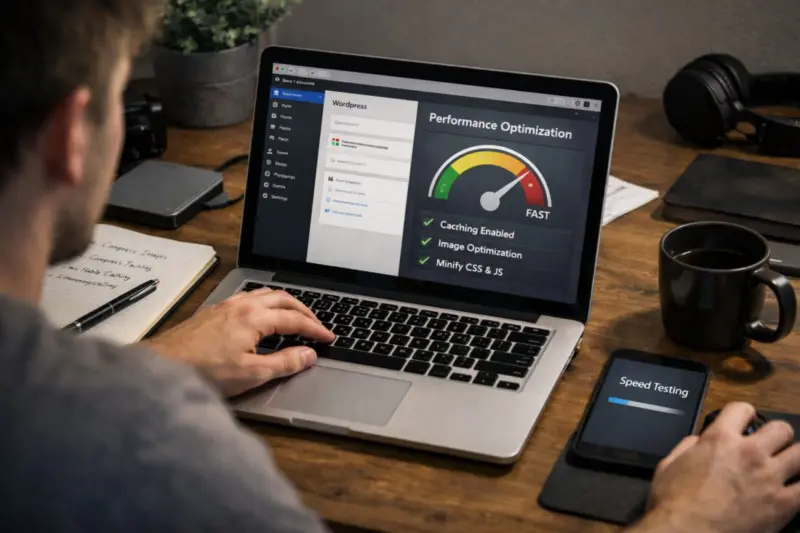
Good on-page structure helps search engines and readers understand your page fast. When headings and sections match the logic of your answer, rankings have a better chance to hold. When structure is inconsistent, your content can become harder to extract and interpret.
Headings are more than formatting. Think of them as a content outline that mirrors your reasoning. A safe strategy is to follow a clear progression such as problem, solution, steps, proof, and next actions. Each section then earns its place by adding new information that supports the main promise.
Make your heading hierarchy consistent. Avoid broken sequences, heading skips, or multiple “H1-like” patterns when your CMS allows styling changes. Keep depth reasonable so readers can skim and still see what each section does. If a page has too many near-identical sections, you can dilute topical focus and make your main thread harder to find.
Internal linking supports structure, even when you only link on the page itself. Link to the next most helpful section so readers do not bounce back to the search results. Use relevance-first anchors that reflect what the linked section actually covers. This is also where link spam patterns can appear, such as repeated anchors that all point to the same general destination.
A deeper insight is that over-fragmentation can backfire. Many webmasters respond to competition by splitting into more headings. But if those headings only rephrase the same idea, the page may feel repetitive and less complete. Consolidate related points into fewer, more informative sections while keeping all required sub-coverage.
Real-world scenario: a troubleshooting article uses dozens of headings for minor variations, but each one contains two sentences. Readers cannot find a real fix quickly. The fix is not more headings. The fix is better section-level density that explains how to solve the issue.
Rewrite titles and snippets so the page promise is specific and deliverable
Your title tag and meta description act like a promise. If the snippet promise does not match what the page clearly delivers, rankings and traffic both suffer. Even strong on-page content can underperform if users do not see the right expectation in the SERP.
Write titles for specificity and audience fit. Include the concrete benefit or outcome, not only the topic. Avoid misleading clickbait because it creates a mismatch between what people click and what the page actually satisfies. In 2026, SERP features vary by query, so your on-page answer must be visible and extractable even when Google chooses its own snippet.
Snippets are not guaranteed to follow your meta description. That is why your content structure must support extraction. If your snippet implies steps, those steps should appear early and be labeled clearly. If your title implies a comparison, your page should include a comparison section with clear criteria and outcomes.
Do not assume higher CTR alone guarantees ranking improvement. CTR can help, but it is not a reliable substitute for relevance and satisfaction. If users click and then immediately return to search, Google may interpret that as poor match. That makes the on-page alignment work even more important.
Deeper nuance: duplicate titles and repetitive metadata across a site can confuse which page should rank. If multiple pages share the same or near-identical title tag patterns, Google may struggle to choose the best result. A practical fix is to differentiate titles based on intent, scope, and content type, not only on small keyword swaps.
Real-world scenario: a page updates its title to a newer keyword variant but keeps the same intro and structure. The page still answers the old question first. Performance can drop because the SERP expects the newer framing. Fix it by aligning the first section to the new promise and ensuring extractable support exists.
Fix keyword placement mistakes that blur topics or create confusing page signals
Keyword placement should reinforce your topic, not confuse it. When on-page SEO mistakes to avoid include stuffing phrases into headings and early paragraphs, the page can read unnatural and still fail to match intent. Google also uses contextual signals to determine what a page is truly about.
What “good” looks like is clear topical coverage and consistent terminology where it genuinely helps. You should use natural language variations that match how real readers describe the same concept. At the same time, do not treat synonyms as a requirement for every section. Clarity wins over forced variety.
Placement pitfalls include repeating the same exact phrase in every subheading and forcing it into the first sentences even when it harms readability. Another pitfall is rewriting headings without updating the sections underneath them. When headings promise one thing and the text delivers something else, the mismatch becomes visible to readers and interpretable by search engines.
When multiple related topics exist, resist the urge to make one page rank for everything. Add a new section when the sub-topic supports the main intent and belongs in the same user workflow. Split into a separate page when the SERP expects a different content type, depth level, or goal. This prevents the page from becoming a bundle of loosely related answers.
A deeper insight is cannibalization. If two pages target too-similar intent, they can compete for the same query set. Minor keyword tweaks will not fix this. You need differentiation, like narrowing the scope of one page, changing its format, or adjusting internal structure so each page is the obvious best answer for its own intent.
Real-world scenario: an ecommerce blog has multiple guides with the same outline and similar wording, each targeting a slightly different phrasing of “how to choose.” The pages then split impressions and never build stable authority. The fix is consolidation or restructuring so one page owns the broad guide and others handle distinct sub-decisions.
Improve on-page clarity for conversions without sacrificing ranking signals

Ranking depends on whether your page resolves the query clearly. Visitor behavior often reflects whether people can find answers fast, understand them, and take the next step. That is why conversion-focused clarity and SEO can reinforce each other.
Many content creators accidentally bury the main answer. They start with long intros, add plenty of background, then reach the practical steps late. For how-to intent, the page should show the core approach early, then expand with details, examples, and edge-case troubleshooting. Clear introductions also reduce bounce because readers quickly confirm they are in the right place.
On-page elements that strengthen topical trust include concrete examples, direct definitions, and visible logic. For instance, a page about fixing a problem should show a typical workflow and then common failure patterns. When you include proof-like support such as before-and-after explanations or realistic scenarios, the page becomes easier to trust and easier to extract.
Boost Your Rankings with Expert Help.
On-Page SEO Mistakes Holding You Back?
Avoid common pitfalls and enhance your website's performance with our professional SEO and web design services. Let’s transform your on-page strategy for better visibility and conversions.
29+ Years of Experience Personalized Service Free On-Page SEO After Launch
Accessibility and media matter for comprehension, which can affect perceived usefulness. Use alt text that describes what an image shows, not repeated keyword phrases. Add captions when the image contains information readers need. Keep layouts readable on small screens, because cramped content reduces extractability and slows comprehension.
A deeper nuance: some teams separate “UX work” from SEO. However, when UX improvements make the answer more visible, Google can interpret the page better. If visitors can instantly find the resolution, the page quality signal becomes stronger. The tradeoff is that you must keep the improvements truthful and aligned with the content, not disguised promotion.
Real-world scenario: a guide includes great steps, but they are hidden behind collapsible widgets that load late. Readers feel forced to work for the answer, and satisfaction drops. The fix can be simple: show the steps in plain text first, then offer deeper details in interactive elements.
Choose between rework, consolidation, or new pages using a decision framework
Not every problem needs a full rewrite. Sometimes the best fix is consolidation, sometimes it is focused rework, and sometimes you must create a new page. A decision framework keeps you from making cosmetic changes that do not solve the underlying intent mismatch.
Start with intent overlap. If two pages cover the same user need with nearly the same content type and structure, they likely cannibalize each other. Consolidation can then raise topical clarity and reduce competition. If the pages serve different needs, avoid merging because each intent needs a coherent structure.
Next evaluate content uniqueness and coverage depth. If one page already earns impressions, rework it to better match the dominant SERP format. If both pages are weak or thin, consolidation can prevent duplication drag. If neither page can be made strong without major scope changes, a new page with a distinct intent may be cleaner.
Also consider operational tradeoffs. Consolidation can be faster but risks removing sections that rank for long-tail questions. Creating new pages increases maintenance costs and the risk of future overlap. Either way, you should adjust internal linking so readers and search engines follow the best pathway.
Safeguard your decisions. Avoid redirecting pages that still fulfill genuinely different user needs. Verify canonicalization and ensure the preferred page is the one that matches the intent and content format. Use evidence-based prioritization by checking which pages have impressions and which queries they already associate with.
A deeper insight is “ranking for the wrong intent.” If your page attracts impressions for a related query but satisfies a different expectation, rework may need to reshape the page’s promise and section order. But sometimes the cleaner solution is a new page that matches the dominant format, while the original page narrows to its true intent.
| When to choose this option | When to rework | When to consolidate | When to create a new page |
|---|---|---|---|
| Primary signal | One page already earns impressions but under-delivers | Multiple pages compete for the same intent with overlapping coverage | Your site lacks a page that matches the SERP’s expected content type |
| Scope mismatch | Small-to-medium gaps in steps, examples, or structure | Two pages cover the same workflow with minimal unique value | Different workflow, different format, or different depth level |
| Main risk | Fixes improve clarity but still fail to beat the best result | Removing one page cuts off long-tail queries | New page increases overlap risk if intent is not truly distinct |
| Best next action | Map the SERP structure and rebuild the page sections accordingly | Merge unique parts, keep the strongest sections, and remove duplication | Design for the dominant answer format and cover missing sub-intents |
Recognize persistent 2026 on-page pitfalls in CMS templates, indexing, and pagination
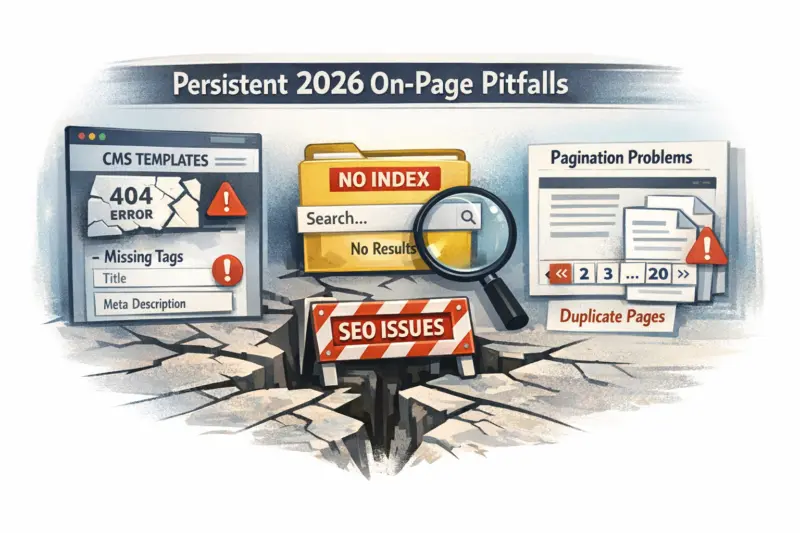
Some on-page problems keep showing up in 2026 because they are caused by templates and platform behavior. Even when content is good, CMS settings can create thin duplicates, parameter pages, or indexable content that should not rank. These issues often look like “SEO” failures, but they are actually page selection and content identity problems.
Template duplicates are a common culprit. Category and tag pages can become thin repeats if they show only a list of posts with little unique context. Similarly, “author” or “archive” pages can generate near-duplicates when they repeat the same layout and summary. The fix is to add unique page-level value or stop indexing pages that do not serve a distinct purpose.
Dynamic parameter pages can also accidentally get indexed. URL parameters can create multiple variants of the same content, such as filtered views or sort orders. When the same core content appears in many indexable URLs, the search engine may treat it as duplication and split signals across versions.
Pagination and series content require careful navigation. If you break a series into multiple pages, ensure next-step navigation is clear and that each page still provides meaningful context. Avoid creating multiple pages where the same content is repeated with only small amounts added. Readers should not feel like they must click through to find the real answer.
Deeper nuance: “doing all the checklist items” can still fail if you lose the gap that matters. Check which sections your page lacks compared to what already ranks. A surface edit can raise readability but not resolve the missing expectation. Gap analysis should focus on content and structure differences that affect satisfaction, not only on small optimizations.
Another measurement pitfall is changing too many variables at once. When you rewrite titles, restructure headings, and overhaul content all in the same week, you cannot tell which change helped. Track page-level outcomes and keep iterations focused so you learn what works for your specific pages.
What are the most common on-page SEO mistakes to avoid when a page isn’t ranking?
The most common issues are intent mismatch, thin or duplicated content, and on-page structure that does not make the answer extractable. You can diagnose intent mismatch by comparing your page format to the top results and checking whether your intro and section order deliver the same kind of answer. You can diagnose thin or duplicate content by reviewing whether key sections are missing or repeated across similar pages. Then check whether titles and headings promise one thing while the body delivers another.
How do I tell whether my on-page problem is intent mismatch or content quality?
A quick test is to compare your page’s early promise with what ranks on the SERP. If top results provide a tool, definition, comparison, or step-by-step workflow and your page does not match that format, it is likely intent mismatch. If your format aligns but your coverage feels incomplete, vague, or repetitive, it points to content quality. You can also review section-level gaps by listing what the top pages include that you do not.
Update an existing page when it already earns impressions but needs clearer coverage, better structure, or stronger alignment to the SERP format. Create a new page when the SERP expects a distinctly different content type or workflow that your current page cannot deliver without becoming unfocused. Use overlap and cannibalization risk as decision guides. If two pages target the same need with near-identical structure, consolidation often beats endless small edits.
What on-page elements should I audit first if I’m starting from scratch?
Start with structure and extractability, then move to content coverage and clarity. Next, audit titles and snippets so the SERP promise matches what the page shows early. After that, review internal structure so each section supports the next step without forcing readers to search for answers. Then check remaining optimizations such as keyword usage patterns and media clarity.
Can duplicate content be “accidental” even when I didn’t copy anything?
Yes. Accidental duplication often comes from templates, tag or category archives, or URL parameters that generate multiple versions of the same content. “Near-duplicate” pages can also happen when you publish posts that follow the same outline with only minor substitutions. If you see similar titles and the same main sections repeated across pages, treat it as a duplication identity problem, not just a copy problem.
Why did my title tag changes hurt performance even though the wording improved?
Title tag changes can hurt when they promise a different scope or expectation than the page delivers early. They can also hurt when the page still matches the old SERP format but the title signals a new format. CTR changes are not a guarantee; users may click but then bounce if they do not find the promised steps or comparison. In that case, on-page content alignment needs to change, not just the snippet wording.
How many keywords should I use on a single page to rank better?
You do not need a fixed number of keywords, and hard caps can lead to unnatural writing. Focus on covering the main intent and the supporting sub-intents that users expect, using natural language variations. If you try to force many separate phrases, you may end up with a page that feels broad but not satisfying. Instead, structure the page around the questions and steps readers need to complete their goal.
What’s the best way to improve internal linking without making the page feel spammy?
Link to content that directly supports the next step a reader needs, and use anchors that describe what the destination actually covers. Avoid repeating the same anchor text many times if the destination topics differ. Keep links sparse and purposeful so the reader finds help quickly rather than being pushed through a maze. When possible, place links where they clarify the logic of your page’s workflow.
Is it worth rewriting headings and sections if my main content is already “good enough”?
It can be worth it when headings and section order do not match how users need to extract the answer. If your content is strong but hard to scan, structure changes can improve satisfaction and extractability. However, if the missing piece is deeper coverage, rewrites to headings alone will not fix the problem. A good test is whether readers can find the core steps within the first few minutes of scanning.
How long should I wait after on-page updates to judge results in 2026?
In 2026, you typically need time for re-crawling and re-indexing, plus time for rankings to stabilize after updates. A common mistake is judging results after only a few days when indexing has not caught up or when SERP testing is still ongoing. Look for evidence first at the page level, such as improved impressions for the intended queries and steadier clicks. Then check rankings after enough time has passed to separate indexing effects from real ranking shifts.
FREE WEBSITE CONSULTATION FOR SEO SUCCESS!
Ready to overcome on-page SEO hurdles? Request a free consultation to discuss your website issues and get a custom quote for our professional web design and development services. Enhance your site’s performance and turn visitors into customers today!
REQUEST YOUR FREE CONSULTATIONConclusion: fix the highest-impact on-page mismatch, then validate with page evidence
The fastest path to better rankings starts with intent alignment and ends with proof that your page resolves the query clearly. Your main priorities should be the on-page SEO mistakes to avoid that block satisfaction: content that is too thin or duplicated, structure that hides the answer, and titles/snippets that promise more than the page delivers. If you focus on clarity, extractability, and coverage that matches what ranks, your improvements will be easier to sustain.
Use a prioritization mindset. Diagnose the biggest mismatch first, then choose a single iteration goal: rework a page to match SERP format, consolidate overlapping pages, or build a new page for a genuinely distinct intent. Avoid cosmetic-only changes that do not change the page promise or the actual steps readers need. Track outcomes using page-level evidence, and change fewer variables per iteration so you learn what truly improved results.
As a practical next step, run a section-by-section audit on one priority page. Compare your early promise, headings, and section coverage to what currently ranks, then decide between rework, consolidation, or a new page using overlap and intent uniqueness. Validate the update with measurement discipline over a realistic post-update window, and keep improving what the page still fails to satisfy.
Updated September 2026