
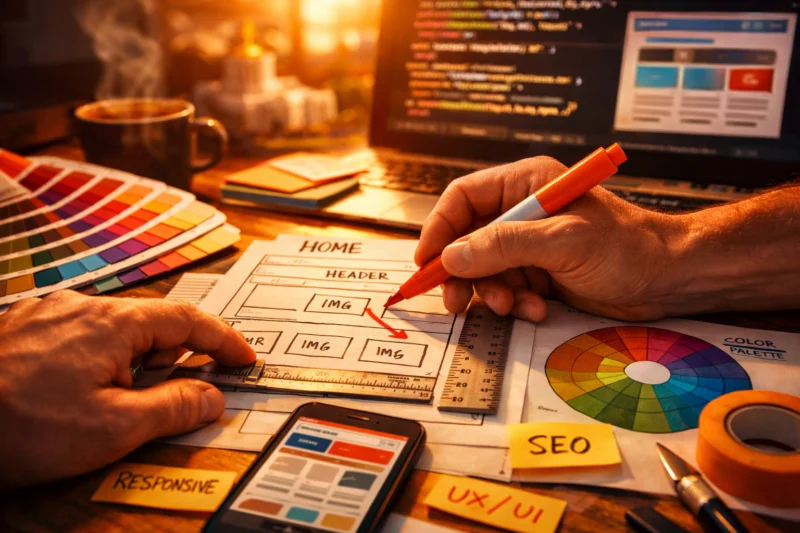
Expert web design Salem Oregon means hiring a team that can build a website that looks credible, loads quickly, supports lead generation, and fits the goals of a Salem-area business. In practical terms, the right site should help local customers trust you faster, contact you more easily, and understand what makes your business worth choosing.
For a Salem company in 2026, that matters because your website is often the first sales conversation you have. A strong site can improve first impressions, strengthen local trust, and create more qualified inquiries without adding more pressure to your team. This guide is a decision framework for comparing teams, spotting weak proposals, and choosing a partner that can deliver more than attractive visuals.
Contents
- 1 What an expert Salem web design team should actually deliver
- 2 How to choose the right web design partner for a Salem business
- 3 Salem Oregon website design options: agency, freelancer, or in-house
- 4 Signs you are looking at true expertise, not just attractive visuals
- 5 Common mistakes Salem businesses make when hiring a web designer
- 6 Web design features that matter most for lead generation and trust
- 7 Advanced considerations most guides on expert web design in Salem get wrong
- 8 What a strong Salem Oregon web design process should look like
- 9 Budget, pricing, and value: how to compare proposals fairly
- 10 Frequently Asked Questions About expert web design Salem Oregon
- 10.1 How do I choose the best web designer in Salem Oregon?
- 10.2 What should an expert web design Salem Oregon project include?
- 10.3 How much does Salem web design usually cost?
- 10.4 Is a custom website better than a template for my business?
- 10.5 How long does a professional website project take?
- 10.6 What should I ask before signing a web design contract?
- 10.7 Do I need SEO included with web design?
- 10.8 Can a Salem web design team help improve leads?
- 10.9 What if I already have a website but need a redesign?
- 11 Conclusion
What an expert Salem web design team should actually deliver
A true expert team delivers business outcomes, not just a polished homepage. The site should make your offer clear, guide visitors toward action, and support the specific lead or sales path your business needs. If the design looks good but visitors still cannot figure out what you do, where to click, or why they should trust you, it is not expert-level work.
This is where the distinction between design, development, strategy, and ongoing support becomes important. Design shapes the visual structure and user experience. Development builds the site so it functions reliably and can be edited later. Strategy connects the website to your audience, services, and conversion goals. Support keeps the site healthy after launch, which is why many businesses later look for ongoing website maintenance instead of treating launch day as the finish line.
Local-market understanding also matters in a measurable way. A Salem business site should feel familiar to the audience it serves, reflect the right level of professionalism, and speak to the decision process of local customers. That might mean clearer service pages for homeowners, stronger appointment paths for healthcare, or trust-building content for professional services. A polished portfolio can impress, but the stronger indicator is whether the team has a repeatable process for improving conversion rates over time.
In other words, expert web design Salem Oregon is not about decorating a page. It is about building a site with a clear structure, mobile usability, and room to grow. Teams that offer custom website solutions should be able to explain how each feature supports leads, usability, and future scalability, not just aesthetics.
How to choose the right web design partner for a Salem business
The best way to choose a web design partner is to start with goals, then compare fit, proof, process, and pricing. If you begin with a portfolio alone, you may select a team that creates attractive work but cannot solve your actual business problem. The right partner should understand what your site must do, who it must persuade, and how success will be measured after launch.

Before hiring, ask how they have handled businesses similar to yours, how long the project will take, who owns the content and code, and what support is available after launch. A strong answer should be specific, not vague. If a proposal talks about “modern design” or “premium experience” without naming pages, revisions, integrations, and deliverables, that is a warning sign because vague scope is where hidden costs and scope creep begin.
Fit also means they understand your audience and your sales process. A contractor serving commercial clients needs a different website structure than a boutique retail shop. A team that knows how to build user-focused web design will ask about buyer objections, service areas, proof points, and the path from homepage to contact form. That kind of questioning matters more than a flashy presentation deck.
For Salem companies comparing Salem web design firms, this is also where local web design support becomes relevant. Local teams can better account for regional trust signals, local competition, and the way nearby customers evaluate service businesses. If you need help with choosing a design team, compare the clarity of the process as carefully as the design samples.
Salem Oregon website design options: agency, freelancer, or in-house
There are three realistic ways to get a website built: hire a full-service agency, work with an independent freelancer, or build in-house. Each option can work, but the right choice depends on complexity, budget, timeline, and how much growth you expect. The cheapest option is not always the best value, especially when the site is expected to generate leads or support multiple service lines.
A full-service agency is usually best for businesses that need strategy, design, development, copy support, and post-launch help in one coordinated process. An independent freelancer can be a strong fit for smaller projects, simpler websites, or companies with in-house marketing support. In-house makes sense when web work is ongoing, the organization has enough internal skill, and the team can maintain momentum without bottlenecks. For many companies, the right path comes down to how much accountability and specialized expertise they need.
The hidden cost of a low-price option is often rework. A site built too quickly can miss conversion structure, mobile usability, or basic SEO setup, which means paying again later for fixes. That is why businesses looking for custom website solutions should think beyond initial price and consider whether the team can handle future growth, content edits, and technical maintenance without forcing a full rebuild.
| Option | Best for | Strength | Tradeoff |
|---|---|---|---|
| Agency | Growing businesses, complex sites, lead generation | Strategy, accountability, broader expertise | Higher cost |
| Freelancer | Smaller projects, simpler sites, tighter budgets | Flexibility, lower overhead | Limited bandwidth or specialization |
| In-house | Organizations with ongoing digital needs | Direct control, immediate access | Hiring, training, and tool costs |
Signs you are looking at true expertise, not just attractive visuals
Real expertise shows up in results-oriented details, not only in visual polish. A strong portfolio should include sites that make services easy to understand on mobile, guide visitors toward action, and look credible in industries where trust matters. If every example looks stylish but none clearly explains a service or supports inquiries, the portfolio may be hiding weak strategy behind nice aesthetics.
Process signals matter just as much as visuals. Good teams ask discovery questions, build wireframes, test layouts, and plan launch carefully. They can explain why a page is structured a certain way, what happens during revisions, and how feedback will be handled. That usually correlates with better outcomes because the team is designing for decisions, not just decoration. Content strategy, page hierarchy, and conversion planning often matter more than animations or trendy effects.
A useful test is whether the team can design for the audience’s decision stage. Someone comparing three service providers needs proof, clarity, and a low-friction path to contact. Someone ready to buy may need pricing cues, service details, or a calendar link. If the designer only talks about “making it modern,” they may not understand how people actually decide. This is why mobile-friendly site design and service-page logic are stronger signals than visual flair alone.
Another edge case: some agencies showcase high-end brands but struggle with practical small-business needs such as faster quote requests, location-based credibility, or simpler content workflows. That is why you should ask not just what they built, but why the site works and how they know it worked. For businesses comparing Salem web design firms, proof of process is often more useful than a visually impressive case gallery.
Common mistakes Salem businesses make when hiring a web designer
The most common mistake is choosing on price alone. A lower quote can look efficient, but if the project misses strategy, content structure, or ownership details, the real cost shows up later in revisions and lost leads. Businesses often discover too late that a “cheap” website needs another round of work because it was built to look complete rather than perform well.
Another frequent mistake is assuming a template is custom enough. A template can be fine when the business is simple and the goals are modest, but it is not automatically strategic. If the layout does not reflect your services, audience objections, and conversion path, the site may be visually acceptable but commercially weak. The same issue appears when owners skip planning and ask the designer to “just make it look professional,” which leaves too much to interpretation.

Ownership is another area people overlook. Before signing, confirm domain access, hosting access, CMS logins, and whether content can be exported later. A business that cannot move its site or content cleanly is exposed to future lock-in. This is especially important when using custom website solutions that may include unique components or integrations.
One more mistake: believing fast turnaround is always a good thing. Some quick-launch promises are legitimate, but others compress discovery and content decisions so much that the site goes live with weak messaging. That often leads to redesign planning within months. If a provider promises speed, ask what they are skipping to achieve it and whether that tradeoff is acceptable for your goals.
Web design features that matter most for lead generation and trust
The most valuable website features are the ones that help people decide to contact you. Clear calls to action, well-structured service pages, visible contact paths, and trust markers all reduce friction. A visitor should never have to guess what the next step is. If they do, the site may look polished but will underperform commercially.
Mobile usability and speed are not technical extras; they are business requirements. Many local customers will view your site on a phone, often while comparing multiple providers. If pages are slow or the navigation is awkward, they are likely to move on. Accessibility matters here too because readable contrast, keyboard support, and logical headings improve usability for everyone, not just people with disabilities. The Web Content Accessibility Guidelines (WCAG) are a useful reference point, and Google Search Central explains core search-friendly site practices that also support structure and discoverability.
Trust builders are especially important for service businesses. Testimonials, case studies, team bios, certifications, and locally relevant context all help visitors feel safer about reaching out. A homepage can create a strong first impression, but if service pages are vague, people still hesitate. That is why website redesign planning should focus on the full path from homepage to contact form, not only the hero section. A site with strong proof and clear service-page structure usually outperforms one that relies on imagery alone.
This is also where mobile-friendly site design and user-focused web design become commercial advantages rather than style choices. A good team should know where to place proof, when to shorten forms, and how to use service hierarchy to reduce bounce. In practice, that means building pages that answer buyer questions in the right order, then making the next step obvious.
Advanced considerations most guides on expert web design in Salem get wrong
Many guides focus almost entirely on first impressions, but a website should support the full buyer journey. Someone may first discover your brand on a homepage, then visit a service page, then compare proof, then return later to contact you. If the website only handles the first step well, it will not perform as a sales asset. Full-funnel planning is what separates a basic brochure site from a site that consistently supports business growth.
Future flexibility also matters. If you expect to add services, locations, case studies, or seasonal offers, the site architecture should allow that without turning into a mess. This is where SEO-ready structure and content flexibility become important. Pages need logical hierarchy, reusable sections, and room for expansion. A beautiful site that is difficult to edit can become expensive to maintain because every update requires design or developer intervention.
Maintenance and workflow are often ignored until something breaks. Ask who handles updates, backups, plugin management, and small changes after launch. Teams offering local web design support should be able to explain how updates are requested and how response times work. If a business does not plan for ongoing website maintenance, the site can slowly decay in speed, security, or content accuracy.
The deeper issue is editability. Some sites are “custom” in appearance but rigid under the hood, which makes future optimization difficult. That becomes a serious problem when you need to test a new call to action, add a landing page, or refine service messaging. A smart build should balance flexibility with stability, especially for businesses that want growth without repeated rebuilds.
What a strong Salem Oregon web design process should look like
A strong process starts with discovery. The team should ask about your services, audience, competitors, conversion goals, and the biggest friction points on your current site. If they do not understand what the website must accomplish, they cannot design it strategically. This stage is also where good teams surface assumptions early, which prevents misalignment later.
Next comes planning. That should include a sitemap, page priorities, messaging structure, and a content list. It is not enough to know which pages will exist; the team should also know what each page needs to say and why. That planning step keeps the project grounded in business goals instead of subjective preferences. It also helps with Salem SEO essentials because page structure and content hierarchy are easier to optimize when they are planned upfront.

Design and build should move through mockups, revisions, quality assurance, mobile testing, and launch prep in a controlled way. Structured feedback rounds matter because they reduce decision fatigue and protect timelines. When feedback is scattered or open-ended, projects drag and the final site often reflects compromise instead of clarity. A good team will define when feedback is due, how many revision rounds are included, and what gets approved at each stage.
This process is especially important when a business needs more than a visual refresh. A successful build connects strategy with execution, then prepares the site for updates, measurement, and future improvements. That is the practical difference between a vendor and a real partner.
Budget, pricing, and value: how to compare proposals fairly
Web design pricing usually reflects scope, expertise, content support, custom functionality, and post-launch service. Some projects are priced as fixed quotes, while others use hourly or milestone-based billing. What matters most is not the label but what is included. A proposal that seems cheaper may omit copy help, SEO setup, revisions, or launch support, which makes direct comparison misleading.
The best way to compare proposals is to line up deliverables side by side. Check the number of pages, revision rounds, content support, integrations, training, and maintenance options. If one proposal includes strategy sessions and another does not, they are not equivalent. The same applies to hosting, accessibility review, analytics setup, and post-launch edits. Businesses that skip this comparison often end up paying extra for items they assumed were included.
Vague pricing is risky when it hides the real cost of the project. Watch for unclear language around revisions, third-party plugins, e-commerce tools, or support after launch. Ask how change requests are handled and what happens if you need a new page later. Good pricing conversations are specific because the work is specific. When the goal is revenue, value means a site that brings in leads, saves staff time, and stays usable as the business changes.
That is why commercial buyers should think in terms of return on investment, not just a finished design. A higher quote may be worth it if it includes better structure, stronger content planning, and fewer rebuild risks. The most valuable proposal is often the one that clearly explains how the site will support conversions over time.
Frequently Asked Questions About expert web design Salem Oregon
How do I choose the best web designer in Salem Oregon?
Choose based on fit, proof, and process, not just style samples. Ask how they handle strategy, revisions, ownership, and post-launch support, and look for results in businesses similar to yours.
A strong designer should explain how their work improves leads or clarity, not only how it looks. If they cannot describe their process clearly, that is usually a warning sign.
What should an expert web design Salem Oregon project include?
A strong project should include discovery, sitemap planning, page messaging, design mockups, build, testing, launch prep, and support options. If the project also includes content help or SEO setup, that is a meaningful advantage for commercial sites.
The key is that each stage should connect to your business goals. A website that is only “designed and launched” without strategy often needs major fixes later.
How much does Salem web design usually cost?
Cost varies based on page count, custom functionality, content support, and whether the project includes strategy or maintenance. The cheapest quote is not always the best value if it leaves out critical items like revisions or SEO basics.
To compare fairly, ask exactly what is included, what is extra, and what happens after launch. That prevents surprises and makes proposals easier to evaluate.
Is a custom website better than a template for my business?
A custom site is worth it when your services are complex, your sales process needs structure, or your growth plans require flexibility. A template can be sufficient for simpler businesses with limited needs and a tighter budget.
The deciding factor is not custom versus template by itself. It is whether the final structure supports trust, lead generation, and future updates without forcing a rebuild.
How long does a professional website project take?
Most timelines depend on scope, content readiness, and how quickly approvals happen. A simple site can move faster, while larger builds with custom features or content development take longer.
Delays usually happen when feedback is slow, content is missing, or the project scope changes midstream. A clear process reduces those delays significantly.
What should I ask before signing a web design contract?
Ask who owns the site, what revisions are included, how support works after launch, and whether hosting or maintenance is part of the agreement. You should also ask what counts as out-of-scope work.
This protects you from hidden costs and helps you understand how the relationship will work once the site is live. Ownership and support details matter as much as the design itself.
Do I need SEO included with web design?
Yes, at least the basics should be built into the project. That includes clear page structure, metadata setup, fast mobile performance, and headings that make the site easier to understand.
Web design and SEO are different disciplines, but they overlap in important ways. The best projects include SEO-ready architecture even if ongoing SEO work is handled separately.
Can a Salem web design team help improve leads?
Yes, if the team understands conversion-focused design. Strong calls to action, trust signals, service-page clarity, and simplified forms can all improve inquiry quality.
The site should make it easy for visitors to decide, contact, or book. If the layout creates confusion, lead volume and lead quality usually suffer.
What if I already have a website but need a redesign?
Start by deciding whether you need a refresh or a full rebuild. If the structure, content, or platform is holding you back, redesign planning is usually the better path.
Migration matters too, especially if you need to preserve content, rankings, or existing links. A careful team will review what should be kept, improved, or removed before changing the site.
Conclusion
The right Salem web design team is judged by business outcomes, clear process, and long-term usability, not aesthetics alone. A site should help people trust your business, understand your services, and take action without friction.
Before choosing a partner, compare approach, deliverables, pricing clarity, and ownership terms. That is the best way to avoid scope creep, unnecessary rebuilds, and weak conversion performance.
For a Salem business, local fit matters because trust and lead quality matter. If you are ready to move forward, compare proposals carefully, schedule a consultation, or audit your current website before committing to the next step.
Updated April 2026