

Web Development Salem Oregon should mean a partner who can turn business goals into a reliable, maintainable website that helps you win better leads, not just a prettier homepage. For a Salem business, the right choice affects site speed, lead quality, ongoing upkeep, and the true cost of ownership long after launch.
If you are comparing vendors in Salem or the greater Willamette Valley, the smartest approach is to evaluate how each team thinks, communicates, and supports growth—not just how their designs look. This guide explains what strong Salem development services should deliver, how to compare options, what to ask before you sign, and how to avoid a web project that becomes a maintenance burden.
Contents
- 1 What Salem businesses should expect from a strong web development partner
- 2 How to choose the right web development partner in Salem, Oregon
- 3 Web development options Salem companies can compare
- 4 What to look for in portfolios, case studies, and technical proof
- 5 Pricing, scope, and contract details that protect your investment
- 6 Common mistakes Salem businesses make when hiring for web development
- 7 Advanced considerations most guides miss
- 8 Local relevance: why Salem-specific experience can matter
- 9 Red flags that suggest a web partner is a poor fit
- 10 Frequently Asked Questions About web development in Salem, Oregon
- 10.1 How do I choose a web development company in Salem Oregon?
- 10.2 What should I ask a web developer before hiring?
- 10.3 How much does web development cost in Salem Oregon?
- 10.4 Is a local Salem web developer better than a remote agency?
- 10.5 What should be included in a web development proposal?
- 10.6 How long does a business website project usually take?
- 10.7 What are the biggest mistakes when hiring a web developer?
- 10.8 Do I need ongoing website maintenance after launch?
- 10.9 How can I tell if a portfolio is actually good?
- 10.10 What if my Salem business needs more than just a website?
- 11 Conclusion
What Salem businesses should expect from a strong web development partner
A strong web development partner should deliver more than a functioning website; they should create a business tool that supports revenue, operations, and growth. At minimum, that means clear messaging, fast load times, mobile usability, and a structure that makes it easy for visitors to take the next step. If a site does not generate leads, reduce friction, or support internal workflows, it is just a cost center with a nice layout.
That distinction matters because many businesses confuse “having a website” with “having a useful website.” A useful site is built around outcomes: requests for quotes, appointment bookings, online orders, or reduced support calls. In practical terms, this means the partner needs to understand content hierarchy, user journeys, and technical foundations, not just visual design. This is where design and development need to work together instead of being treated as separate phases with no shared strategy.
Trust signals are especially important for Salem businesses evaluating local vendors. Look for clear communication, a repeatable process, relevant case studies, and a willingness to define what success looks like before any work begins. A team that talks only about aesthetics may still deliver something attractive, but without discovery and architecture, even a beautiful site can underperform. The best partners think strategically about conversion paths, content structure, and long-term maintenance, which is why their work often aligns better with small business websites that need practical results rather than flashy extras.
One common mistake is assuming technical skill alone is enough. In reality, the partner should understand how the website fits into sales, operations, and content management. If they cannot explain how they would support future updates or how they handle launch issues, they may be good executors but weak advisors. For many companies, that difference shows up six months later when the site needs a change and nobody knows who owns the fix.
How to choose the right web development partner in Salem, Oregon
Start with your business goals before you start comparing vendors. A good partner can only recommend the right solution if you know whether the site must generate local leads, support online bookings, publish content, or streamline an internal process. Without that clarity, proposals tend to be vague, and vague proposals usually hide scope gaps that become expensive later.

The most practical evaluation path is simple: shortlist two or three providers, compare their scope and process, review relevant work, ask targeted questions, and then judge fit. This is where a structured Salem agency selection mindset helps, because the goal is not merely finding the most creative team. The goal is finding the team that can execute consistently, communicate well, and support the site after launch. For some organizations, that means the best creative fit; for others, it means the best operational fit.
When a team is strong, the first call should feel organized and specific. They should ask about audience segments, conversion goals, existing tools, and content readiness. A serious partner will also describe the web build process in a way that clarifies discovery, design, development, testing, approvals, and launch support. If the next step is just “we will send over a quote,” that is a warning sign because it often means the proposal will be built on assumptions instead of business realities.
One deeper question most guides miss is whether the partner can match your company stage. A startup or small team may need speed and simplicity, while a more established organization may need deeper integration planning and documentation. The right partner is not always the one with the most polished presentation; it is the one whose process fits your risk tolerance, internal resources, and budget. That is the essence of choosing the best fit: not just buying a website, but buying a working relationship.
Web development options Salem companies can compare
Salem companies usually compare four paths: a local agency, a freelance developer, an in-house hire, or a hybrid team model. Each can work well, but each has different strengths. The right answer depends on whether you need strategic guidance, speed, ongoing iteration, or deep internal control. There is no universal best option, only the best option for your current stage and operating model.
A local agency typically fits businesses that want a broader mix of strategy, design, development, and support in one place. Freelancers can be a strong choice for smaller projects or narrow technical needs, especially if the scope is simple and the client can manage project details internally. In-house hiring makes sense when web work is frequent and tightly tied to company operations, but it carries ongoing salary, management, and retention costs. A hybrid model can be useful when a company keeps strategy or content in-house while outsourcing build and maintenance to a specialist.
The tradeoffs show up in communication, continuity, and expertise breadth. Local agencies may be easier to meet with and more accountable, but they can cost more than a solo developer. Freelancers can move quickly and keep overhead lower, yet they may be harder to replace if they disappear or become unavailable. In-house teams offer control, but smaller businesses often underestimate the time required to manage them well. This is where web development and ongoing support become linked: a lower upfront cost can become more expensive if revisions, downtime, or unsupported features pile up after launch.
For Salem organizations that need dependable execution without building a full internal department, a hybrid setup often strikes the best balance. But if the business has a complicated integration stack, regulated workflows, or frequent campaign changes, a more complete partner may be worth the extra cost. The right comparison is not just hourly rate; it is total ownership over the life of the site.
| Option | Best for | Main advantage | Main drawback |
|---|---|---|---|
| Local agency | Businesses needing strategy, design, development, and support | Broader expertise and accountability | Usually higher cost than solo options |
| Freelancer | Smaller, defined projects | Lower overhead and often faster start | Limited bandwidth and continuity risk |
| In-house hire | Companies with constant web needs | Strong control and internal knowledge | Salary, management, and retention costs |
| Hybrid team | Businesses mixing internal ownership with outside expertise | Flexible and scalable | Requires clear responsibility boundaries |
What to look for in portfolios, case studies, and technical proof
Portfolio review should go beyond aesthetics. A pretty homepage tells you almost nothing about whether a partner can solve business problems, manage complexity, or build something maintainable. Instead, look for projects with similar goals, industries, technical requirements, or content challenges. If your business depends on lead generation, booking flows, or local service pages, the portfolio should show evidence that the team understands those use cases.
Case studies are more valuable than isolated screenshots because they reveal how the team approaches constraints. Did they start with discovery? Did they simplify navigation? Did they improve mobile conversion? Did they work around a difficult CMS migration or a content bottleneck? These details matter because they show how the partner thinks under real-world pressure. If you want a better lens for evaluating front-end quality and navigation flow, related topics such as WordPress user experience and content structure are often more revealing than visuals alone.
Technical proof should include responsive design, performance considerations, accessibility awareness, CMS quality, and a clean handoff. For Salem businesses, especially those serving competitive local markets, these details affect whether the site is discoverable, usable, and easy to maintain. A strong partner can explain how they handle forms, analytics, backups, and testing. They should also be able to talk through accessible design basics without treating accessibility like an afterthought or a checkbox.
One thing most buyers miss is that impressive work can still be hard to maintain. A site with highly customized components may look excellent but create dependency problems later if only one developer understands it. Ask what happens when the original developer is unavailable, whether documentation is included, and how updates will be handled. In 2026, maintainability is not optional; it is part of the value proposition.
For businesses that need a useful reference point, articles on common design mistakes can also help you separate polished presentation from real quality. A portfolio that avoids those mistakes consistently is usually a stronger sign than a portfolio that simply looks expensive.
Pricing, scope, and contract details that protect your investment
The lowest quote is not automatically the best value because pricing depends heavily on scope, complexity, and support. A cheap project can become expensive if the initial estimate leaves out content migration, integrations, revisions, testing, or launch assistance. The right question is not “What is the cheapest price?” but “What is included, what is excluded, and what happens if the scope changes?”

Scope clarity matters because it determines how predictable the project will be. A proposal should specify page counts, template types, content support, integrations, revision rounds, and who is responsible for launch tasks. If those items are fuzzy, the project can drift into an endless back-and-forth that raises costs and delays delivery. Clear scope also makes it easier to compare proposals fairly, which is especially important when one partner includes strategy and another only includes production.
Contract terms should reduce ambiguity around ownership, approvals, timeline, support boundaries, and change-order handling. Confirm who owns the domain, hosting, code, and content once the project is complete. Ask how delays are handled if your team is late providing copy or approvals. These details may feel administrative, but they protect you from the hidden cost drivers that derail many projects, including unclear content readiness, third-party tools, and revision loops. That is why a transparent website development proposal should read like a working plan, not a sales document.
Another deeper issue is future flexibility. If you anticipate new service pages, campaigns, or location landing pages, the contract should account for growth rather than locking you into a brittle structure. This is where the right design and development partner can save money over time: they build a foundation that can be extended instead of repeatedly rebuilt.
Common mistakes Salem businesses make when hiring for web development
One of the biggest mistakes is choosing based only on price, speed, or visual style. Those factors matter, but they do not predict whether the project will support your business goals or remain easy to manage. A beautiful site with weak planning can still underperform, while a modest design built on strong strategy can generate better leads and require less maintenance.
Another common error is failing to define goals, audience, and success metrics before requesting quotes. If you cannot say whether the site should improve quote requests, sell products, support appointments, or reduce calls, then vendors have to guess. Guessing leads to vague proposals, and vague proposals are the fastest route to scope creep. This is also where Salem development services can vary dramatically: some teams help define the problem, while others only respond to whatever you ask for.
Businesses also overlook maintenance, training, and post-launch support. That omission creates problems after launch when staff need help updating content, fixing forms, or understanding the CMS. The misconception is that a website project ends at launch; in reality, launch is just the point when the site becomes part of your daily operations. If the partner is not clear about support boundaries, the real cost often appears later in the form of unpaid internal labor or emergency fixes.
One subtle but serious mistake is accepting a polished proposal that avoids specifics. If the document sounds impressive but does not define deliverables, ownership, timeline, approval steps, or revision limits, it is likely to create friction later. Good partners are specific because specificity reduces risk. Bad fits often reveal themselves before the contract is signed if you ask how they handle discovery, content delays, and post-launch changes.
Advanced considerations most guides miss
Long-term ownership should be part of the conversation from the beginning. A business should know who controls the domain, hosting, admin accounts, code repository, analytics access, and content library. If access is scattered or poorly documented, the site becomes dependent on one person or one vendor. That can make even simple updates slower and more expensive than they should be.
Scalability is another issue most buyers underestimate. If you may add services, service areas, multilingual content, or new campaign landing pages, the architecture should support that growth without turning into a redesign project every time. This is where the difference between a flexible system and a fragile one becomes obvious. Site structure, CMS configuration, and template planning all affect future redesign cost and performance, which is why a smart partner thinks about the next two years, not just launch day.
Integrations also deserve early planning. Forms, CRM connections, analytics, booking tools, payments, chat, and email automation can each add friction if they are bolted on late. A thoughtful partner will ask what tools the business already uses and whether they should be connected during build or after launch. For some organizations, especially those with lean teams, this is the difference between a website that helps operations and one that creates more manual work. Content support matters too, because even a good system fails when staff do not know how to use it.
The tradeoff between custom flexibility and maintainable simplicity is especially important for smaller Salem organizations. Custom features can solve specific problems, but they can also increase cost, training needs, and future support burden. Many businesses are better served by a stable, well-structured system than by a heavily customized one that only one developer understands. Good partners explain those tradeoffs clearly instead of defaulting to the most complex solution. That kind of judgment is often the real value behind web build process expertise.
Local relevance: why Salem-specific experience can matter
Familiarity with the Salem market can improve messaging, positioning, and practical recommendations. A partner who understands local service areas, buyer behavior, and competitive context can often make better calls about page structure, calls to action, and content emphasis. That does not mean they need to be physically nearby, but it does mean they should understand how local customers search, compare, and decide.
Local context is most useful when your business relies on community trust, regional reputation, or in-person service relationships. For example, a contractor, clinic, law office, or specialty retailer may benefit from a partner who understands how local credibility is communicated online. Still, a strong remote team can be equally effective if they ask the right questions and have a disciplined process. Geographic proximity is helpful, but it should never outweigh proof of competence. This is why many businesses weigh Salem agency selection alongside broader technical and strategic fit.
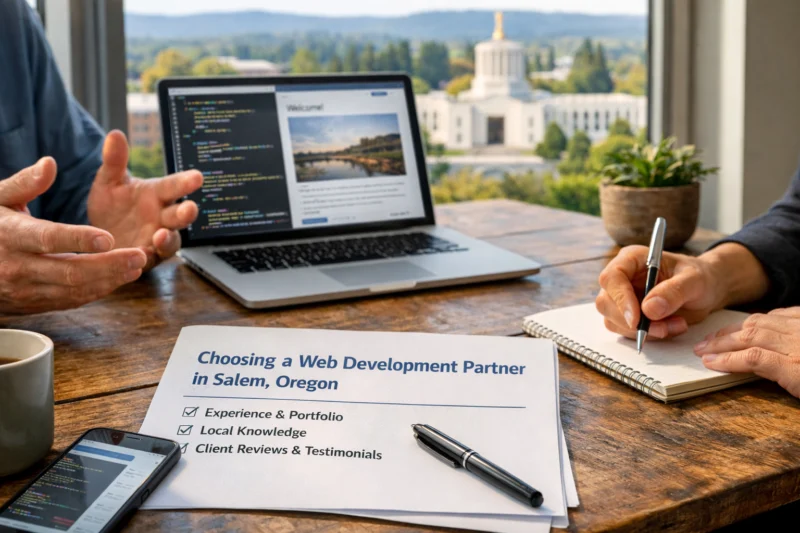
Local communication and accountability can also make collaboration easier. Being able to meet in person, align on priorities faster, or review work with less friction can save time for some teams. But the real business outcome is not convenience for its own sake; it is a clearer process, fewer misunderstandings, and faster decisions. If a remote partner delivers stronger strategy and support, that can easily outweigh a local option with weaker execution.
For businesses that want a more practical view, local relevance should be treated as one factor among many, not the deciding factor. The best partner is the one that understands your audience, can execute cleanly, and is easy to work with after launch. That is especially true when your goals involve content growth, lead generation, or evolving service pages rather than a static brochure site.
Red flags that suggest a web partner is a poor fit
Promised timelines that are unrealistically fast or prices that feel too good to be true are the first obvious warning signs. Good web projects require discovery, planning, content review, build time, testing, and approval cycles. If someone implies that all of that can be compressed without consequence, they are probably reducing scope, skipping process, or planning to make up the difference later with change requests.
A second red flag is a lack of clear process for discovery, revisions, approvals, and post-launch support. If the vendor cannot explain how decisions are made, who approves what, and how fixes are handled after launch, the project will likely become chaotic. Weak communication also shows up as generic answers, inconsistent follow-up, or a tendency to avoid direct questions about ownership and support. The best partners welcome these questions because they know good process lowers risk.
Another subtle issue is polished language without specifics. Some proposals sound sophisticated while remaining vague about deliverables, technical choices, or assumptions. That kind of language can mask gaps that only become visible once the project is underway. In many cases, the buyer could have spotted the problem early by asking for examples, naming the support model, or requesting a sample workflow. Poor fit often appears before a contract is signed if the questions are detailed enough.
One practical edge case is the vendor who is excellent at visuals but weak at operations. That person may be ideal for a brand campaign but not for a business website that needs stability, CMS training, and clean handoff. Another is the technically strong developer who cannot communicate tradeoffs in plain English. Both can create friction. The right partner is the one whose strengths line up with your most important risks.
Frequently Asked Questions About web development in Salem, Oregon
How do I choose a web development company in Salem Oregon?
Choose based on goals, relevant portfolio examples, process, communication, support, and pricing transparency. The best partner should understand what your site needs to accomplish and be able to explain how they will get there.
What should I ask a web developer before hiring?
Ask how they handle discovery, timeline, revisions, ownership, maintenance, and content support. You should also ask for examples of similar work and how they measure success after launch.
How much does web development cost in Salem Oregon?
Cost depends on scope, integrations, content needs, custom features, and support expectations. A small brochure site is usually priced very differently from a lead-generation site or a custom platform with multiple workflows.
Is a local Salem web developer better than a remote agency?
Not always. A local partner can be easier to meet with and may better understand the area, but a remote agency can still be the better choice if it offers stronger strategy, technical depth, or support.
What should be included in a web development proposal?
A good proposal should include deliverables, scope, timeline, responsibilities, assumptions, revision limits, launch details, and support terms. If those items are missing, the project may be hard to compare and even harder to manage.
How long does a business website project usually take?
Most projects take longer than buyers expect because content, approvals, and revisions add time. The exact timeline depends on scope, responsiveness, and how much strategy and custom work are involved.
What are the biggest mistakes when hiring a web developer?
The biggest mistakes are price-only decisions, vague scope, weak communication, and ignoring post-launch support. Another common issue is not defining business goals before asking for quotes.
Do I need ongoing website maintenance after launch?
Yes, because websites need updates, backups, security checks, and occasional fixes. Without maintenance, technical issues and outdated content can quietly reduce performance and trust.
How can I tell if a portfolio is actually good?
Look for results, relevance, usability, and complexity rather than just appearance. A strong portfolio should show that the work solved a real business problem and can be maintained over time.
What if my Salem business needs more than just a website?
Then you should look for a partner who can handle strategy, integrations, content support, and long-term growth planning. That is especially important when the site needs to connect with CRM tools, booking systems, or campaign landing pages.
Conclusion
The best choice for Web Development Salem Oregon is not the cheapest option, the fastest option, or the prettiest option alone. It is the partner whose process, proof, scope clarity, and support model match your business goals and your team’s capacity. When you evaluate fit, ask better questions, and compare actual deliverables, you reduce the risk of hidden costs and post-launch frustration.
For Salem businesses, local relevance can help, but competence and accountability matter more than geography. Review portfolios carefully, check for strategic thinking, and compare 2–3 qualified partners before deciding. If you want to move forward efficiently, build a short vendor checklist, request a consultation, or ask for a proposal that clearly defines scope and ownership before you commit.
Updated April 2026