
Professional web design Salem Oregon matters because your website directly affects how many local prospects trust you, contact you, and choose you over competitors. In 2026, a website is not just branding; it is a revenue asset, a sales tool, and a credibility signal that can either accelerate growth or quietly suppress it.
For Salem businesses competing in a city-based market, the difference between a polished but strategic site and a generic template can show up in lead volume, conversion rate, and long-term operating costs. If you are evaluating professional web design Salem Oregon for your business, this guide will help you understand what quality really looks like, how to avoid expensive mistakes, and how to choose an approach that supports growth instead of creating rework later.
Contents
- 1 Why web design quality affects long-term growth for Salem businesses
- 2 What professional web design in Salem Oregon actually includes
- 3 How to choose the right professional web design approach in Salem Oregon
- 4 Key traits to look for when evaluating a web design partner
- 5 Common mistakes businesses make with Salem Oregon web design projects
- 6 Advanced considerations most guides get wrong
- 7 What to expect from the process of getting professional web design in Salem Oregon
- 8 Local SEO and location relevance for Salem-area businesses
- 9 Questions to ask before hiring for commercial web design
- 10 Frequently Asked Questions About professional web design Salem Oregon
- 10.1 How much does professional web design in Salem Oregon usually cost?
- 10.2 Is a custom website better than a template?
- 10.3 How long does a professional website project take?
- 10.4 What makes a website look professional to local customers?
- 10.5 Do I need SEO and web design together?
- 10.6 How do I know if my current site needs a redesign?
- 10.7 Can a small Salem business compete with larger companies online?
- 10.8 What should be ready before starting a website project?
- 10.9 What are the biggest red flags in a web design proposal?
- 10.10 What is the best long-tail approach for service businesses in Salem?
- 11 Conclusion
Why web design quality affects long-term growth for Salem businesses
Web design quality affects long-term growth because visitors decide quickly whether your business feels trustworthy, capable, and easy to work with. In Salem, where buyers often compare multiple local providers in a short window, your site is frequently the first proof point they use to judge professionalism before they ever call or submit a form.
That first impression matters because design influences more than aesthetics. It affects conversion rate, lead volume, and whether people understand what you do within a few seconds. A clean page structure, clear messaging, and mobile-friendly layout can move a visitor from curiosity to action. A cluttered or dated site does the opposite, even if the business behind it is highly capable in real life.
Long-term growth also depends on how much ongoing maintenance the site will require. A site built with weak structure often needs constant patchwork fixes, frequent redesigns, and manual workarounds when the business expands. By contrast, a site planned for scalability can support new services, service area pages, and future campaigns with less friction. That is why SEO-focused web design is not just a marketing preference; it is a practical way to reduce rework while improving visibility and conversions over time.
The deeper point most guides miss is that “pretty” design can still underperform if it does not help people make decisions. A visually impressive homepage that fails to answer pricing, service fit, trust, or next steps may generate attention without generating revenue. Salem customers do not reward decoration alone; they reward clarity, relevance, and confidence.
For local companies, that is especially important because your website sits inside a regional comparison process. If your competitor’s site explains services more clearly, loads faster on mobile, and makes contact easier, they may win the lead even if your business is better. The business case for better design is not abstract; it is about reducing friction in the buying process.
What professional web design in Salem Oregon actually includes
Professional web design in Salem Oregon includes strategy, visual design, user experience, mobile responsiveness, performance, SEO-friendly structure, and conversion-focused page layout. It is not just about choosing colors and fonts; it is about building a site that supports business goals and customer behavior from the first visit to the final inquiry.
A professional project usually starts with business discovery. That means understanding services, target customers, service areas, differentiators, and the action you want visitors to take. From there, the site structure is planned so that important pages are easy to reach, messaging is aligned with buyer intent, and the design reinforces trust instead of distracting from it. Good design is inseparable from content structure because navigation, headings, and page hierarchy shape how users read and act.
This is where small business site strategy becomes a commercial advantage. A local contractor, law firm, medical practice, or specialty service company does not need the same site architecture as a national brand, but it does need a clear path to inquiries, calls, bookings, or quote requests. The best projects balance creativity with practical outcomes, especially for service-based businesses that depend on local lead generation.
What separates professional work from template-only or DIY builds is business fit. A polished template can look fine on launch day but still fail if it cannot support specific service pages, local search visibility, or conversion goals. Professional work aligns brand, content, structure, and technical execution so the site can perform, not just exist.
Another nuance is that “professional” should be judged by usefulness, not by visual polish alone. A site with modest visuals but strong content hierarchy, fast loading, and a well-planned inquiry path can outperform a flashy but confusing build. That is why experienced teams also think about support pages, case studies, FAQs, and trust signals as part of the design system, not as afterthoughts.
Technical quality also matters. Behind the scenes, performance-driven web development helps make the design fast, stable, and easier to maintain as the business grows. The best websites are built so new pages, forms, or content updates do not break the overall experience.
For accessibility and usability, professional teams also apply accessible design best practices so people can navigate the site more easily, including users with screen readers or keyboard-only navigation. That improves both inclusivity and long-term site quality.
How to choose the right professional web design approach in Salem Oregon
The right web design approach depends on your budget, growth plan, timeline, and how much differentiation your business needs. For many Salem companies, the choice is between custom design, semi-custom design, and template or DIY builds guided by a professional.
Custom design is best when the business needs strong brand differentiation, complex service structures, or a site that will support ongoing expansion. Semi-custom design works well when you want a more efficient build using a proven framework, but still need tailored content, layout, and conversion strategy. Template or DIY builds can be acceptable for very early-stage businesses or limited launches, but they often become expensive later if they require major rework to improve usability, performance, or content structure.
When comparing options, think about speed, flexibility, uniqueness, and maintainability together. A lower-cost starting point may be reasonable if the business is validating an offer or needs a fast launch, but it becomes a bad deal if the site cannot scale with new services, local pages, or SEO work. That is why budget-friendly design options should be evaluated as a starting strategy, not automatically as the final strategy.
| Approach | Best for | Main advantage | Main tradeoff |
|---|---|---|---|
| Custom design | Established businesses, competitive markets, growth plans | High flexibility and brand alignment | Higher cost and longer timeline |
| Semi-custom | Small to mid-sized businesses needing balance | Efficient build with strong structure | Less unique than fully custom |
| Template or DIY | Very small budgets or early validation | Fast and low upfront cost | More rework risk and weaker differentiation |
The best decision also depends on how much content complexity you have. A simple local business with a few services may succeed with a leaner framework. A business serving multiple service areas, industries, or buyer types often needs a more strategic architecture from the start. For many teams, the smartest path is to start with a focused structure and expand later with measurable improvements rather than trying to build everything at once.
It is also worth remembering that a cheaper site can become more expensive if it generates fewer leads or requires a full redesign within a year. The hidden cost is often lost conversions, not just repair time. That is why custom brand-driven websites are often worth the investment when the site is expected to play a central role in revenue growth.
Key traits to look for when evaluating a web design partner
The best web design partner is not the one with the flashiest portfolio alone; it is the one whose work shows structure, clarity, speed, and a genuine understanding of conversion. A strong portfolio should demonstrate more than attractive visuals. Look for pages that guide attention well, create trust quickly, and make the next step obvious.
Before design begins, a capable provider should ask discovery questions about business goals, ideal customers, service priorities, competitive positioning, and how the website will support sales. If the conversation stays at the level of colors, inspiration sites, and general aesthetics, the project may lack the strategy needed for long-term value. That is especially important when choosing a design partner because the relationship often affects not just the launch but also future edits, support, and expansion.
Local and industry understanding also matters. Salem-area service businesses benefit when a provider understands service area pages, location-specific messaging, and how local buyers evaluate trust. A provider who understands your market can recommend page structure and content patterns that fit real customer behavior instead of generic design trends. That is one of the reasons many businesses seek mobile responsive layouts and localized page structure as part of the same project.
Communication and process are equally important. Ask how revisions are handled, what the timeline looks like, who owns the design files, and what happens if you need changes after launch. A good partner should be transparent about handoff, asset ownership, and support options. If those details are vague, the project may look smooth early and become difficult later.
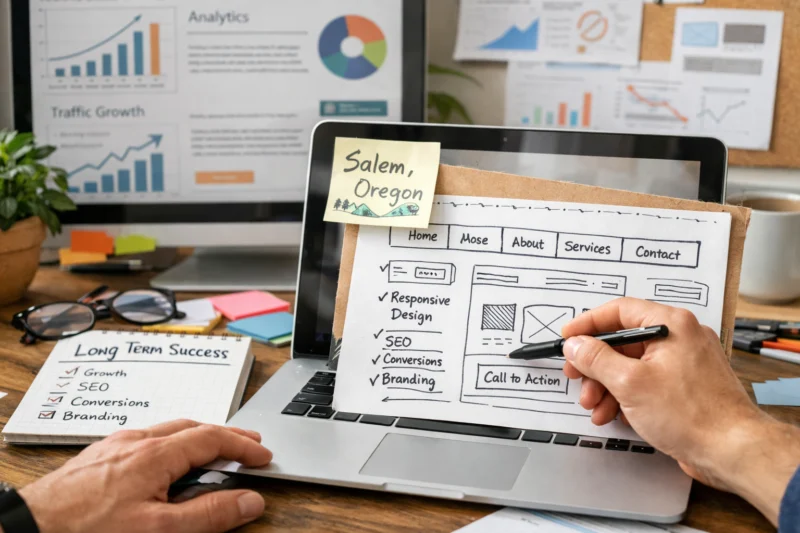
The deeper issue is that some vendors sell visuals but cannot explain business impact. If a provider cannot describe how a layout improves inquiry rates, how a service page should be structured, or why certain pages matter more than others, they may not be the best long-term partner. In commercial web design, clarity of thinking matters as much as visual skill.
Common mistakes businesses make with Salem Oregon web design projects
One of the biggest mistakes is choosing based on price alone and treating the website as a commodity. Low quotes can be attractive, but they often exclude strategy, content planning, mobile optimization, or post-launch support. That can lead to a site that looks acceptable but does not perform where it matters most: leads and trust.
Another common mistake is treating the website like a brochure instead of a lead-generating asset. A brochure can afford to be static and general. A commercial website cannot. It needs clear calls to action, useful page structure, and enough trust-building content to help visitors take the next step. If the site does not make it easy to inquire, book, or request a quote, it is leaving money on the table.
Many businesses also ignore mobile experience, speed, and navigation clarity. That is costly because a large share of local visitors will first encounter the site on a phone. Slow pages, cramped layouts, and confusing menus cause people to leave before they ever learn what the business offers. Strong clear navigation structure reduces that friction and helps users find what they need quickly.
Another failure pattern is overloading the site with too much content, too many calls to action, or weak messaging. A homepage should not try to solve every question at once. It should guide the visitor through a logical path. Too much clutter creates indecision, and indecision reduces conversions.
The hidden cost most guides understate is redesign churn. A site built without a growth plan may need a major rebuild sooner than expected, especially when the business expands services or wants better local visibility. In practice, the cheapest project today can become the most expensive project next year if it cannot support the next stage of the business.
Advanced considerations most guides get wrong
Many web design guides overvalue trendy visuals and undervalue conversion structure. In service industries, the page layout that best supports trust and action is often more important than the newest visual effect. Visitors want to know what you do, where you serve, why they should trust you, and how to contact you. That sequence matters more than decorative design flourishes.
Content hierarchy should also vary by page type. A homepage needs concise positioning and directional links. A service page needs explanation, benefits, objections, and a clear next step. A location page needs local relevance, service-area clarity, and supporting trust signals. If every page is designed the same way, the site becomes generic and less effective. This is where the best SEO-focused web design and content planning work together.
Search visibility and design should never be treated as separate workstreams. Headings, internal links, crawlable structure, and local relevance all affect how well the site supports discovery. A strong site can make it easier for search engines and AI systems to understand what the business does and who it serves. If the structure is unclear, even good content can be harder to surface.
Technical performance is another area where many projects underperform. Speed, accessibility, and maintainable code all influence long-term outcomes. Fast pages create better user experiences, and accessible structures support broader audiences while improving site quality. For technical guidance, official references such as Google Search Central and WCAG are useful benchmarks for modern web standards, while the U.S. Web Design System shows how structured, usable interfaces can be built for clarity.
The most important nuance is that effective sites often need fewer features, not more. If each element does not support a commercial goal, it creates noise. The best sites simplify decisions, reinforce trust, and make action feel easy. That restraint is often what separates high-performing business sites from crowded, underperforming ones.
What to expect from the process of getting professional web design in Salem Oregon
A professional website project usually follows a clear path: discovery, planning, sitemap development, wireframes, design, development, testing, launch, and post-launch support. Each phase exists to reduce risk and make the final site more usable, maintainable, and aligned with business goals.
Discovery and planning are where the project should begin. The team needs to understand your services, customers, goals, competitive positioning, and content priorities before any visuals are finalized. If the process starts with color palettes or homepage mockups, the project may drift away from business needs. The most efficient projects often begin with small business site strategy, not visual preferences.
Clients can help the process move faster by preparing goals, brand assets, service descriptions, example websites they like, and any existing content or photography. It also helps to define who approves feedback, what success looks like, and which pages are most important at launch. Vague feedback is one of the most common causes of delay because design teams cannot infer priorities that were never clearly stated.
Testing and launch readiness matter just as much as design. Redirects, forms, analytics, mobile checks, and page speed review should all be part of final quality assurance. If a site goes live without those pieces in place, traffic can be lost and reporting becomes less reliable. A professional process also includes post-launch support so the business is not left alone when updates, fixes, or refinements are needed.
In practice, the smoothest projects are those where business goals are clear before the first layout is built. That reduces revisions, improves decision-making, and makes the final site more effective because every element has a purpose. It also makes future expansion easier because the structure was planned intentionally from the start.
Local SEO and location relevance for Salem-area businesses
Local SEO and location relevance help Salem-area businesses get discovered by people who are actually nearby and ready to buy. Design and structure matter because they shape how clearly your site communicates where you serve, what you offer, and whether a local visitor should trust you.
Location signals work best when they are integrated naturally into the site. That means clear contact information, service area descriptions, locally relevant page copy, and pages that reflect real customer needs in Salem and nearby communities. When these elements are built into the structure rather than forced into the copy, the website feels more credible and more useful to both users and search systems.
Design choices can support local visibility in subtle but important ways. Service pages should be easy to find from the main navigation. Contact details should be obvious. If you serve nearby areas, dedicated location or service area pages can help clarify relevance without making the site feel repetitive. The goal is to help the right local customer know immediately that your business is a fit.
That is also where neighborhood references and regional language can help, as long as they are accurate and not stuffed into every paragraph. Overdoing location keywords can make the content feel spammy and less trustworthy. The better approach is to create a natural structure that reflects how local buyers search and evaluate providers. For businesses that need region-specific demand generation, custom brand-driven websites can provide the flexibility needed to support both local relevance and stronger conversion paths.
When done well, local relevance builds trust. People want to know that a business understands their area, responds quickly, and can actually serve them. A site that communicates that clearly can outperform a larger competitor with a more generic presentation.
Questions to ask before hiring for commercial web design
The most important questions before hiring a web design provider are about outcomes, process, ownership, and support. A good commercial project should be judged by business impact, not just by whether the final site looks polished.
Start by asking how the provider defines success. Do they focus on inquiries, conversions, time on page, service clarity, or search visibility? The answer should connect design decisions to real business goals. Then ask what happens after launch: do they offer maintenance, updates, training, or a handoff process that leaves your team able to manage the site?
It is also smart to ask how they handle SEO basics, mobile testing, and performance review. A strong provider should be able to explain how page structure, titles, headings, and responsive behavior are considered before launch. Those are not optional extras; they are part of a site that is meant to grow over time. You should also ask about content strategy and how the site will support a local buyer’s decision-making process.
One of the most overlooked questions is ownership. Make sure you know who controls hosting, files, platform access, analytics, and backups. If the business does not control critical assets, future changes can become costly or complicated. This is where budget-friendly design options can be smart only if they still preserve business ownership and long-term flexibility.
If a provider cannot answer these questions clearly, that is a warning sign. A commercial website project needs more than visual design; it needs accountability, structure, and a plan for ongoing value.
Frequently Asked Questions About professional web design Salem Oregon
How much does professional web design in Salem Oregon usually cost?
Pricing depends on scope, content complexity, custom functionality, and whether strategy, copy support, and SEO planning are included. A cheap quote may omit important pieces like mobile optimization, revision rounds, or launch support, which can create higher costs later.
Is a custom website better than a template?
Custom is usually better when you need stronger differentiation, more flexibility, or a site that will grow with the business. Templates can work for simple launches, but they often require more rework if the business expands or needs better conversion structure.
How long does a professional website project take?
Timelines vary based on scope, content readiness, and how quickly feedback is provided. A straightforward site can move faster, while projects with multiple service pages, custom features, or content development take longer because planning and revisions matter.
What makes a website look professional to local customers?
Local customers notice clarity, trust signals, mobile usability, and whether the site quickly explains what the business does. A professional site makes contact easy, uses consistent branding, and helps visitors feel confident that the company is legitimate and responsive.
Do I need SEO and web design together?
Yes, because structure, headings, page hierarchy, and performance affect both usability and visibility. When design and SEO are planned together, the site is easier for people to use and easier for search systems to understand.
How do I know if my current site needs a redesign?
Common signs include weak mobile experience, poor lead generation, outdated branding, slow load times, and a structure that is hard to update. If the site is preventing you from making changes quickly or converting visitors into inquiries, a redesign may be overdue.
Can a small Salem business compete with larger companies online?
Yes, if the business has stronger positioning, clearer messaging, and a better user experience. A smaller company can often win locally by making it easier for visitors to understand services, trust the brand, and take the next step.
What should be ready before starting a website project?
You should prepare goals, service details, brand assets, content inputs, examples of styles you like, and access to existing accounts or platforms. The more clearly you define the business objective and decision makers, the smoother the project will run.
What are the biggest red flags in a web design proposal?
Watch for vague deliverables, no strategy phase, unclear ownership of assets, and promises without measurable outcomes. If the proposal focuses only on visuals and ignores structure, performance, or post-launch support, it may not be a strong commercial fit.
What is the best long-tail approach for service businesses in Salem?
A strong long-tail approach combines service pages, local relevance, and conversion-focused design. When the site clearly matches specific services to a local audience and makes contact easy, it creates a better path to qualified leads.
Conclusion
Professional web design Salem Oregon is a growth investment, not a cosmetic expense. For local businesses, the right site improves trust, increases lead quality, and creates a stronger foundation for long-term marketing and expansion.
The best decisions are based on strategy, conversion focus, local relevance, performance, and maintainability. If you are comparing options, look beyond surface design and ask whether the site will support your business goals a year from now, not just today.
The smartest next step is to compare approaches, request a consultation, or review your current site before committing to another round of guesswork. In a competitive local market, the right website can become one of your most valuable business assets.
Updated April 2026