

E-Commerce Web Design Salem OR is the service of building an online store that turns Salem and regional visitors into buyers through clear navigation, strong product presentation, mobile-friendly checkout, and trustworthy store experiences. For Salem businesses in 2026, that matters because the stores winning online are not just polished—they are easier to shop, easier to trust, and easier to manage.
If you are evaluating a partner, this guide will help you compare conversion-focused design, platform choices, features, process quality, and long-term support so you can choose an e-commerce site that actually increases completed orders. A strong store can improve mobile shopping, reduce abandoned carts, and make daily operations simpler for the owner, which is why Salem ecommerce design should be judged by revenue impact, not visuals alone.
Contents
- 1 Why Salem e-commerce websites need to be built for conversion, not just aesthetics
- 2 What to look for in E-Commerce Web Design Salem OR when choosing a partner
- 3 How to get better sales from your online store: the practical e-commerce design process
- 4 Platform choices for Salem e-commerce projects: what to compare
- 5 Must-have features in a sales-focused online store
- 6 Local SEO and regional trust signals for Salem-based stores
- 7 Common mistakes that hurt e-commerce sales in Salem OR
- 8 Advanced considerations most e-commerce design guides miss
- 9 Salem OR e-commerce design options: in-house, freelancer, or agency
- 10 Frequently Asked Questions About E-Commerce Web Design Salem OR
- 10.1 How much does e-commerce web design cost in Salem OR?
- 10.2 How long does a Salem e-commerce website take to build?
- 10.3 What platform is best for small e-commerce businesses?
- 10.4 Do I need custom design or can I use a template?
- 10.5 How do I know if my online store needs a redesign?
- 10.6 Can an e-commerce site help me sell to customers outside Salem?
- 10.7 What features matter most for checkout conversion?
- 10.8 How do I choose the right e-commerce designer in Salem?
- 10.9 What should I ask before hiring for E-Commerce Web Design Salem OR?
- 10.10 What is the best way to improve online sales after launch?
- 11 Conclusion
Why Salem e-commerce websites need to be built for conversion, not just aesthetics
A visually attractive store is not the same as a store that generates revenue. Conversion-focused design guides shoppers toward products, answers objections quickly, and removes friction from cart and checkout.
In Salem, that distinction matters because local and regional shoppers often compare you against larger retailers with faster sites, cleaner category structures, and more familiar buying flows. If your product pages are unclear or your checkout creates hesitation, design polish will not save the sale. This is why high-converting website structure is more important than decorative homepage effects or oversized banners.
Buyer behavior is shaped by navigation, trust signals, speed, and product discovery. Shoppers want to find the right item quickly, understand pricing and shipping, and feel confident that the purchase is safe. When a store makes that process feel effortless, conversion improves. When a store forces too many clicks, hides policies, or slows down on mobile, shoppers leave before they ever reach payment.
Custom design helps, but only when it supports product pages, load speed, and checkout flow. Many businesses assume a custom storefront guarantees stronger sales, yet a custom design with weak merchandising or clumsy cart logic still underperforms. The best stores combine branding with buying psychology, and they treat every page as part of the selling process. That is the practical difference between a design project and a revenue project. For related guidance on ecommerce design best practices, the planning stage should always start with conversion goals, not color palettes.
What to look for in E-Commerce Web Design Salem OR when choosing a partner
The best partner will show conversion focus, platform expertise, mobile-first execution, and speed optimization, not just attractive mockups. They should be able to explain how design decisions affect sales.
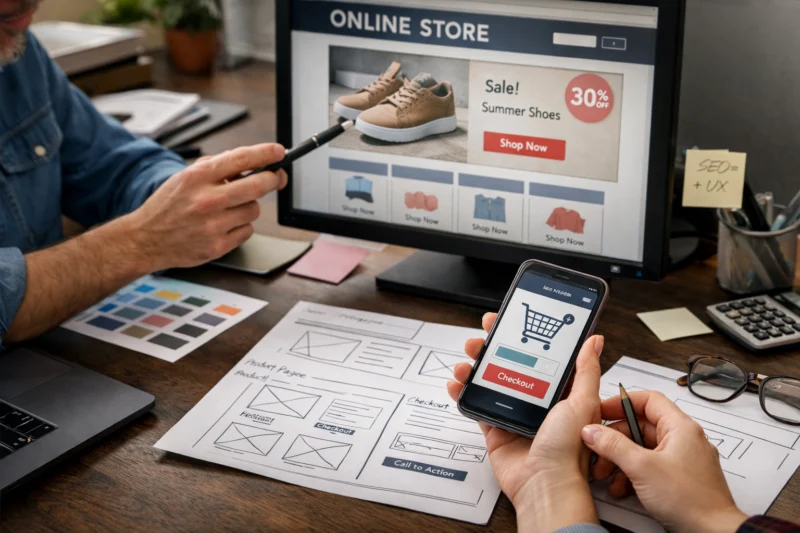
Start by reviewing portfolios for results, not only appearance. Ask whether the agency can point to improved product discovery, lower bounce rates, stronger checkout completion, or better average order value. A trustworthy provider should also show a structured process: discovery, information architecture, design, development, testing, and launch support. That process reveals whether they understand the business side of e-commerce or only the visual side.
Another important distinction is between design-only vendors and full-service e-commerce specialists. A design-only team may create a nice storefront, but a full-service team considers search filters, category organization, inventory logic, shipping rules, and integrations. That difference matters because sales problems often live below the surface. If a provider cannot speak clearly about merchandising, cart flow, or customer decision-making, they may miss the factors that determine whether people buy.
Look for evidence that they understand purchasing behavior, especially for Salem businesses competing with regional and national stores. The right partner should know how to reduce friction for first-time buyers while also supporting repeat customers. They should also be comfortable discussing small business website development in practical terms: budget, maintenance, content updates, and how the store will grow over time. If the conversation stays focused on visuals alone, the partner is likely not thinking like a merchant.
How to get better sales from your online store: the practical e-commerce design process
The best e-commerce builds follow a clear process: discovery, architecture, design, development, testing, launch, and post-launch refinement. That sequence helps the store reflect how people actually shop.
Discovery is where conversion goals should be defined before any design begins. The team should identify the products that matter most, the audience segments, average order patterns, shipping expectations, and the actions that count as success. Without those answers, design choices become subjective and the store is more likely to favor internal preferences instead of customer behavior. This is also where page hierarchy should be planned around how users browse, search, compare, and buy.
Site architecture should be built to support product categories and decision paths. For example, a business with a small catalog may need fewer layers and stronger product storytelling, while a larger catalog may need filters, comparison logic, and more refined category groupings. Mockups should then translate that structure into a shopping experience that works on desktop and mobile. Good teams also factor in approvals early, because stakeholder input can improve the build when it is structured, but slow it down when every page becomes a debate. Clear review milestones keep the project moving.
Testing and launch are not the end. The best stores use post-launch insights to improve product pages, calls to action, and checkout. This is where merchants can improve checkout conversions by watching where users hesitate, which devices convert poorly, and which products need stronger descriptions or shipping clarity. A store that continues learning after launch usually outperforms one that treats launch day as the finish line. If your team is evaluating the process itself, a good internal reference topic is streamlined store navigation because navigation quality affects nearly every later decision.
Platform choices for Salem e-commerce projects: what to compare
The right platform depends on budget, catalog complexity, growth plans, and how much control the business needs. For many Salem retailers, simpler platforms are enough; more complex systems are only worth it when the business truly needs them.
Hosted platforms such as Shopify or similar services are often the best fit for smaller stores that want a dependable setup with lower maintenance. They are usually faster to launch, easier to manage, and better for teams that do not want to handle deep technical upkeep. Open-source platforms can offer more flexibility and customization, but they also require more maintenance, more hosting decisions, and more technical oversight. Headless setups and custom builds may be appropriate for businesses with demanding content structures, multi-store workflows, or specialized integrations, but they come with higher complexity and cost.
The key tradeoff is control versus simplicity. If a Salem business has a focused catalog, standard shipping, and modest growth expectations, a complex platform is often unnecessary overhead. The more advanced the stack, the more maintenance, coordination, and troubleshooting it tends to require. That overhead can reduce speed to market and consume budget that would have done more good in better product photography, improved descriptions, or stronger paid traffic campaigns.
Here is a practical comparison:
| Approach | Best for | Main strengths | Main tradeoffs |
|---|---|---|---|
| Hosted platform | Small to mid-sized stores | Fast launch, easier updates, lower maintenance | Less deep customization |
| Open-source build | Stores needing flexibility | More control, broader customization | More maintenance and technical management |
| Headless setup | Complex growth-focused businesses | High flexibility and performance potential | Higher cost and complexity |
| Custom development | Unique workflows or advanced logic | Tailored functionality | More time, cost, and support needs |
Most guides overlook the fact that the “best” platform is often the one the team can operate well after launch. A less glamorous option that is easy to maintain can outperform a sophisticated build that the merchant struggles to update. If you need additional decision support, compare the project to accessible shopping experiences so the platform choice also supports usability, not just technical ambition.
Must-have features in a sales-focused online store
A sales-focused store must load quickly, work well on mobile, and make it easy to move from browsing to checkout. If shoppers cannot find products or complete payment without friction, the site is underperforming.
Start with product discovery. Categories should be clear, filters should match real shopping decisions, and search should return useful results quickly. Product pages need strong photos, concise copy, pricing clarity, stock visibility, and a compelling call to action. Payment options should feel familiar and secure, and shipping details should be easy to find before the cart stage. These features matter because they reduce uncertainty at the exact moments when shoppers are deciding whether to continue.
Trust features are just as important. Secure checkout indicators, return policies, business contact details, and reviews all help reduce abandonment. For Salem businesses, local pickup or local delivery options can also strengthen confidence, especially for first-time buyers who want a nearby fallback. Real-time inventory visibility helps prevent disappointment and reduces customer service issues after purchase.
Some features look impressive but do little for conversion. Overly complex animations, unnecessary homepage carousels, or oversized pop-ups can distract shoppers from the product. The goal is not to pack in every possible function; it is to support the buying journey. In many cases, better merchandising and clearer copy deliver more revenue than flashy extras. Well-planned features align with mobile-first store layouts and make the checkout path easier to complete on smaller screens. The underlying structure should still reflect ecommerce design best practices rather than trendy add-ons that slow people down.
Local SEO and regional trust signals for Salem-based stores
Local geography can strengthen credibility because nearby shoppers often trust businesses that feel real, reachable, and clearly rooted in the area. Salem-specific signals help support that confidence.
These signals include consistent business information, local service areas, store pickup availability, and clear location cues on key pages. Even if a business sells beyond Salem, local trust can still improve conversion because it gives shoppers a sense of accountability. People are often more comfortable buying from a company that shows where it operates, how to contact it, and whether it serves their region directly. That is especially true for first-time buyers who need a reason to believe the store is legitimate.
Local signals also support product and shipping expectations. If a store can show in-stock pickup in Salem, fast regional delivery, or shipping coverage across Oregon, it removes uncertainty early in the buying journey. That matters for products where timing, size, or availability influence the sale. A business does not need to be limited by geography to benefit from local trust; instead, it can use Salem identity as a credibility anchor while still serving broader markets. This is one reason a well-planned local store can complement regional SEO, branded search, and direct traffic strategies. When that messaging is consistent, it can reinforce Salem ecommerce design without feeling forced.
The deeper mistake many stores make is treating local SEO as a ranking tactic only. In reality, it is also a conversion tactic. When shoppers see familiar place names, local pickup options, and transparent contact details, they are more likely to finish the purchase. Local trust is not just about discovery; it also helps close the sale.
Common mistakes that hurt e-commerce sales in Salem OR
The most common failures are cluttered navigation, slow pages, weak product descriptions, and checkout steps that ask too much too soon. Each one creates friction that lowers sales.
Generic templates often underperform because they are not adapted to the business’s actual products or customer behavior. A template may look polished, but if the category structure is poor or the product pages fail to answer key questions, shoppers will still leave. Speed is another common issue. Large images, excessive scripts, and unnecessary plugins can make pages slow on mobile, where many customers now browse first and buy quickly.
Shipping clarity is another frequent problem. If a shopper cannot tell how much shipping costs, how long delivery takes, or whether pickup is available, they may abandon the cart and shop elsewhere. Trust issues matter too. Missing policies, vague contact details, and a lack of reviews create hesitation. Many stores also make the mistake of adding too much homepage content, assuming more information always helps. In practice, too much content can bury product discovery and distract from the path to purchase.
Teams often want to avoid design mistakes by adding more banners, more copy, or more sections, but that does not always improve revenue. The better fix is usually simplification: clearer hierarchy, better product pages, and fewer dead ends. If a site feels busy but not helpful, it probably needs strategic refinement rather than a full visual overhaul. This is why mobile-first store layouts matter so much; the mobile experience is often where the weakest conversion losses become obvious.
Advanced considerations most e-commerce design guides miss
Not every store has a simple catalog and a standard checkout. High-SKU stores, B2B ordering, subscriptions, bundles, and complex shipping rules require design decisions that go beyond basic storefront templates.
A large catalog may need stronger filters, better faceted search, and clearer category relationships so shoppers do not get lost. B2B stores often need account-based pricing, repeat-order functionality, invoice workflows, or minimum purchase logic. Subscription products need renewal visibility, easy modification, and a subscription management flow that does not frustrate customers. Bundle products need thoughtful presentation so customers understand the value without confusion. In each case, the design should adapt to how the order is made, not just how the homepage looks.
Repeat buyers and first-time buyers also need different experiences. New visitors want trust, clarity, and education. Returning customers often want speed, reorder convenience, and fewer steps. A good store balances both without making either group work too hard. Analytics should be part of that process from the start, with event tracking, funnel review, and A/B testing built into the plan. Those tools help identify which changes actually improve revenue instead of relying on assumptions.
What most guides miss is that performance, accessibility, and scalability all affect future revenue. A store that is inaccessible excludes buyers. A slow store depresses conversion. A site that cannot scale may need a costly rebuild too early. These are not just compliance or technical concerns; they directly affect income over time. For that reason, the design process should also support future content updates and growth planning, especially when the site is part of broader small business website development rather than a one-off launch.
Salem OR e-commerce design options: in-house, freelancer, or agency
The right engagement model depends on budget, internal bandwidth, and how strategic the store needs to be. Each option has a valid use case, but not every option fits every stage.
An in-house team works best when the business has recurring website needs, technical staff, and enough order volume to justify ongoing optimization. Freelancers can be a smart choice for smaller projects, faster turnarounds, or specific tasks such as theme customization or product page improvements. Agencies are usually the best fit when the business wants strategy, design, development, and post-launch support coordinated by one team. That broader support often matters most for stores that need conversion planning, integrations, and future growth strategy.
Cost is only one factor. Communication, speed, strategic depth, and long-term support should also influence the decision. A freelancer may be less expensive upfront, but if the store later needs redesigns, merchandising improvements, or technical fixes, the business may end up managing multiple vendors. An agency can be more expensive, but it may reduce risk when the store has a lot riding on the launch or when the product catalog is expected to grow.
The hidden risk is choosing the cheapest option when the site needs ongoing conversion optimization. If the store is not just being built but needs to keep improving after launch, the support model matters as much as the build itself. The best choice is the one that matches your selling complexity, not just your budget. If the store requires frequent updates or technical coordination, a more complete team usually pays off.
Frequently Asked Questions About E-Commerce Web Design Salem OR
How much does e-commerce web design cost in Salem OR?
Pricing depends on scope, platform, custom features, product count, and how much content needs to be created or migrated. A simple storefront with a limited catalog costs far less than a store with custom integrations, advanced filters, or complex shipping logic.
How long does a Salem e-commerce website take to build?
Timelines vary based on the number of pages, product data readiness, and approval speed. A straightforward build can move quickly if product photos, descriptions, and decisions are ready early, while delays usually come from content gaps or repeated revisions.
What platform is best for small e-commerce businesses?
The best platform is usually the one that fits your budget, technical comfort level, and growth plans. Smaller businesses often benefit from hosted platforms because they are easier to maintain, but the right answer depends on catalog complexity and update needs.
Do I need custom design or can I use a template?
Templates are often enough when the catalog is simple and the brand only needs a clean, reliable shopping experience. Custom work makes more sense when the store needs stronger differentiation, more conversion control, or product presentation that a template cannot support well.
How do I know if my online store needs a redesign?
Common signs include low conversion rates, poor mobile performance, slow page loads, and checkout abandonment. If traffic is present but orders are weak, the issue is often structure, clarity, or friction rather than traffic volume.
Can an e-commerce site help me sell to customers outside Salem?
Yes. A Salem store can still serve regional or national buyers while using local trust signals to strengthen credibility. Clear shipping options, pickup details, and service-area messaging help buyers outside Salem understand how fulfillment works.
What features matter most for checkout conversion?
The biggest conversion drivers are fewer steps, clear shipping costs, multiple payment options, and visible trust signals. When shoppers feel informed and safe, they are much less likely to abandon the cart at the last minute.
How do I choose the right e-commerce designer in Salem?
Review portfolio quality, process clarity, platform experience, communication style, and whether the team talks about outcomes instead of only aesthetics. A strong partner should explain how they will improve product discovery, checkout flow, and long-term maintainability.
What should I ask before hiring for E-Commerce Web Design Salem OR?
Ask who owns the site after launch, what SEO support is included, how updates are handled, and what post-launch optimization looks like. It also helps to ask how they approach analytics, accessibility, and conversion measurement.
What is the best way to improve online sales after launch?
Use analytics, test changes, and refine product pages based on actual behavior rather than assumptions. The best improvements usually come from iterative updates to navigation, copy, search, checkout, and product presentation.
Conclusion
Sales-focused e-commerce design is about conversion, trust, speed, and usability, not just appearance. The right store makes it easier for shoppers to find products, feel confident, and complete checkout without friction.
For Salem businesses, local credibility and regional fit matter because they help buyers trust the store faster, whether the audience is nearby or spread across a wider market. The best partner will understand the buying journey, the platform tradeoffs, and the features that actually support revenue.
If you are comparing options now, review platform fit, feature priorities, process quality, and long-term support before you commit. A store audit or consultation can reveal where your current site is losing sales and what changes would produce the strongest return.
For additional context on accessibility and web standards, see Web Content Accessibility Guidelines and Google Search Central for official guidance on site quality and discoverability. For business registration and consumer-facing compliance basics, the U.S. Small Business Administration is also a useful reference.
Updated April 2026