

Small business web design Salem Oregon helps a local company turn website visitors into calls, bookings, and sales with a site that looks credible, loads quickly, and makes the next step obvious. If you want to hire an agency or compare website design services in Salem, the real goal is not just a nicer homepage; it is a site that helps you compete with larger brands by matching their clarity, trust, and usability.
That matters now because Salem customers do not spend long comparing options. They scan a site, check whether it feels current, look for proof you serve the area, and decide fast whether to contact you or move on. In practice, your website often decides whether your business gets the lead, especially when prospects are comparing you against bigger competitors with stronger brand recognition. A smart local build can close that gap.
For Salem companies, this usually means a design strategy built around trust, mobile performance, and conversion-ready content. It also means choosing a partner who understands commercial intent, not just layout. The strongest projects connect design, messaging, and small business development so the website does real business work instead of sitting online as a digital brochure.
Contents
- 1 What Salem Small Businesses Need a Website to Do in 2026
- 2 How to Choose the Right Salem Web Design Approach
- 3 Comparing Your Options: DIY, Freelancer, Local Agency, or Full-Service Team
- 4 What Makes a Local Business Site Look Bigger Than It Is
- 5 SEO and Conversion Essentials for Salem Business Websites
- 6 Common Mistakes Small Businesses Make With Web Design in Salem
- 7 Local Credibility Signals That Help You Compete Against Bigger Brands
- 8 Advanced Considerations Most Small Business Web Design Guides Miss
- 9 What to Look For in a Salem Oregon Web Design Partner
- 10 Frequently Asked Questions About Small Business Web Design in Salem Oregon
- 10.1 How much does small business web design in Salem Oregon cost?
- 10.2 How long does it take to build a small business website?
- 10.3 What should a Salem small business website include?
- 10.4 Is a local designer better than a national agency?
- 10.5 Can my existing website be redesigned instead of rebuilt?
- 10.6 How do I make my website compete with bigger brands?
- 10.7 Do I need SEO with web design?
- 10.8 What if I only need a simple website for now?
- 10.9 What are the biggest red flags when hiring a web designer?
- 10.10 How do I know if my website is actually working?
- 11 Final Takeaways: Building a Salem Website That Wins More Business
What Salem Small Businesses Need a Website to Do in 2026
A Salem small business website should generate leads, book appointments, sell services, or build trust fast enough to move a visitor to action. If it does not support one of those outcomes clearly, it is underperforming no matter how polished it looks.
Local buying behavior is different from generic web traffic because Salem visitors want to know you are nearby, responsive, and relevant to their situation. They are not just looking for information; they are looking for a provider they can trust to answer the phone, show up on time, and understand local expectations. That is why Salem web design has to do more than present a brand. It has to remove hesitation.
“Competing with big brands” does not mean matching their budget or scale. It means matching their clarity, structure, and user experience while adding local proof they cannot easily copy. A smaller company can win when it makes the next step obvious, shows real service details, and feels easier to contact than a national competitor. The common mistake is thinking a site is fine because it looks modern, when the real issue is weak trust signals, slow performance, or no clear path from interest to inquiry.
In 2026, users are less patient with friction. If the site makes them hunt for pricing cues, service areas, hours, or contact options, many will leave before you ever know they were interested. That is why the best local websites are built around conversion paths first and visual polish second.
How to Choose the Right Salem Web Design Approach
The right approach depends on your business model, your timeline, and how much revision work you can handle after launch. A DIY site can work for very early-stage companies, but most Salem businesses eventually need professional strategy, especially if the website is meant to support revenue instead of simply exist online.
Service businesses and appointment-based businesses usually need the strongest focus on conversion, mobile flow, and local proof. Retail businesses need product clarity, hours, location cues, and friction-free browsing. Professional services need strong credibility, detailed service pages, and a structure that helps visitors understand expertise quickly. Restaurants and hospitality businesses need visual appeal, simple navigation, and an easy path to reservations or calls. In all of these cases, the choice is not just about design style. It is about how much support you need around content, SEO readiness, and post-launch maintenance.
The hidden cost of a cheap build often appears later, when the business needs revisions, better copy, stronger calls to action, or a page structure that can actually convert. By then, the site may already need cleanup. That is why many owners search for “choose best designer” guidance early: the real decision is whether you want a one-off page build or a partner who understands SEO and conversions and can support growth over time. If you are comparing options, ask whether the process includes strategy, content support, and mobile-first structure, not just theme installation.
The best fit is usually the option that solves the most expensive problem first. For some companies, that is a fast launch. For others, it is a stronger message, better lead flow, or a site foundation that can scale without a rebuild six months later.
Comparing Your Options: DIY, Freelancer, Local Agency, or Full-Service Team
DIY works best when budget is tight, the offer is simple, and you can accept a basic result. It gives you control, but it also puts the burden of strategy, copy, technical setup, and quality control on your team. For a business that only needs a placeholder presence, that may be enough. For a company trying to win against established competitors, it often breaks down in the same places: weak messaging, inconsistent branding, and poor mobile experience.
Freelancers can be a strong middle ground if they have both design taste and commercial judgment. The risk is inconsistency in support. One freelancer may build a clean site quickly, but not handle content cleanup, SEO basics, or post-launch fixes well. That can be fine for a simple project, but it creates problems when the business wants revisions or needs the site to support more complex marketing.
A local agency usually brings more process, more accountability, and a broader skill set. A full-service team is often the best choice for businesses that need strategy, content, design, technical launch support, and ongoing improvements in one place. The tradeoff is cost, but that cost is usually tied to fewer mistakes and less rework later. If your site needs structured growth, Salem web design plus content planning is usually more efficient than stitching together separate vendors.
| Approach | Best For | Strength | Common Breakdown |
|---|---|---|---|
| DIY | Very small or early-stage businesses | Lowest upfront cost | Weak conversion strategy and limited polish |
| Freelancer | Simple sites with moderate budget | Flexible and often faster | Limited support, revision bottlenecks |
| Local agency | Businesses needing local market fit | Better process and accountability | Can be more expensive than a solo build |
| Full-service team | Businesses competing on leads and trust | Strategy, design, copy, and maintenance | Higher investment, but stronger long-term value |
A “simple” website still needs strategy when the business depends on calls, forms, or bookings. The cheapest option is not always cheapest after you factor in revisions, missed leads, or a later rebuild.
What Makes a Local Business Site Look Bigger Than It Is
A smaller company can look established when the website communicates order, confidence, and consistency. That starts with strong branding, clear navigation, and a visual hierarchy that helps people understand what the company does without effort. If the homepage makes visitors work too hard, the business feels smaller than it really is.
Trust is built through proof, not decoration. Real team photos, detailed service descriptions, client reviews, clear guarantees, and visible contact options all reduce uncertainty. Local buyers want to know that the company is real, reachable, and experienced. That is why practical details often outperform fancy effects. A well-written homepage with a clear service path can create more trust than a highly animated site with vague copy.
Local relevance also matters more than generic polish. A nearby provider that speaks directly to Salem customers often beats a more generic competitor because it feels immediate and accessible. This is where local trust signals become especially valuable. Real-world examples, service-area references, and local context help a smaller firm compete with national brands that may look larger but feel less personal.
There is also a downside to overdesigned sites: when everything looks overly styled, visitors may question authenticity or struggle to find key information. Sometimes a clean, direct site with strong business messaging creates more confidence than a dramatic one that hides contact details or buries the service offer.
SEO and Conversion Essentials for Salem Business Websites
A high-performing local site needs both visibility and lead generation. That means using local keyword targeting, well-structured service pages, fast load times, and calls to action that match what the visitor is ready to do. A site can rank and still fail commercially if it attracts the wrong intent or sends people to a page that does not convert.
Good content supports both search engines and humans. FAQ sections, service-area mentions, testimonials, and detailed explanations of what you do help the page answer real questions faster. Internal linking matters too because it helps users move from general pages to specific offers and helps search engines understand how the site is organized. This is where SEO and conversions should be planned together, not treated as separate disciplines.
Many sites make the mistake of ranking for broad traffic but not qualified leads. They may attract visitors who want general information while failing to reassure buyers who are ready to contact someone today. The fix is not more keywords. It is better intent alignment: page titles, service descriptions, calls to action, and proof all need to match what Salem prospects are actually trying to solve.
Fast load times and strong mobile performance also matter because they affect both rankings and conversion behavior. A site that is technically visible but slow or confusing on a phone will lose leads even if the content is solid. That is why mobile first design is a practical business requirement, not a design trend.
Common Mistakes Small Businesses Make With Web Design in Salem
The most common mistake is relying on a generic template and assuming it will be enough. Templates can be useful, but they rarely solve the business problem on their own. If the offer is unclear, the contact path is weak, or the content does not speak to local customers, the site may look acceptable while failing to produce inquiries.
Another frequent problem is using a homepage that tries to say everything at once. Overloaded messaging makes it harder for visitors to understand what matters, especially on mobile screens. A homepage should guide people to the next best action, not present the entire business history in one long block. This is where better user experience becomes directly tied to revenue.
Slow pages and poor mobile layouts also hurt a lot of small businesses. If the site loads late, buttons are hard to tap, or forms are too long, people leave. The misconception is that a website only needs to exist because customers will figure it out somehow. In reality, many visitors compare several businesses quickly and only contact the one that feels easiest and safest.
One more issue is weak follow-through after launch. A website is not complete just because it is live. If analytics, content updates, and conversion tweaks are ignored, small issues continue to suppress results. Many owners learn too late that a polished-looking site can still underperform if it does not reflect how real customers search, compare, and decide.
Local Credibility Signals That Help You Compete Against Bigger Brands
Local credibility signals are the details that make a Salem business feel established and real. These include your location cues, team photos, reviews, service-area references, recognizable local landmarks or neighborhoods, and clear contact details. They reduce hesitation because buyers can quickly tell that your company is actually part of the community.
These signals work best when they appear in multiple places, not only on a testimonials page. A strong homepage, detailed service pages, footer contact info, and a focused contact page all contribute to trust. If a visitor has to hunt for proof that you serve Salem, the experience weakens. If they see it naturally as they browse, confidence rises before they ever call.
Smaller businesses often assume trust comes from visual polish alone, but that is incomplete. A website with stock-heavy imagery and vague copy can feel less real than a larger brand because it hides the actual business behind generic content. Real photos, honest service descriptions, and specific local references help you look more credible without pretending to be larger than you are. If you want a practical framework, think in terms of local trust signals plus proof, not decoration.
Placement matters. The homepage should introduce the business and show why it is trustworthy. Service pages should prove expertise. The footer should make contact easy. The contact page should reduce friction by making the next action simple. When these elements work together, a smaller business can look more dependable than a bigger competitor with a weaker local presence.
Advanced Considerations Most Small Business Web Design Guides Miss
Some websites look straightforward on the surface but need more planning because of the business model. Multi-location companies need location-specific pages. Seasonal businesses need flexible messaging and scheduling. High-ticket services often need a longer trust-building path with more proof, clearer FAQs, and stronger explanation before the visitor is ready to submit a form.
The call-to-action strategy also changes depending on whether the business needs phone calls, form submissions, or bookings. A phone-first business needs prominent tap-to-call actions and concise proof near the top of the page. A form-driven business needs fewer distractions and clearer expectations about response time. A booking-driven business needs a frictionless path from service page to schedule step. These are not cosmetic choices; they shape conversion behavior.
Post-launch work matters more than many guides admit. Analytics, heatmap review, message refinement, and content updates can change a site’s performance significantly over time. A website can be visually done but still underperform until the hierarchy, proof, and messaging are refined. This is also where accessible website design becomes part of business quality, because users with different devices and abilities still need a smooth path to action.
The edge case many owners miss is that a good-looking site can fail if it is built for the wrong user journey. For example, a contractor might need immediate trust and a fast estimate flow, while a consultant might need authority-building pages before the first call. The right structure follows the sale, not the template.
What to Look For in a Salem Oregon Web Design Partner
The best partner understands both the local market and the business outcome. Look for a process that starts with goals, target customers, and conversion paths rather than colors and layouts alone. A strong provider can explain how the site will support leads, bookings, or sales and can connect design decisions to those outcomes.
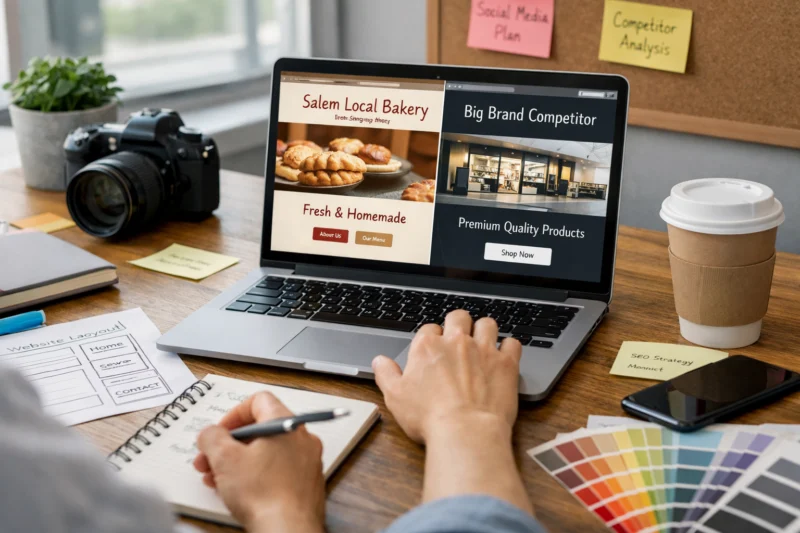
Portfolio relevance matters too. You want to see work for businesses with similar sales cycles, not just attractive visuals. Communication is another major factor: who writes copy, who handles SEO basics, how revisions are managed, and what happens after launch should all be clear before the project starts. These details reveal whether the provider is organized or simply selling pages.
Red flags include vague timelines, no discussion of mobile performance, no plan for post-launch support, and an inability to explain business goals in plain language. Another warning sign is when the provider talks only about design style and never about conversion, lead quality, or content structure. If you are trying to decide whether a vendor can really help, ask whether they are selling design only or a commercial growth outcome. That is the difference between a website that looks good and one that helps you compete.
It also helps to ask how they handle revisions and whether they can support ongoing small business development as your needs change. A provider that can grow with you is usually more valuable than one that just hands over files and disappears.
Small business web design Salem Oregon should do more than look polished; it should help a local company feel credible the moment a visitor lands on the page. A clear layout, fast loading, and simple messaging can make a smaller brand feel ready to compete with much larger names.
When planning a site, it helps to avoid design mistakes that distract from your services or slow down a customer’s next step. The right choices support trust, improve usability, and give Salem businesses a stronger starting point before they reach the FAQ section.
As you think about what your site needs, focus on the details that make the experience feel easy and professional. That approach is often what gives small business web design Salem Oregon the edge it needs in a crowded market.
Frequently Asked Questions About Small Business Web Design in Salem Oregon
How much does small business web design in Salem Oregon cost?
Pricing usually depends on scope, content support, and whether you need strategy, SEO basics, or ongoing maintenance. A simple brochure site will cost less than a conversion-focused build with custom copy, multiple service pages, and booking integration.
How long does it take to build a small business website?
Most projects take longer when content is not ready or when revision cycles expand. A lean site can move quickly, but a more strategic build often needs time for planning, copy, design, development, and testing.
What should a Salem small business website include?
At minimum, it should include a clear homepage, service pages, contact information, trust elements, and mobile-friendly navigation. For many businesses, reviews, FAQs, and service-area details make a measurable difference in lead generation.
Is a local designer better than a national agency?
A local designer can help when Salem market familiarity, in-person communication, and regional trust matter. A national team may be better if you need a very specialized capability or a broader multi-market strategy.
Can my existing website be redesigned instead of rebuilt?
Yes, if the structure is still sound and the main problems are visual or content-related. A rebuild is usually smarter when the platform, page architecture, or conversion flow is holding the business back.
How do I make my website compete with bigger brands?
Focus on clarity, proof, usability, and local relevance instead of trying to imitate their size. Smaller businesses often win by being easier to understand and easier to contact.
Do I need SEO with web design?
Yes, because design and search visibility work best together for commercial intent. Good structure, local page targeting, and clear headings help visitors and search engines understand what your business offers.
What if I only need a simple website for now?
Keep it lean, but do not skip trust signals or mobile usability. Even a simple site should make the offer clear, explain the service, and guide people to contact you quickly.
What are the biggest red flags when hiring a web designer?
Watch for vague scope, unclear communication, no revision process, and no discussion of business goals. If they cannot explain how the site will produce outcomes, they may only be thinking about visuals.
How do I know if my website is actually working?
Track calls, form submissions, bookings, and engagement with key pages. If visitors arrive but do not take action, the issue is often message clarity, trust, or the path to contact rather than traffic volume.
Final Takeaways: Building a Salem Website That Wins More Business
The goal of small business web design Salem Oregon is not just to create a nicer-looking site. It is to build a website that earns trust quickly and turns local interest into commercial action. That means understanding what Salem customers need, how they compare businesses, and what makes a smaller company feel dependable.
The businesses that compete best usually do five things well: they present a clear offer, prove credibility, load fast on mobile, support SEO basics, and make the next step obvious. When those pieces come together, a local company can outperform larger brands even without matching their scale. The advantage is not size. It is relevance, clarity, and a better path to action.
If your current site is not doing that, compare providers, request a consult, or audit the existing pages before investing in a redesign. The right website should work like a sales asset, not just a digital placeholder.
Updated April 2026