

Digital Web Designers Salem Oregon should be chosen for business results first: more qualified leads, stronger credibility, clearer brand presentation, and a website people actually use. If you are trying to hire a dependable partner in Salem without wasting budget, the real question is not who makes the prettiest mockup, but who can build a site that supports calls, bookings, quote requests, and long-term growth.
This guide helps you compare options, evaluate fit, and avoid expensive hiring mistakes before you sign anything. It also explains how to judge portfolio quality, process clarity, SEO readiness, and conversion thinking so you can choose with confidence instead of guessing.
Contents
- 1 What Salem Businesses Should Expect From a Modern Web Design Partner
- 2 How to Choose the Right Salem Oregon Web Designer Step by Step
- 3 Compare Your Main Options Before You Hire
- 4 Key Criteria to Judge Digital Web Designers in Salem, Oregon
- 5 Common Mistakes When Hiring a Web Designer in Salem
- 6 Local Fit Matters: Salem Market, Audience, and Practical Business Needs
- 7 What Most Guides Get Wrong About Choosing a Web Designer
- 8 Budget, Scope, and Value: What to Clarify Before You Sign
- 9 Frequently Asked Questions About Digital Web Designers Salem Oregon
- 9.1 How do I choose the best digital web designer in Salem Oregon?
- 9.2 What should a Salem Oregon web designer include in a proposal?
- 9.3 How much does a digital web designer cost in Salem Oregon?
- 9.4 Is it better to hire a local Salem designer or a remote one?
- 9.5 What should I look for in a web design portfolio?
- 9.6 Do digital web designers also handle SEO?
- 9.7 How long does a website design project usually take?
- 9.8 What questions should I ask before hiring a web designer?
- 9.9 What are signs of a bad web designer?
- 9.10 Can a web designer help improve my current website instead of starting over?
What Salem Businesses Should Expect From a Modern Web Design Partner
A modern web design partner should do far more than make a site look good. The best designers combine strategy, user experience, conversion-focused structure, and responsive implementation so the website supports actual business goals. For Salem businesses, that usually means a site that makes it easy for customers to understand what you do, trust you quickly, and take the next step without friction.
That distinction matters because a beautiful website can still underperform if it lacks clear messaging, local relevance, or obvious conversion paths. A designer who thinks only in terms of colors, layouts, and fonts may deliver a polished homepage that fails to generate leads. In contrast, a partner who understands local service websites, retail promotions, professional credibility, and startup positioning will shape the site around how people decide, compare, and contact businesses in real life.
This is where conversion focused design becomes a practical business asset. It affects the order of content, the placement of calls to action, the strength of trust signals, and whether visitors know what to do next. A good Salem designer should also think about responsive design benefits, because local users will often visit on phones while searching for a nearby provider, checking hours, or comparing options on the go. That mix of strategy and execution is what separates a site that looks finished from one that actually performs.
For service businesses, a modern partner should create pages that explain services clearly, answer objections, and support contact actions. For retailers, the site may need store details, featured products, seasonal promotions, and easy mobile browsing. For professional firms, credibility, clarity, and authority matter more than visual novelty. For startups, flexibility and launch speed may matter most, especially if the brand is still evolving. In each case, the designer should make choices based on the customer journey, not just design trends.
What many guides get wrong is treating web design like a one-time art project. In practice, good sites are business tools that need structure, maintainability, and room for growth. That is why businesses comparing local Salem web services should ask not only “Does it look good?” but also “Will it help us win work, and can it evolve with us later?”
How to Choose the Right Salem Oregon Web Designer Step by Step
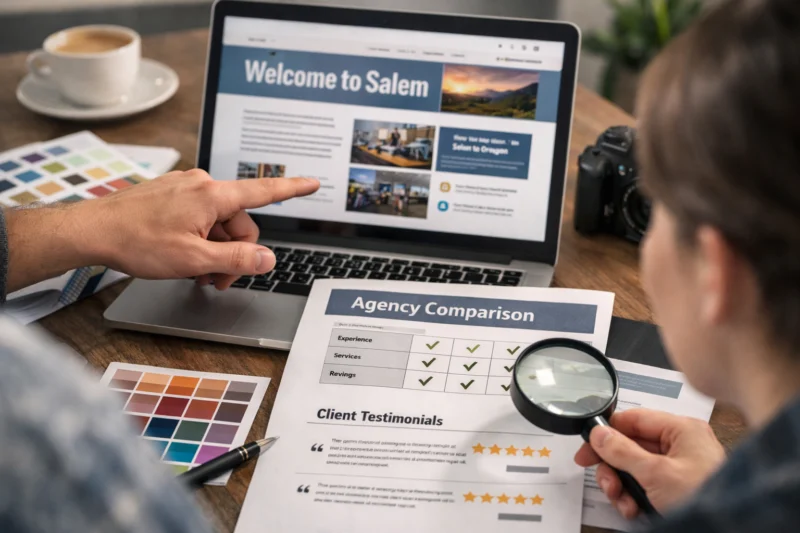
The best way to choose a web designer is to start with your business goals, then evaluate candidates against those goals. If you want more leads, ask how they design for quote requests and contact forms. If you want bookings, ask about scheduling flows. If you want more calls, ask where phone actions appear on mobile and desktop. If you want foot traffic, ask how they support local discovery and store visibility.
Once goals are clear, review the portfolio with relevance in mind, not just aesthetics. A designer may have attractive work that does not match your industry, your audience, or your website complexity. A strong portfolio should show more than visual taste. It should reveal whether the designer can build websites that communicate clearly, guide attention, and solve practical business problems. This is also where custom versus template becomes a meaningful question, because the right choice depends on your timeline, content needs, and growth plans rather than a generic rule.
Process clarity is the next major filter. A dependable designer should be able to explain discovery, wireframes, revisions, launch, and post-launch support in plain language. You should know who writes copy, who supplies images, how feedback is handled, and what happens if you need changes after launch. A vague process usually signals vague accountability. That is also why you should ask about ownership of files, domain access, hosting, and final assets before any work begins.
Communication style matters more than many business owners expect. If a designer responds slowly during the sales process, project delays are likely later. If decisions are made without structure, revisions can become endless. If the proposal is too cheap to explain, the hidden costs often appear through extra fees, limited edits, or unpaid support requests. In commercial projects, the cheapest bid can become the most expensive if scope, SEO, or ownership terms are vague. Clear expectations are part of small business development, because the website should strengthen operations instead of creating more work.
One practical sign of a strong fit is whether the designer can explain tradeoffs. For example, they should be able to tell you when a fast launch is realistic and when it will sacrifice quality. They should know when a simpler page set is better than a large site that will be hard to maintain. That kind of advice is more valuable than flashy promises, especially for businesses that need results rather than creative experiments.
Compare Your Main Options Before You Hire
Most Salem businesses will choose between a freelancer, a small local studio, or a full-service agency. Each path can work, but each is suited to different budgets, timelines, and complexity levels. The right choice depends on how much guidance you need, how many moving parts your website has, and how much ongoing support you expect after launch.
| Option | Best For | Strengths | Tradeoffs |
|---|---|---|---|
| Freelancer | Smaller sites, lean budgets, simple launches | Direct communication, lower overhead, flexibility | Limited bandwidth, narrower skill set, fewer backup resources |
| Small local studio | Most small and midsize businesses | Balanced strategy, hands-on service, practical collaboration | May have limited capacity during busy periods |
| Full-service agency | Complex sites, multi-channel marketing, larger teams | Breadth of expertise, structured process, scalable support | Higher cost, more formal process, sometimes less personal attention |
A freelancer can be the best choice when your site is relatively straightforward, your budget is tight, and you value direct collaboration. A small studio often fits businesses that want a local partner and a more complete process without the overhead of a large firm. An agency is usually best when the launch is business-critical, the site needs advanced functionality, or the project touches branding, content, analytics, and ongoing marketing at the same time. The right answer is not always the biggest team.
This is also where the phrase budget friendly web design should be interpreted carefully. Budget-friendly does not mean bare minimum. It means the project scope matches the business goal and the provider can deliver the essentials without creating future rework. In some cases, a solo designer is ideal. In others, a solo designer may be too limited for a launch that needs content strategy, development support, migration planning, and technical cleanup. On the other hand, a large agency may be unnecessary if you only need a focused brochure site with strong messaging and good local performance.
The deeper lesson is that responsiveness, depth, and specialization are tradeoffs. Speed can improve with a freelancer, but so can project risk if they are unavailable. A studio may offer stronger collaboration, but not the breadth of a large agency. Think through how much coordination your business can handle, how quickly the site must go live, and whether you need one expert or an integrated team. That decision framework is more useful than asking which option is “best” in the abstract.
Key Criteria to Judge Digital Web Designers in Salem, Oregon
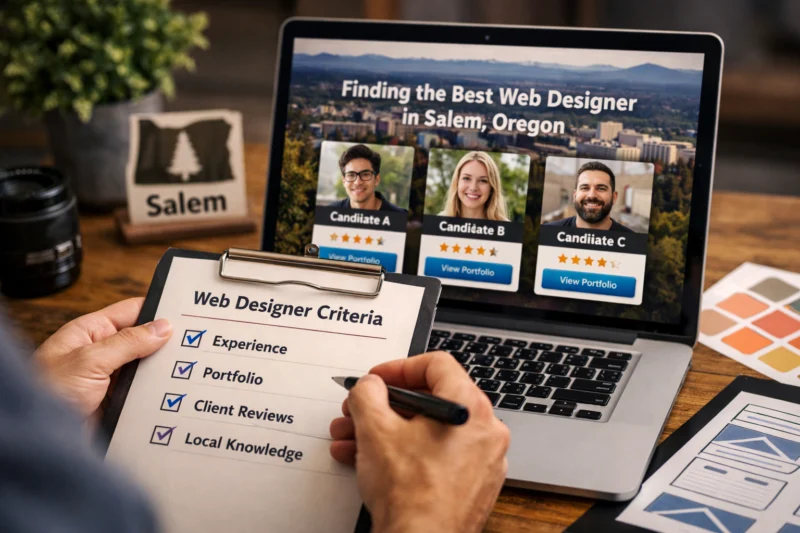
The best designers prove fit through portfolio quality, SEO awareness, conversion thinking, and technical reliability. Portfolio proof should show range, not repetition. Look for mobile responsiveness, clear service pages, and websites that resemble the kind of business you run. If every sample looks visually impressive but behaves the same way, that may indicate a style-first process rather than a problem-solving one.
SEO awareness matters because structure affects discoverability. A designer does not need to be a full SEO agency, but they should understand headings, metadata, page hierarchy, internal linking logic, and how local customers search. A site with an elegant design can still be hard to find if the structure is weak. That is why an SEO friendly site structure should be part of the discussion early, not something added at the end after the homepage is already approved.
Conversion thinking is visible in how the designer uses calls to action, forms, testimonials, trust signals, and page flow. A strong website helps visitors move from interest to action with minimal confusion. It answers basic questions quickly, removes friction, and gives people a clear next step. If a portfolio shows pages that look polished but bury contact buttons or use vague messaging, that is a warning sign. Beautiful mockups can hide poor navigation, slow load times, or dependence on one-off hacks that are hard to maintain.
Technical reliability is another non-negotiable. The platform should be maintainable by a normal business owner or a future support team, not trapped in a custom setup no one can edit. Ask what tools they use, how content updates work, and whether the site will integrate with common business systems. This is where a designer’s ability to support small business development becomes concrete: the website should be manageable, not fragile. If they cannot explain how they build for speed, accessibility, backups, and future edits, keep looking.
One common mistake is judging a designer only by finished screenshots. A better test is to ask what happened behind the scenes: why the layout was chosen, how the contact flow was structured, and what changed after launch. Designers who can explain those choices usually understand real business outcomes, not just visual style. That is the difference between a site that “looks custom” and one that actually performs.
Common Mistakes When Hiring a Web Designer in Salem
The most expensive hiring mistakes usually come from assumptions, not obvious failures. The first mistake is choosing based on price alone without comparing deliverables, revision limits, or long-term maintenance. A low quote may exclude copy help, mobile optimization, SEO setup, or post-launch support, which means you pay later in time, stress, or rework. If the proposal is thin, the project scope is probably thin too.
Another common mistake is failing to confirm who owns the domain, hosting, files, and final website assets. Ownership confusion creates real business risk because you may lose access to critical accounts or become dependent on one vendor for routine updates. Before signing, make sure you understand where everything lives and how you regain control if the relationship changes. That is basic operational hygiene, not a technical detail.
Many businesses also assume design and local search visibility are the same thing. They are not. A visually strong site can still have weak page titles, poor structure, and no local discoverability. Likewise, a search-friendly site can still fail if the user flow is confusing. Good web design should support both clarity and discoverability, which is why strategy and SEO need to be discussed together instead of treated as separate tasks.
It is also easy to overlook copy, structure, and user flow while focusing only on colors and layout. Yet messaging is often the difference between an inquiry and a bounce. Visitors need to understand what you do, where you serve, why they should trust you, and what to do next. That is where clear navigation planning supports the full website experience, especially for service businesses with multiple offerings or location-specific pages.
One deeper issue is vague revision policy. Some designers say they will “work with you” but never define rounds, deadlines, or decision gates. Others promise to “handle it later” on important items like forms, redirects, analytics, or accessibility fixes. Those promises can derail a project because they postpone critical decisions until the launch is already at risk. If a proposal does not describe revisions, timelines, and support clearly, treat that as a warning, not a flexibility bonus. Also review guidance around user-friendly navigation menu planning when comparing proposals, because a confusing menu can undermine even a strong visual design.
Local Fit Matters: Salem Market, Audience, and Practical Business Needs
Local familiarity can help a designer write better messaging, choose stronger trust cues, and reflect the expectations of Salem-area customers. A designer who understands the local market may be better at identifying what makes a business feel established, approachable, and relevant to nearby buyers. That matters for service providers, retail locations, professional firms, and community-based organizations that rely on trust and familiarity.
Different businesses in Salem need different site priorities. A contractor may need service-area pages, quote requests, and proof of recent work. A clinic may need credibility, intake clarity, and accessibility. A boutique retailer may need product highlights, event promotion, and local visits. A B2B firm may need case studies and a stronger authority narrative. The more clearly a designer understands those distinctions, the better the site will support real customer behavior.
At the same time, proximity matters less than process and results in many cases. A remote designer with a strong workflow may outperform a local one with a weak process. The key is whether they understand your business model, can communicate clearly, and can deliver a site that supports the customer journey. If you are exploring choosing design partners, look for evidence that they understand both the business side and the implementation side, not just visual trends.
The deeper risk is hiring someone who knows current design styles but not the local customer journey or service area realities. For example, a designer might create a generic site that looks modern but does not explain how far you serve, what neighborhoods you prioritize, or how local buyers usually contact providers. That gap can reduce conversions even if the website appears professional. Salem businesses should favor partners who ask about audience behavior, service territories, and practical decision-making patterns before they start designing.
In many cases, local understanding improves messaging more than layout. A good designer can use that knowledge to shape calls to action, trust signals, and service descriptions that feel grounded in the market. But local familiarity is only valuable when it is paired with a process that turns insight into structure. That combination is what makes a website feel relevant instead of generic.
What Most Guides Get Wrong About Choosing a Web Designer
Most guides focus too heavily on portfolios and ignore business outcomes. A portfolio can show taste, but it does not tell you whether the website increased leads, simplified operations, or improved conversion paths. The better question is whether the designer knows how to connect design choices to customer action. That difference matters much more than color palettes or animation effects.
Another mistake is treating web design as a one-time purchase instead of an evolving asset. A website should grow with your offers, seasonal needs, service changes, and marketing strategy. If a provider disappears after launch or leaves you with a hard-to-edit system, the website becomes a liability instead of a tool. Maintenance planning, content updates, and support expectations should be part of the initial conversation, not an afterthought.
Guides also underweight content structure, SEO readiness, and lead-generation flow. A site that lacks page hierarchy, clear headings, and strong calls to action can create confusion even if the design is attractive. This is one reason businesses should ask about SEO readiness and related content workflows before they hire. A designer with strong visual skill but weak content strategy may still be a poor commercial fit.
Post-launch support is another commonly skipped topic. Websites often need redirect checks, form testing, analytics verification, accessibility adjustments, and minor fixes after launch. If the designer does not plan for that, the launch can be messy and the site can underperform from day one. This is exactly where local Salem web services should be judged by what they include after the handoff, not just what the homepage looks like on delivery day.
The biggest misconception is that “local” automatically means “best fit.” Local knowledge helps, but weak process is still weak process. A nearby provider who communicates poorly or avoids specificity can create more risk than a remote expert with a disciplined workflow. Good hiring decisions come from evidence, not geography alone.
Budget, Scope, and Value: What to Clarify Before You Sign
Website pricing usually depends on page count, custom functionality, content help, revisions, and technical complexity. A five-page informational site is fundamentally different from a site with booking logic, e-commerce, membership features, or custom integrations. That is why headline price alone is a poor comparison point. Two proposals can look similar while hiding very different levels of work.
To compare proposals fairly, look at deliverables instead of just cost. Ask what is included in discovery, copy support, design revisions, development, mobile testing, basic SEO setup, training, and launch support. Clarify whether the designer provides wireframes, whether they handle redirects, and whether analytics are configured before launch. These details determine the real value of the investment.
You should also understand what is included after launch. Will the designer provide a tutorial, a training call, or a handoff document? Are small edits included for a short period after launch? What happens if you need help with forms, plugins, or platform updates later? These are not minor details. They determine whether the website is easy to own or difficult to maintain. A strong proposal should also name deliverables connected to website design Salem Oregon goals such as lead generation, brand credibility, and usability, rather than stopping at visual design language.
Hidden cost centers can include content writing, accessibility fixes, third-party integrations, platform migration, and extra revision rounds. Some projects also require new photography, legal pages, or improved structure for SEO. If those items are not discussed upfront, the budget can drift quickly. That is especially relevant when evaluating budget friendly web design, because a lower quote may only be affordable if the scope is realistic and clearly limited.
The smartest move is to ask each candidate to explain exactly what would change the price. That conversation reveals whether they understand scope control or simply hope to fill in the gaps later. Value is not the cheapest number; it is the clearest path to a site that meets your business goal without unpleasant surprises.
Frequently Asked Questions About Digital Web Designers Salem Oregon
How do I choose the best digital web designer in Salem Oregon?
Choose based on business goals, portfolio relevance, process clarity, and communication quality. The best decision is usually the designer who understands your customer journey, explains tradeoffs clearly, and can show how their work supports leads, calls, bookings, or sales.
What should a Salem Oregon web designer include in a proposal?
A strong proposal should define scope, timeline, revision rounds, deliverables, ownership, and support expectations. It should also explain what is included at launch and what costs extra, so there are no surprises later.
How much does a digital web designer cost in Salem Oregon?
Cost varies based on page count, custom features, content support, and how much strategy is involved. A simple brochure site usually costs less than a custom build with integrations, migrations, or conversion-focused planning.
Is it better to hire a local Salem designer or a remote one?
Local can help when you value in-person collaboration, market familiarity, or easier communication. A remote designer can be just as effective if they have a strong process, clear timelines, and proven results.
What should I look for in a web design portfolio?
Look for relevance, mobile quality, clarity, and evidence that the sites support business goals. The best portfolios show variety and practical problem-solving, not just attractive visuals.
Do digital web designers also handle SEO?
Some do basic SEO setup, but full SEO is often a separate specialty. A designer should at least understand page structure, headings, metadata, and local discoverability even if a dedicated SEO provider handles deeper optimization.
How long does a website design project usually take?
Timelines depend on scope, content readiness, feedback speed, and technical complexity. A simple site may move quickly, while a larger redesign with content approval and integrations can take several weeks or longer.
What questions should I ask before hiring a web designer?
Ask who owns the domain and files, how revisions work, what support looks like after launch, and what happens if the scope changes. You should also ask how they approach navigation, mobile design, and lead generation.
What are signs of a bad web designer?
Warning signs include vague scopes, poor communication, weak examples, hidden fees, and promises that do not explain how work gets done. Be cautious if the designer cannot clearly explain ownership, timelines, or what happens after launch.
Can a web designer help improve my current website instead of starting over?
Yes, and sometimes that is the best option. A redesign is not always necessary if the site only needs better navigation, updated messaging, improved mobile behavior, or stronger conversion paths.
When you compare Digital Web Designers Salem Oregon, the best choice is rarely the flashiest portfolio or the lowest quote. It is the partner who balances proven design quality, a clear process, business understanding, and long-term value. Salem businesses should prioritize fit, communication, and conversion-focused thinking over design alone, because those are the factors that determine whether the site actually supports growth.
Your next step should be practical: compare two or three candidates, ask direct questions, and review proposals side by side before making a decision. If you want help evaluating options or scoping a new project, start a consultation or request a quote comparison so you can choose with clarity instead of guesswork.
For additional guidance on platform choice, mobile usability, and on-page SEO best practices, review related resources before you sign.
Google Search Central — official guidance on search-friendly structure and technical basics
W3C Web Accessibility Initiative — accessibility standards that should shape modern website planning
U.S. Small Business Administration — useful context for aligning website decisions with marketing goals
Updated April 2026