

An SEO-friendly blog structure is the plan that organizes your categories, URLs, navigation, archives, and internal linking so search engines and readers can understand how your topics relate. When your information architecture is clear, crawlers find content faster, indexation becomes more consistent, and topical authority signals strengthen over time. In practice, building an SEO Friendly Blog Structure means designing a system you can maintain as your blog grows, not patching changes after rankings drop. This comprehensive guide walks you through a repeatable model for taxonomy, URL patterns, archive choices, and discovery pathways. You will also learn how to avoid thin, duplicate, or confusing archive pages that look helpful but dilute quality.
Because many blogs use WordPress-like CMS patterns, we will focus on practical decisions that map cleanly to common features such as categories, tags, archive templates, and pagination. In 2026, search behavior still rewards clear topic grouping, but it also punishes low-value indexation. So you will design not only what gets indexed, but also what should stay out of the index. You will finish with a plan you can implement in a controlled order, verify with crawl and index signals, and adjust without breaking existing links.
Contents
- 1 Designing a structure starts with inputs, then you choose rules for categories, tags, and hubs
- 2 Choosing taxonomy depth ensures your categories help users without creating index bloat
- 3 Clean URL patterns reduce long-term maintenance and improve canonical clarity
- 4 Internal linking systems build topical clusters without causing crawl traps
- 5 Navigation, menus, and breadcrumbs should mirror taxonomy while staying selective
- 6 Archive pages should earn indexation with unique value and controlled pagination
- 7 Pick an architecture option that fits your blog’s scale and editing workflow
- 8 Common blog structure mistakes break SEO value even when content is strong
- 9 Handling multi-author blogs, cross-topic posts, and refresh cycles keeps the structure coherent
- 10 Frequently asked questions about building an SEO friendly blog structure
- 10.1 How many categories and tags should I use in an SEO friendly blog structure?
- 10.2 Should I include dates in my blog post URLs for SEO friendly blog structure?
- 10.3 What is the best way to structure internal links across categories and tags?
- 10.4 When do category pages need unique content, and how much?
- 10.5 Is it better to use one main blog page with filters or separate category archives?
- 10.6 How can I stop tag archives from getting indexed if they’re mostly duplicates?
- 10.7 What should I do if my blog already has messy URLs and inconsistent categories?
- 10.8 Do breadcrumbs help SEO on blogs, and how should they be implemented correctly?
- 10.9 How do I handle cross-topic posts that fit multiple categories without hurting topical clarity?
- 10.10 What internal links should never be forgotten when updating older posts?
- 11 Turn the system into a plan you can implement and measure in 2026
A strong SEO-friendly blog structure starts before you touch your CMS. You need a clear picture of what you publish, who reads it, and how your existing URLs behave during updates. This upfront work prevents category sprawl, archive duplication, and URL pattern drift later. It also makes your structure predictable for future editors and new contributors. When you define the inputs first, the resulting SEO Friendly Blog Structure becomes a system rather than a one-time setup.
Begin with a content inventory. List your published posts, their current categories and tags, and any existing series or content collections. Also capture the intent each post serves, such as “learn the basics,” “compare options,” or “follow a step-by-step process.” Then include your author workflow, because governance matters once multiple people add categories or tags. Finally, document current URL constraints and migration needs, especially if older posts already rank or have inbound links.
Next, set criteria that decide which taxonomy tools you use. Categories usually represent higher-level topic groupings and map closely to navigation. Tags often capture secondary aspects, but they can create too many archive pages if you apply them loosely. If you have editorial series, treat them as deliberate hubs rather than an automatic label. Custom taxonomies can help when your content type has unique relationships, but every new taxonomy increases maintenance and indexation complexity. A hub page, whether a category landing page or a dedicated topic landing page, should summarize a topic and link to supporting posts.
This approach matters because search engines and users both look for clarity in topic relationships. How it works is simple: your taxonomy choices define your archive pages, your archive pages define what gets indexed, and your internal links define how authority flows. Your practical application is to draft a taxonomy map on paper first, including your planned categories and the rules for tag usage. A tradeoff is that a strict system can feel slower at the start, especially for new posts that do not fit neatly. A real-world scenario is a growing WordPress blog that adds a new “misc” tag for everything, which later creates hundreds of low-value tag archive pages.
One deeper nuance is separating “grouping for humans” from “indexable structure for crawlers.” Humans need navigation that feels natural, while crawlers need stable, useful archive pages. Many teams misuse tags because tags are easy to add, not because tags improve discovery. The common mistake is treating every tag as an indexable entity, then relying on pagination to do quality work. Instead, limit tags, enforce consistent assignment rules, and ensure each indexable archive has enough unique value to justify crawling.
Choosing taxonomy depth ensures your categories help users without creating index bloat
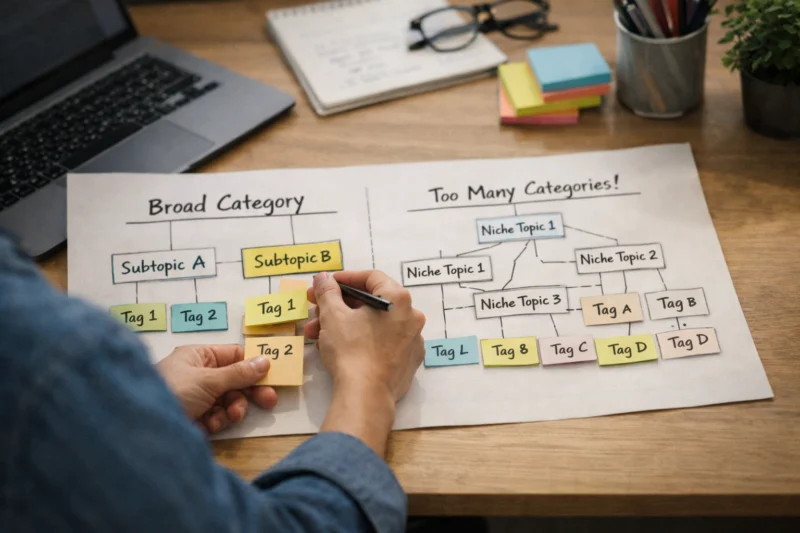
Category and tag structure should match how your topics relate, but it must not over-fragment your site. If you add too many levels, users struggle to navigate, and crawlers waste time on thin archives. If you add too few levels, your category pages become vague and fail to represent a coherent topic. An SEO Friendly Blog Structure finds a practical middle where categories become meaningful pathways and archives stay useful.
Model your topic hierarchy as parent categories and subcategories only when the relationship is truly stable. For example, a “Content Marketing” parent category might split into “Editorial Strategy” and “Distribution,” but only if you regularly publish posts that belong there with clear differences. Stop adding levels when each deeper node has few posts, since that usually signals either taxonomy confusion or inadequate content volume. Depth should be driven by how readers search, not by how many labels you can create in your CMS.
Also consider archive intent. Category pages typically aim to give an overview and then link to relevant posts. A good category archive includes an editorial summary, clear subtopic grouping when needed, and a list of posts that support the category’s promise. If you create a subcategory archive with a single post, it rarely becomes a strong landing page and may behave like a thin index target. Pagination strategy then matters, since too many pages can spread relevance signals thinly across many URLs.

Deeper insight comes from handling edge cases like orphan posts and cross-topic posts. An orphan post is one that has no meaningful category fit or lacks links from key hubs. A cross-topic post might fit multiple categories, but it should not create confusion about its primary topic. Decide which category is primary for navigation, and let supporting taxonomy tools guide secondary discovery. Many blogs solve this with “primary category plus optional tag attributes,” rather than assigning multiple primary categories that dilute archive clarity.
A common misconception is that more taxonomy nodes always means better topical coverage. More nodes can create more indexable pages, but it often increases duplicate or near-duplicate archive templates. If your blog uses WordPress categories and tags, each combination can generate archive URLs that look different but deliver similar content lists. The practical tradeoff is controlling indexation quality over indexation quantity. In 2026, that balance matters because search systems can downrank or ignore low-value archive pages even if they are technically indexable.
Clean URL patterns reduce long-term maintenance and improve canonical clarity
Clean, consistent URLs help both search engines and humans understand your site’s structure. When your URL scheme is predictable, you avoid constant redirects and reduce errors during edits. An SEO Friendly Blog Structure includes URL rules for categories, slugs, and when to use date-based paths. You also need canonical behavior so archives and filtered views do not create duplicate signals. The goal is stability: once URLs work, you should rarely change them.
Decide whether category slugs appear in post URLs. Some blogs include the category in the path, others keep it out for simplicity. Including it can reinforce topical context, but it also increases the impact of category changes on URL stability. For most evergreen educational blogs, keeping slugs stable and avoiding frequent post re-categorization reduces risk. If you serve different audience intents, you can still reflect topic relationships through hubs and internal links rather than rewriting URLs.
Next, choose between date-based and non-date slugs. Date in URLs can help for news-like updates, product releases, or time-specific posts. For evergreen guides, dates often create a misleading “freshness” signal and complicate reorganizing content later. If you do use dates, keep them consistent and decide whether you will treat updates as new posts or refreshed content. Your migration-safe approach should also cover slug renames, since every rename can break internal links and dilute accumulated signals if redirects are mismanaged.
Canonical behavior is a deeper issue than it seems. Archives often involve pagination, filters, and tag intersections that can create multiple URLs for the same list content. For example, a category page and a paginated version may represent the same intent with different items shown. If your templates output parameters or duplicate listing patterns, canonical tags and template logic must be aligned. Practical application means checking canonical rules for archives and verifying that pagination uses consistent link signals.
An edge case is “URL pattern drift” caused by multiple authors or editors. One editor uses one slug style early, another changes the format later, and soon you have inconsistent patterns that confuse internal linking and content discovery. The common mistake is allowing editors to rename slugs casually during refreshes. Instead, adopt a naming convention and a policy: rename only when necessary, then plan redirects immediately. When you migrate categories or tags, map redirects carefully and validate internal references so the updated internal structure supports the final URL destinations.
Internal linking systems build topical clusters without causing crawl traps
Internal links are how your blog teaches search engines topic relationships through crawl paths. A good internal linking strategy makes it easy to discover related posts, reinforces hub authority, and keeps important content reachable. This is a key part of any SEO Friendly Blog Structure, especially because archives alone do not always create the best crawl paths. The system should also support readers as they move from overview to details, not force them to hunt. When internal linking is planned, it also reduces the chance that older posts become disconnected.
Use a hub-and-spoke model to implement internal links. A hub page represents a primary topic, such as a category archive or a dedicated topic landing page. Supporting posts connect back to the hub using contextual links within the content body. This is more effective than relying only on menus or footers because contextual links signal stronger topical relevance. Practical application is to define, for each hub, a set of “neighbor” posts that address subtopics in a logical sequence.
Anchor text also deserves governance. Use descriptive anchors that match what the reader will get after the click. Avoid repeating the same anchor pattern too aggressively, and ensure the destination actually covers the anchor topic. In content refresh workflows, you can update older posts by adding a single contextual link to a newly improved hub or a newly published supporting guide. This approach makes internal linking an ongoing editorial habit rather than an afterthought.
Hub pages should include modules that support discovery. Include featured posts, concise editorial summaries, and a short explanation of what a reader can learn in that topic area. If you publish subtopics, show clear internal pathways that reflect your hierarchy. Also ensure crawl paths stay shallow enough that important pages are reachable within a few clicks. A deeper insight is to avoid internal link loops, especially where category templates link to tags and tags link back to categories.
A common limitation is that internal links can become “index fragmentation” if they point to paginated URLs or parameterized variants. For example, linking to a page that loads with filters can create multiple URL versions of the same list. Another misconception is that older posts automatically link to new ones. In reality, you must update internal links during content refresh cycles. This is especially true when you reorganize categories, introduce new hubs, or revise taxonomy rules.
Navigation clarifies where content fits in your blog’s topic map. Menus, breadcrumbs, and contextual navigation should reflect your taxonomy, but they should also avoid flooding users with every archive. In an SEO Friendly Blog Structure, navigation serves two purposes: it guides humans and it exposes crawlable paths to important pages. When implemented carefully, navigation helps search engines understand your hierarchy without requiring complicated discovery. When implemented poorly, it can expose dozens of thin archives that add noise.
Your primary menu should represent your top-level pathways, usually categories that match reader intent. Keep the menu minimal and stable, since every menu change can shift crawl patterns. Secondary links can support discovery within articles, such as links to the relevant category hub or key subtopics. Footer links can offer broader navigation, but they should not mirror every tag, especially if tags generate many archive URLs. The practical tradeoff is that a full “everything menu” feels helpful, but it often increases indexation risk and reduces clarity.
Breadcrumbs help when they accurately represent taxonomy hierarchy and improve user orientation. They are most useful on category and subcategory archives, as well as on posts that belong to a clear parent node. Implement breadcrumbs so they match your actual taxonomy assignments, not a display workaround that hides deeper relationships. In WordPress-like setups, breadcrumbs often need careful template logic to avoid mismatches between visible categories and actual post assignments.
For mobile, navigation depth matters. If users cannot reach a category within a few taps, your structure fails in practice even if it is crawlable. A deeper insight is aligning visibility with indexation alignment. Some teams hide categories in menus to prevent user distraction, but still let archive pages be indexable. If a hidden category has thin content, you may need to adjust indexation templates instead of relying on navigation invisibility.
A common mistake is turning taxonomy into a giant sitemap through menus and widgets. That can lead crawlers to discover many archive URLs quickly, including those with low uniqueness. Another misconception is that breadcrumbs always help SEO automatically. Breadcrumbs help when they reflect true hierarchy and when the related archive pages are meaningful. Use breadcrumbs to communicate structure, not to paper over weak taxonomy or low-quality archives.
Archive pages should earn indexation with unique value and controlled pagination
Archive pages are not all equal, and an SEO Friendly Blog Structure treats them as purposeful assets. Some archives should be indexable because they provide a useful overview and discovery pathways. Others should be noindexed or limited because they add little unique value beyond a list of post excerpts. If you index everything automatically, you often create thin targets that dilute your site’s overall quality signals. The core job is to decide which archive types deserve crawling and which ones need restraint.
Start with the archive types you actually use. Category and subcategory archives often serve readers with an overview plus links to supporting posts. Tag archives can be useful if tags represent recurring, distinct facets, but they often become thin if you assign tags too frequently. Author archives might be valuable on multi-author sites when authors have unique writing and consistent topical coverage. Series pages can be excellent, but only when each series page has a clear purpose and enough content to justify indexing.

Indexation control logic should be tied to content volume, uniqueness, and usefulness. A simple rule is to index archive pages that can serve as a landing page with editorial guidance. That means more than a list; it includes summaries, filters that change meaning without creating duplicates, or curated ordering with explanations. For low-post-count categories or tags created for planning, consider noindex until you have enough substance to make them genuinely helpful. In 2026, thin archives often do not improve discovery and can increase crawl waste.
Pagination must also be handled carefully. If you use pagination page numbers, ensure there is a consistent canonical strategy and a predictable way to discover later pages. “Load more” can be tricky if it hides content from crawlers, so ensure the server-rendered pagination model supports discovery. Practical application means testing with crawl tools and confirming that the archived lists you want are actually indexable and stable.
An edge case is evergreen vs time-bound content. If your category archive mixes evergreen guides and outdated time-sensitive posts, the archive can look stale or confusing. You can solve this by ordering logic that highlights evergreen posts, or by separating time-sensitive content into distinct categories or series. The common mistake is letting older posts dominate a category page without editorial curation. Another misconception is that pagination alone fixes thinness; pagination pages still need unique value signals and coherent ordering to avoid being treated as redundant.
Pick an architecture option that fits your blog’s scale and editing workflow
There is no single “best” blog structure for every site, but there are a few proven architecture options. The best choice depends on your content volume, category stability, and the way editors add taxonomy. An SEO Friendly Blog Structure works when it fits your team’s workflow and prevents archive quality problems. A practical decision framework helps you choose between lean taxonomies, deeper hierarchies, and hub-and-spoke landing pages.
Consider four common options. First, a lean taxonomy uses fewer categories and a selective tagging system, reducing indexable archive count. Second, a deep taxonomy adds sublevels where the topic relationships are stable and you have enough posts per node. Third, a hub-and-spoke model uses dedicated topic landing pages that summarize and link to cluster content. Fourth, category-as-hub and tag-as-hub variations change which taxonomy entities become indexable hubs, which affects maintenance and indexation risk.
Match options to your likely growth path. A small new blog often benefits from a lean taxonomy because it reduces early decision errors and prevents category sprawl. A growing multi-author blog might need governance and slightly deeper hierarchy to keep internal linking efficient. An established site with legacy content may prefer hub-and-spoke with careful migration, because changing categories across thousands of posts can create redirect chains and indexation confusion. Decide based on expected growth rate, internal linking capacity, and your tolerance for archive management work.
Evaluate with evidence rather than assumptions. Use crawl reports to see whether key pages get discovered and whether thin archives consume crawl budget. Check index coverage trends and examine search performance by topic cluster rather than only by page. If you rely on Search Console signals, track whether category hubs gain impressions for topic-related queries. For manual checks, review each indexable archive and confirm it provides clear discovery value, not just a shuffled list.
A deeper insight is handling editorial intent conflicts. Sometimes editors tag content under “marketing” even when it is really about “product usage,” which can break topical clarity in archives. Governance helps: define a primary category rule based on the reader’s main goal in that post. Another nuance is that internal linking capacity should shape architecture. If your team cannot reliably link from older posts to hubs, fewer indexable nodes may perform better because you reduce pathways that require constant upkeep.
Common blog structure mistakes break SEO value even when content is strong
Many blogs lose SEO value from structural mistakes, not from weak writing. A poor SEO Friendly Blog Structure can create thin archives, duplicate listing pages, and confusing navigation paths. Even strong content struggles when crawlers cannot find it reliably or when your index becomes cluttered with low-value pages. The good news is that most failures follow predictable patterns. If you can spot these patterns early, you can fix the structure before rankings and index coverage stabilize around the wrong signals.
Start with the taxonomy trap. Too many categories and tags make archive pages fragmented and low value. Inconsistent taxonomy assignments lead to the same topic appearing in multiple archives, which dilutes topical clarity. Changing slugs unnecessarily also creates avoidable redirect chains and breaks internal link consistency over time. Another mistake is forgetting to add internal links when updating older posts, which can leave new hubs isolated from the content that supports them.
Archive-quality issues also matter. The archive-quality trap happens when teams index tag pages or author pages that do not add unique value. A tag page might look like it should rank because it contains posts, but if it lacks editorial summary and has weak topical coherence, it often behaves like a thin list. Navigation problems compound the issue when users cannot reach important pages easily, even if those pages are indexable.
Canonical and redirect errors can silently damage structure changes. Common issues include canonical points to a paginated list when the correct canonical should be the first page, or redirect loops when migrating URL patterns. Broken internal links also reduce the effectiveness of internal linking clusters. A deeper misconception is “more indexable pages equals more SEO.” That is not true for blogs because low-value archives consume crawl attention and can dilute authority signals.
Real-world scenario: a WordPress blog launches and automatically indexes every tag. Over time, the blog accumulates tags for minor details, like “templates,” “tips,” and “strategy,” each applied inconsistently. Search engines then find many tag archives that show similar post lists. Fixing it requires a mix of tag governance, template-level indexation rules, and sometimes a migration plan for existing archive URLs. The tradeoff is that you must define what counts as a meaningful tag and enforce that going forward.
Blog structure stays SEO-friendly when you manage editorial complexity instead of letting it drift. Multi-author setups, cross-topic posts, and frequent content refreshes can all break taxonomy consistency if governance is unclear. An SEO Friendly Blog Structure anticipates these situations and includes rules for category selection, tag assignment, and how updates change internal linking. In 2026, this discipline matters because search systems reward stable topical entities over frequent reshuffles. When you keep the system coherent, you protect existing crawl paths and topical signals.
For multi-author blogs, define governance roles and enforce consistent taxonomy rules. Decide who can create new categories and who can assign tags, then document the “primary category” policy for cross-topic posts. Practical application is to provide editors with examples of what belongs in each top category, plus a short checklist for tag usage. If you do not enforce governance, editors will add near-duplicate tags, misassign posts, and create archive pages that do not reflect real topical relationships.
Cross-posting and content overlap need careful handling to avoid cannibalization and archive confusion. If similar posts exist across clusters, differentiate their focus. Make one post the primary guide for a subtopic and ensure it links strongly to the correct hub. Supporting posts should explain how they add value, such as a different audience level or a different method within the topic. Also ensure that internal links from older posts point to the updated “current” hub rather than an outdated version.
For refresh cycles, update both content and structure safely. Keep URL patterns stable and adjust on-page linking so the cluster remains connected. When you improve a guide, update internal links from relevant older posts to point to the refreshed version or to a new supporting article. If you change taxonomy assignments during refresh, plan redirects and verify canonical behavior for archives. The deeper nuance is pillar vs supporting content: changing pillar selection can be safe, but changing URL identity too often increases complexity.
An edge case is seasonal content alongside evergreen clusters. Time-sensitive posts, like yearly updates or event recaps, can dilute an evergreen category if they appear as recent items forever. Separate them into a time-aware series or a dedicated category, then use ordering logic so evergreen guides remain visible. The common mistake is mixing all content into one category and relying on pagination to handle recency. Instead, treat recency as an editorial choice, not a structural accident.
Frequently asked questions about building an SEO friendly blog structure
Use as many categories as you need to represent distinct main topics, but avoid creating categories with only a handful of posts. Tags should represent stable secondary facets, not every detail you mention once. In practice, start small, then add new categories only when multiple posts share a clear reader intent that fits together. If a tag archive has low content volume or weak uniqueness, consider noindex or reduce tag usage frequency.
Should I include dates in my blog post URLs for SEO friendly blog structure?
Dates can help when content is inherently time-based, such as release notes or yearly updates. For evergreen guides, dates can make older posts look outdated and complicate refresh strategies. If you add dates, keep them consistent and avoid renaming older posts during updates. If you later decide to remove dates, plan redirects and check archive canonical behavior carefully.
Build hub-and-spoke clusters where each category or topic hub links to supporting posts, and supporting posts link back contextually to the hub. Use descriptive anchor text that matches the destination’s actual topic coverage. Limit internal links to archive URLs that provide meaningful discovery value, and avoid linking to paginated or filtered variants when they create duplicate listings. When you update older posts, add a few contextual links to the current hubs rather than overhauling every link at once.
When do category pages need unique content, and how much?
Category pages need unique content when they should function as landing pages, not just a list of excerpts. Add an editorial summary that explains what the category covers, plus short guidance or subtopic sections when relevant. A practical minimum is enough text to clarify scope and reduce ambiguity, followed by a list of posts that match that scope. If you cannot maintain that value, consider reducing indexation for small categories.
Is it better to use one main blog page with filters or separate category archives?
Separate category archives usually provide clearer crawlable pathways and more stable archive intent than filtered views that depend on parameters. A single blog page with filters can create many URL variants that are hard to canonicalize and can fragment indexing signals. If you use filters, ensure crawlers can access the underlying pages in a consistent way and that canonical tags align to the primary archive. For most blogs, categories as indexable hubs offer a simpler, more predictable structure.
How can I stop tag archives from getting indexed if they’re mostly duplicates?
If tag archives are thin or highly overlapping, you can use template-level indexation controls to noindex low-value tag pages. Pair that with canonical rules so tag archives do not create conflicting index signals. Validate changes by checking whether the tag archive URLs stop appearing in index coverage and by monitoring indexing requests. Also tighten tag assignment rules so tags that remain indexable represent clear, recurring subtopics.
What should I do if my blog already has messy URLs and inconsistent categories?
Start with an audit: inventory your current URL patterns, list categories and tag assignments, and identify which archive pages are indexable. Then plan a migration order that prioritizes the most important URLs and hubs first. Map redirects from old URLs to final destinations using a one-to-one approach when possible, and update internal references after redirect setup. Finally, verify internal link rewiring and canonical alignment with crawl checks so you do not create redirect loops or broken link paths.
Breadcrumbs can help by showing hierarchy and improving navigation clarity, especially on category and subcategory archives. Implement them so they reflect the real taxonomy path for each post, not a static workaround. If breadcrumbs do not match your structure accurately, they can confuse users and weaken the value of the hierarchy signals. Use consistent taxonomy assignments and ensure templates generate breadcrumbs reliably across devices.
How do I handle cross-topic posts that fit multiple categories without hurting topical clarity?
Choose one primary category that matches the post’s main reader goal, and then use tags or contextual links to support the secondary relationship. This keeps each category archive coherent while still allowing discovery across related topics. Also ensure your hub pages connect to these cross-topic posts in a way that explains how they fit within the topic. Avoid assigning multiple primary categories in a way that makes archives overlap heavily with similar post lists.
What internal links should never be forgotten when updating older posts?
When updating older posts, always check links to the current topic hubs and to the next-step supporting posts in the cluster. Update any “related posts” style modules so they reflect the refreshed editorial focus and do not keep pointing to outdated guides. Also add contextual links from the updated sections to the correct hub pages, not to paginated or thin archive variants. Finally, confirm that older posts still connect forward to current cluster members so the topic path stays intact.
Turn the system into a plan you can implement and measure in 2026
You can make your blog structure SEO-friendly by implementing changes in a safe order and measuring outcomes as you go. The main promise of a comprehensive guide is not just learning concepts, but producing a repeatable system that survives growth. An SEO Friendly Blog Structure combines taxonomy choices, stable URL patterns, intentional archive indexation, and hub-based internal linking. In 2026, measurement matters because small template mistakes can quietly expand low-value indexing. If you treat structure like an ongoing project, it stays coherent.
Start with taxonomy and taxonomy governance. Decide your categories, define tag assignment rules, and identify which taxonomy nodes will become hubs. Next, lock URL patterns and slug naming rules to prevent drift. Then implement archive indexation decisions in your templates so that category hubs remain indexable while low-value archives are limited. After that, wire the internal linking system by adding contextual links within posts and ensuring each hub page includes a clear editorial overview.
Finally, validate with evidence and make targeted adjustments. Review crawl and index coverage to confirm that important hubs and supporting posts are discoverable. Check search performance by topic cluster rather than only by individual URLs, since structure helps topics, not just pages. For manual quality checks, open each indexable category or hub and ask whether a reader can understand the topic scope in seconds. If not, refine the archive summary and internal pathways.
Tradeoffs are real. You may need to accept that some archives will not rank, and that is fine if they serve as navigation tools rather than indexable entities. You might also do fewer taxonomy changes to protect stability and maintain redirect correctness. A deeper insight is that structural success depends on editorial consistency, not one-time configuration. Your best next step is to audit your current taxonomy and archives, pick one architecture option, and implement changes in a controlled order, starting with categories and URL patterns.
If you want a simple checklist for your first week, map your taxonomy nodes and hub pages, define your URL rules, set archive indexation policies, and then update internal linking across existing clusters. After that, measure crawl discovery and index coverage, and fix the most harmful thin archive signals first. You will end with a site that is easier to maintain, easier to navigate, and clearer for search engines to interpret.
You should audit your current structure, pick one architecture option, then implement changes in a controlled order starting with taxonomy and URLs first, and linking and navigation second. That same approach keeps your next content refresh safe, so hubs remain connected to supporting posts and archives stay aligned with topic intent. Over time, this method produces a more coherent SEO Friendly Blog Structure that scales without constant reorganizations.
Related topics you can map to your hubs include on-page SEO best practices, content cluster planning, and internal linking for topic authority. If your site spans multiple intent levels, treat series pages as editorial hubs and ensure each series has enough unique overview text. When you refresh content, update the links so newer supporting posts reinforce the same hub, rather than splitting signals across old versions.
Primary external references that inform these structural practices include Google Search Essentials, which discusses how Google views crawling and indexing, and WordPress documentation on how templates and archives behave in common setups. For canonical and duplicate URL guidance, the Google Search Central documents on canonicals and pagination help ensure archive templates signal the correct page. Use these resources alongside your own crawl and index checks to validate that your structure matches how search engines interpret your site.
To ground your implementation in official guidance, review these sources: Google Search Essentials and Google Search Central: Canonical URLs and WordPress Developer Resources.
Updated August 2026