
To choose the right Salem-based web designer for a small business, focus on fit, process, and results—not just a polished portfolio. The best choice for Small Business Web Designers Salem Oregon is the one that helps you get more qualified leads, builds trust quickly, and supports local visibility without wasting budget or time.
That matters because your website is often the first sales conversation a prospect has with your business. In Salem, Oregon, a good designer should understand how to turn local traffic into calls, bookings, and purchases while keeping the site fast, mobile-friendly, and easy to manage. This guide shows you how to compare options, spot red flags, and choose a local design partner with confidence.
Contents
- 1 What Salem Small Businesses Should Expect From a Web Designer
- 2 How to Evaluate Salem Oregon Web Designers Before You Hire
- 3 Compare Your Options: Freelancers, Small Agencies, and Local Studios
- 4 Local Fit Matters: Why Salem Experience Can Change the Outcome
- 5 Signs a Website Designer Understands Small Business Goals
- 6 Common Mistakes When Choosing a Web Designer in Salem
- 7 What Most Guides Get Wrong About Web Design Selection
- 8 Pricing, Value, and Budgeting for a Salem Small Business Website
- 9 Questions to Ask Before You Sign a Contract
- 10 Red Flags That Should Make You Pause
- 11 Advanced Considerations Most Buyers Overlook
- 12 Frequently Asked Questions About Salem Oregon Small Business Web Designers
- 12.1 How do I choose the right web designer for a small business?
- 12.2 What should a Salem small business website include?
- 12.3 How much does a small business website cost in Salem, Oregon?
- 12.4 Should I hire a freelancer or a small agency?
- 12.5 How long does a small business website project usually take?
- 12.6 Do I need local Salem experience in a web designer?
- 12.7 What questions should I ask before hiring a web designer?
- 12.8 How can I tell if a designer understands conversions?
- 12.9 What are the biggest red flags when hiring?
- 12.10 What if I already have a website but need a redesign?
- 13 Conclusion
What Salem Small Businesses Should Expect From a Web Designer
A small business web designer should do much more than make a site look attractive. The job should include discovery, information architecture, visual design, development, launch support, and conversion-focused improvements that help the business get measurable outcomes. If you only get a homepage and a few pages with no strategy behind them, you are probably paying for design without getting business value.
For a Salem, Oregon business site, “good” usually means the visitor knows who you are, what you do, where you serve, and what to do next within a few seconds. That requires clear calls to action, visible trust signals, strong mobile usability, and fast load performance. A bakery, law office, contractor, clinic, or retail store all need different content priorities, but they all need a site that reduces friction and answers real buyer questions quickly.
The most common mistake is confusing a pretty layout with a site that actually works. A designer who understands business goals will tailor the structure to your customer journey, not force every client into the same template process. That is especially important if you need calls, form fills, quote requests, online bookings, or in-store visits. If you want to improve conversion rates, the site must be designed around actions, not just aesthetics.
Good designers also think about support after launch. That can include training, updates, performance checks, and help when a form breaks or a plugin conflicts with the theme. Businesses looking for budget friendly design options should still expect these essentials, because a cheap site that fails early becomes expensive later through fixes, lost leads, and rework.
How to Evaluate Salem Oregon Web Designers Before You Hire
Start by looking at portfolio relevance, communication style, process clarity, and evidence of results. A designer may have impressive visuals, but if the work does not resemble your business model or customer type, it may not be a good fit. For example, a portfolio full of artistic brand sites does not automatically mean the designer can build a practical lead-generation site for a plumbing company or professional practice.
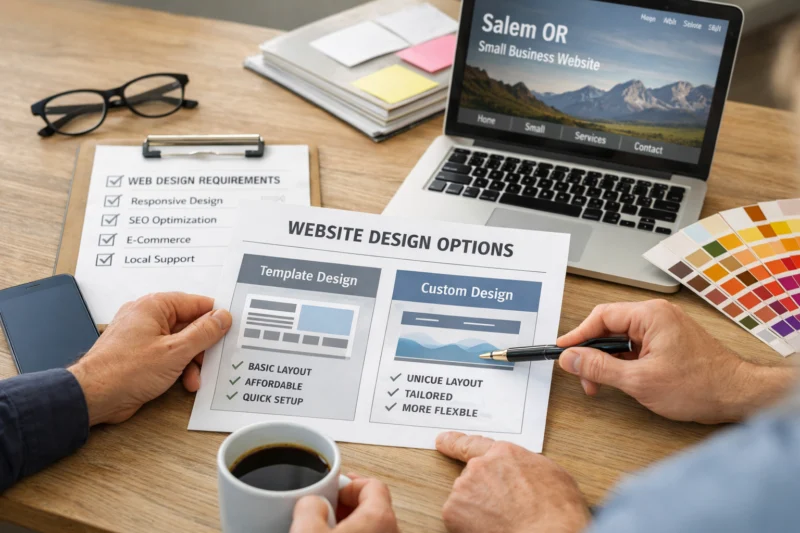
During early conversations, pay attention to whether they ask about your margins, lead sources, service area, and most profitable services. That is a strong sign they understand how small businesses actually operate. A Salem business owner often needs quick wins, limited revisions, and a clear path to launch, so the designer should be able to explain how they handle scope, approvals, and timelines without making the project feel vague or open-ended.
Trust signals matter a lot. You want a clear scope, realistic deadlines, transparent revision rounds, and written ownership terms for site assets, content, and logins. A designer who explains these details up front is usually more dependable than one who only talks about style. One useful test is to ask whether they can choose the best fit for your goals instead of pushing a standard package.
Do not confuse confident presentation with strategic competence. Some designers are excellent at sales conversations but weak at information structure, UX, or post-launch problem solving. The stronger choice is usually the person who can explain why a page exists, what action it should drive, and how the layout supports that goal. That is the kind of process you want if you plan to build a site that performs long after launch.
Compare Your Options: Freelancers, Small Agencies, and Local Studios
Most Salem-area small businesses will choose between a solo freelancer, a small web design agency, or a local boutique studio. A freelancer can be a smart choice for simple sites, tight budgets, and owners who want direct communication. A small agency may be better when you need strategy, copy, SEO, development, and ongoing support under one roof. A local studio often sits between the two, offering more continuity than a freelancer and more personal attention than a larger agency.
The best option depends on your business stage and how much support you need after launch. Startups often benefit from a nimble freelancer if the scope is narrow and the budget is strict. Service businesses and professional practices often do better with a small agency when they need messaging, lead generation, and technical setup handled together. Retail stores and growing brands may want a studio that can manage design changes, marketing support, and periodic updates without starting from zero each time.
There are hidden costs in every model. A freelancer may have limited capacity, which can slow revisions or delay launch if they are juggling other clients. Agencies can be more expensive, and some charge extra for items you thought were included, such as copy edits, forms, analytics setup, or post-launch changes. This is why you should compare the full scope, not only the headline price. If you are weighing a freelancer or agency, ask what happens when timelines change or the business needs new pages later.
| Option | Best For | Tradeoffs |
|---|---|---|
| Freelancer | Simple projects, tight budgets, direct communication | Limited capacity, less redundancy, variable support after launch |
| Small agency | Lead generation, growth-focused sites, multiple deliverables | Higher cost, more formal process, possible add-on fees |
| Local studio | Businesses wanting personalized service and ongoing help | May still have limited specialization compared with larger teams |
Local Fit Matters: Why Salem Experience Can Change the Outcome
A designer who knows Salem can often make better decisions about messaging, service-area wording, and trust-building content. They are more likely to understand how local customers think, what nearby competitors are saying, and how to position your business in a way that feels familiar without sounding generic. That can be useful for home services, healthcare, legal, hospitality, and other businesses where local trust plays a big role.
Local experience can also influence how the site handles search behavior. Someone familiar with the area may know when to emphasize neighborhood references, nearby landmarks, or regional service language instead of using broad city phrases that do not match how people search. If your business serves Salem and surrounding communities, that local understanding can support stronger content structure and help design for search visibility in practical ways.
That said, local expertise is not automatically enough. A designer can know Salem well and still miss important conversion or technical fundamentals. The risk is overvaluing “local” while ignoring whether the person understands mobile behavior, page hierarchy, or site performance. For some businesses, especially e-commerce brands or highly niche services, broader expertise may matter more than a geographic connection. Local knowledge helps, but it should not replace strong web strategy.
If you want the site to reflect local credibility, ask how the designer would balance Salem-specific language with scalable content. A good answer usually includes service pages, location cues, review strategy, and a plan for future expansion. That blend of local relevance and solid fundamentals is what separates a useful website from one that only feels locally branded.
Signs a Website Designer Understands Small Business Goals
A designer who understands small business goals will begin with discovery questions about leads, sales, customer types, and your most profitable services. They should want to know what your best customers buy, how they contact you, and where the current website is losing opportunities. If they ask only about colors and style, they may be thinking like a visual designer instead of a business partner.
Business-oriented design decisions are usually visible in the homepage hierarchy, navigation labels, calls to action, and mobile behavior. The site should guide visitors toward the next step without making them hunt for basic information. That matters because small business owners often have limited staff, and the website should reduce time spent answering repetitive questions. If you need a mobile friendly website, the designer should talk about tap targets, readable text, sticky contact options, and form simplicity, not just responsive breakpoints.
Post-launch support is another major signal. A site should not be treated as a one-time handoff if your business depends on it. Ask how changes are handled after launch, who updates content, and how reporting works. The best designers connect the website to real operational limits, such as appointment scheduling, sales follow-up, staffing availability, and the kinds of inquiries your team can actually handle. That is especially valuable for businesses that need a Salem website redesign because the old site no longer matches how the business operates today.
The deeper question is whether the designer understands that website work affects the rest of the business. A strong site can reduce wasted inquiries, improve intake quality, and make it easier for your team to respond consistently. That is the kind of thinking that creates long-term value.

Common Mistakes When Choosing a Web Designer in Salem
The biggest mistake is choosing based on price alone. Low-cost projects often look acceptable at launch but fail to convert, are hard to update, or create expensive fixes later. A better question is whether the site will help generate revenue, credibility, and operational efficiency over time. Cheap can become costly when the project needs extra pages, better copy, or technical cleanup that was never included.
Another mistake is assuming a beautiful portfolio proves the designer can handle your industry. A portfolio may show style, but it does not reveal whether the designer understands local buying behavior, content strategy, compliance needs, or conversion path design. A salon, contractor, accountant, and medical practice all need different information priorities, so industry fit matters a lot more than generic polish.
Ownership is also easy to overlook. You should clarify who owns the domain, site files, hosting account, theme licenses, content, and login access. If those details are vague, you can run into problems when you want to switch providers or make changes later. Poor communication and vague scope can create budget overruns even on projects that sounded simple at the start, especially when the designer and client are not aligned on revisions or approvals.
Many guides understate how much project success depends on communication. If updates are slow, expectations drift and decisions get delayed. That can hurt timelines more than actual design work. A clear process, defined deliverables, and written responsibilities often matter more than flashy demos or broad promises.
What Most Guides Get Wrong About Web Design Selection
Most generic advice focuses too much on design aesthetics and not enough on business fit. A website is not just a brand asset; it is a sales and service tool. If the designer ignores your business model, local competition, and the actions you want customers to take, the finished site may look professional but still underperform.
Another common misunderstanding is treating “responsive design” and “SEO-ready” as if they guarantee results. They do not. A responsive site may still bury contact details, bury key services, or fail to guide users toward conversion. Likewise, basic SEO setup is not the same as a strategy built around keywords, content structure, internal linking, and local intent. If you want a site that can design for search visibility, it has to be planned that way from the start.
Small businesses also need to think beyond launch. Maintenance, security, content support, and analytics all affect whether the site remains useful. A designer who only talks about launch date is overlooking the ongoing work that keeps the site effective. The best advice is not “find the prettiest site,” but “find the team that understands how the website supports operations, lead flow, and future updates.”
There is also a false assumption that every Salem business needs the same feature set. Some need appointment booking, some need quote forms, some need product pages, and some need strong service-area content. The right package depends on the customer journey, not a standard checklist. That is why strategy should come before features.
Pricing, Value, and Budgeting for a Salem Small Business Website
Website price usually depends on page count, design complexity, content writing, SEO setup, integrations, and maintenance. A simple brochure site with a few pages is very different from a conversion-focused site with custom forms, local SEO structure, booking tools, or e-commerce functions. When you compare proposals, make sure you understand exactly what is included and what is billed separately.
Value matters more than the sticker price. A website that brings in better leads, saves staff time, or reduces customer confusion can pay for itself faster than a cheaper site that only exists online. For many businesses, a slightly higher upfront investment reduces long-term rework and technical debt. That is especially true when the project includes content planning, proper setup, and a structure that can grow with the business.
Budgeting mistakes usually happen when owners cut scope too aggressively. They may remove pages, skip copywriting, or leave out analytics and then wonder why performance is weak. Another common problem is underestimating how many rounds of feedback are needed to get the messaging right. If you want reliable outcomes, the budget should cover the parts of the project that affect results, not just the visible design.
This is where you should think in terms of return, not expense. A website that supports better lead quality, smoother sales follow-up, and stronger credibility can contribute to revenue for years. That makes thoughtful budgeting one of the smartest decisions you can make before hiring.
Questions to Ask Before You Sign a Contract
Before you sign, ask how the designer handles discovery, wireframes, revisions, launch steps, and post-launch support. You want to know what the process looks like from kickoff through handoff so there are no surprises. A good designer can explain the workflow in plain language and tell you what decisions they need from you at each stage.
Also ask who provides copy, images, technical access, and approvals. This matters because delays often happen when the client and designer assume the other person is responsible. If you want a smoother project, you need clear ownership for each task. That includes domain access, hosting, analytics, form emails, and any integration credentials needed for the build.
Support questions are just as important. Ask about maintenance, updates, security, response time for issues, and what happens if a plugin update breaks a page. If the business changes mid-project, can the designer adapt without starting over? That flexibility matters more than many buyers realize. It is often the difference between a useful partner and a rigid vendor.
If the designer cannot explain these basics clearly, that is a warning sign. The contract should reflect the real working relationship, not just the launch deliverables. Clear questions now can prevent disappointment later.
Red Flags That Should Make You Pause
Vague promises are one of the biggest red flags. If a designer guarantees rankings, traffic, or instant growth without explaining the work required, they are overselling. Good web design can support visibility and conversions, but it cannot replace content, SEO, or market demand. Be cautious of anyone who makes results sound automatic.
Unclear pricing and missing timelines are another problem. If deliverables are not defined in writing, the project can balloon in scope and cost. You should know how many pages are included, how revisions work, what counts as a change request, and what support is available after launch. If these details are fuzzy, the project may become harder to control than you expect.

Polished portfolios can also be misleading if they do not show relevance to small business needs. A site may look elegant and still fail to provide practical results. Watch for overly rigid packages too. If the offer leaves no room for your actual business requirements, you may end up paying for features you do not need while missing the ones that matter. That kind of mismatch is one of the most common causes of regret.
Another subtle red flag is weak communication early on. If replies are slow before you pay, they are often slower after. For a business website, responsiveness matters because issues do not wait for a convenient time.
Advanced Considerations Most Buyers Overlook
Accessibility, analytics, conversion tracking, and content structure should be part of the buying decision, not afterthoughts. Accessibility helps more users navigate the site, analytics shows what is working, and conversion tracking helps you see which pages generate inquiries. If a designer skips these basics, you may launch a site that looks fine but gives you very little business insight.
Ownership and technical handoff also matter after launch. Ask who controls backups, hosting, updates, and security settings. If the process is not documented, you can run into trouble when something breaks or when you need to change providers. Poor handoff is one of the most expensive hidden problems because it can force extra work later even when the initial design is strong.
Edge cases deserve attention too. Multi-location businesses need location pages and consistent branding. Highly regulated industries may need more careful content review. Businesses that need frequent edits should ask for a setup that makes updates easy rather than requiring a developer for every small change. These details are often overlooked in generic proposals, yet they strongly affect long-term usability.
If you want a site that performs well over time, think beyond launch and ask how the structure will support future changes. That is where strong web strategy becomes a real business advantage.
Frequently Asked Questions About Salem Oregon Small Business Web Designers
How do I choose the right web designer for a small business?
Choose based on fit, process, and evidence of results rather than visuals alone. The best designer will ask about your customers, revenue goals, and service priorities, then explain how the site will support those outcomes.
Look for clear scope, realistic timelines, and ownership of site assets. A strong candidate can also show examples relevant to your business model, not just attractive layouts.
What should a Salem small business website include?
It should include core pages such as Home, About, Services, Contact, and any location or booking pages that support your business. Strong trust signals, mobile usability, and clear calls to action are just as important as the page count.
For Salem relevance, include location language naturally, plus local proof such as reviews, service-area details, or community references when appropriate.
How much does a small business website cost in Salem, Oregon?
Cost depends on page count, design complexity, copywriting, SEO setup, integrations, and ongoing support. A simple site can cost much less than a custom lead-generation build, but the cheapest option often leaves out important pieces.
Think about value, not just price, because a better site can reduce lost leads and rework later. Ask for a written scope so you can compare proposals fairly.
Should I hire a freelancer or a small agency?
A freelancer can be a good fit for smaller projects, tighter budgets, and direct communication. A small agency is often better when you need strategy, design, development, and support bundled together.
Choose based on your need for speed, specialization, and long-term maintenance. The right choice depends on how much help you need after launch, not just before it.
How long does a small business website project usually take?
Timelines vary based on scope, content readiness, and revision speed. A simple project may move faster, while a larger build with custom copy, SEO, or integrations will take longer.
Delays usually come from unclear approvals, late content, or expanding scope. A designer with a clear process should explain milestones before work begins.
Do I need local Salem experience in a web designer?
Local experience helps when messaging, service-area wording, and trust signals need to fit Salem buyers. It can also improve how the site reflects regional competition and local search behavior.
Still, broader conversion and SEO expertise can matter more than location alone. Local knowledge helps most when it is paired with strong web strategy.
What questions should I ask before hiring a web designer?
Ask about process, ownership, revisions, launch steps, and support after launch. You should know who writes copy, who provides images, and who controls the domain, hosting, and logins.
Also ask what happens if priorities change mid-project. A flexible designer will explain how changes are handled without derailing the build.
How can I tell if a designer understands conversions?
They should talk about lead goals, CTA placement, homepage hierarchy, and how users move through the site. Their portfolio should show sites that are built to drive action, not just to look polished.
Ask how they would improve inquiries, calls, or bookings for your specific business. The answer should connect design choices to real outcomes.
What are the biggest red flags when hiring?
Watch for vague promises, missing timelines, unclear pricing, and no written scope. Another red flag is reluctance to define ownership of files, hosting, and logins.
Also be cautious if the designer seems rigid about packages that do not fit your business. Good partners adapt the plan to the project.
What if I already have a website but need a redesign?
A redesign makes sense when the current site is outdated, hard to update, not mobile friendly, or failing to generate leads. Keep anything that still performs well, such as useful content, strong URLs, or pages with existing traffic.
Before changing everything, review analytics, search performance, and your best-converting pages. A smart redesign protects what works while fixing what does not.
Conclusion
The best choice for a Salem small business is rarely the cheapest or the flashiest option. It is the designer who understands your business goals, Salem context, and the practical work required to turn a website into a lead-generating asset.
As you compare candidates, focus on fit, process, transparency, conversion thinking, and long-term support. Use the same criteria for every proposal so the decision is easier to compare and less risky to make.
If you are ready to move forward, shortlist a few Salem web designers, review their process carefully, and request proposals that reflect your real goals. That approach will help you hire with confidence and build a site that supports your business well beyond launch.
For related planning, it can also help to review on-page SEO best practices, local search strategy, and website maintenance expectations before you sign anything.
Updated April 2026