

SEO metrics are the numbers that show how your site is performing in search, and the KPIs are the smaller set you actually manage against to decide whether the work is paying off. If you are asking which metrics matter and how to know whether SEO is working, the answer is to focus on visibility, traffic quality, and conversions rather than trying to watch everything at once. Understanding SEO metrics and KPIs helps you separate useful signals from noise so you can make better decisions about content, technical fixes, and reporting.
This matters more in 2026 because search teams are dealing with more data than ever: query variation, SERP features, zero-click results, AI-generated answer experiences, and mixed attribution across channels. Too many numbers create confusion; the right KPI set creates direction. When you measure the right things, you can tell whether a content update, a crawlability fix, or a better snippet is actually moving the business forward. That is the practical value of Understanding SEO metrics and KPIs in a modern reporting stack.
Contents
- 1 What SEO metrics and KPIs actually measure
- 2 The core metrics every SEO report should include
- 3 How to choose the right SEO KPIs for your goals
- 4 Comparing SEO measurement approaches: which view is best for what?
- 5 How to measure SEO success step by step
- 6 Common mistakes and misconceptions in SEO metrics tracking
- 7 Advanced considerations most guides get wrong
- 8 How to turn SEO data into decisions, not just reports
- 9 Frequently Asked Questions About SEO metrics and KPIs
- 9.1 What is the difference between an SEO metric and a KPI?
- 9.2 Which SEO metrics matter most for beginners?
- 9.3 How many KPIs should an SEO report have?
- 9.4 What are the best KPIs for measuring SEO ROI?
- 9.5 Why do SEO rankings and traffic not always match?
- 9.6 How do you know if SEO is improving overall?
What SEO metrics and KPIs actually measure
SEO metrics are individual signals, while KPIs are the few metrics tied directly to a business goal. A metric can tell you that something changed; a KPI tells you whether that change matters to the outcome you care about. In practice, metrics show search visibility, traffic quality, engagement, and conversions, while KPIs connect those signals to growth, revenue, leads, or retention.
This distinction matters because more traffic is not automatically better. If a page attracts visitors who bounce quickly or never convert, the raw traffic metric may look healthy while the SEO result is weak. That is especially common when a page begins ranking for broader, lower-intent terms or when informational content gets clicks that satisfy curiosity but not commercial need. A good reporting system filters the noise so you can see whether the audience matches the page purpose.
The same metric can mean different things depending on the page type and funnel stage. A blog post may be judged by assisted conversions and return visits, while a product page is more likely to be judged by organic revenue or add-to-cart rate. A ranking increase on a category page may matter much more than the same movement on a support article. This is why SEO measurement works best when it is tied to page intent, not treated as one universal scoreboard.
One common mistake is treating every metric as equally important. That leads to dashboards full of numbers but no decisions. A better approach is to group metrics by what they tell you: discoverability, engagement, and business outcomes. If you need a deeper measurement framework, this is where data driven SEO becomes practical instead of theoretical, because each number has a role in diagnosis rather than acting as a vanity signal.
The core metrics every SEO report should include
Every useful SEO report should include a small set of core metrics that show whether search visibility is turning into business value. The most important are organic impressions, clicks, average position, CTR, organic sessions, organic users, and at least one conversion metric such as leads, sales, or sign-ups. Together, these numbers show how often searchers see you, how often they choose you, what they do after clicking, and whether the visit produces value.
Organic impressions tell you discoverability. If impressions rise, your pages are appearing in more searches, even if traffic has not caught up yet. Organic clicks show actual visits from search, but clicks only make sense when paired with impressions and CTR. Average position and rankings can be useful, but they should be read cautiously because small shifts can be normal, and average position can hide wide variation across query groups, device types, and countries.

CTR is often where the real story begins. A low CTR can mean the snippet is weak, the query intent is mismatched, or a SERP feature is stealing attention. That is why teams trying to improve organic CTR should inspect titles, meta descriptions, schema, and the competitive appearance of the results page. In Search Console terms, strong Search Console metrics without corresponding sessions in analytics may mean your site is visible but not drawing enough clicks or not being measured consistently.
Organic sessions and users belong in the report because analytics captures post-click behavior that Search Console cannot. Search Console tells you what happened in search results; analytics tells you what happened on the site. When you connect the two, you can see whether a keyword win also produced qualified visits, and that is where analytics conversion tracking becomes essential. If clicks rise but conversions fall, the issue is usually not visibility alone; it is often relevance, friction, or a mismatch between the promise in search and the experience on the page.
The most business-facing metric is conversion-related outcomes. That may be leads, purchases, demo requests, newsletter sign-ups, or assisted conversions in a longer purchase cycle. This is also the clearest way to evaluate SEO campaign ROI. A page can improve in traffic and rankings while performance worsens if the new traffic comes from low-intent queries or non-buying audiences. The metric improved, but the business result did not.
For practical reporting, connect these metrics to supporting content like technical SEO impact reviews, on-page SEO best practices, and conversion rate optimization audits. If the numbers show traffic growth but a weak revenue path, you may need to boost conversion performance before chasing more impressions. If clicks are the issue, the answer may be to improve organic CTR rather than rewrite the whole page.
How to choose the right SEO KPIs for your goals
The right SEO KPIs come from the business objective, not from the dashboard. If the goal is awareness, visibility and reach matter most; if the goal is lead generation, qualified sessions and form fills matter more; if the goal is ecommerce revenue, transactions and conversion rate matter most; and if the goal is retention, returning visits and assisted actions may be more useful than first-click traffic. Good KPI selection begins with the question, “What are we trying to achieve through search?”
A simple way to organize KPIs is by type: visibility KPIs, engagement KPIs, and outcome KPIs. Visibility KPIs include impressions, ranking distribution, and share of voice for target queries. Engagement KPIs include CTR, engaged sessions, scroll depth, and page interaction patterns. Outcome KPIs include leads, sales, subscriptions, demo requests, and assisted conversions. This structure helps teams see which numbers are leading indicators and which are lagging indicators.
Page intent and funnel stage should decide whether a metric is a KPI or just context. A top-of-funnel blog article might be monitored for qualified organic sessions and assisted conversions, while a bottom-of-funnel landing page should be judged on direct conversions and conversion rate. If you use the same KPI set for all page types, you will misread results and chase the wrong fixes. That is one reason many reports look busy but fail to guide action.
Vanity KPIs are a common trap. These are numbers that look impressive but do not help decision-making, such as raw impressions without click quality, or average position without query context. A stronger KPI is one that changes behavior: if it drops, someone investigates; if it improves, the team knows what to repeat. For teams building a more rigorous SEO reporting system, this is where SEO campaign ROI should be framed around business outcomes rather than ranking screenshots.
To keep the KPI set usable, define what each metric means for the team that owns it. Content teams may own engagement and snippet performance, while technical teams may own indexation and crawl health. Revenue teams may own conversions and assisted value. That alignment matters because the best KPI is not the most popular one; it is the one that supports a decision.
Comparing SEO measurement approaches: which view is best for what?
No single SEO tool gives you the full picture, which is why discrepancies are normal and should be interpreted rather than “fixed” blindly. Search Console, analytics, rank tracking, and executive dashboards each answer different questions. The best measurement setup uses them together so visibility, behavior, and business value can be read in context.
| Measurement view | Best for | Main limitation |
|---|---|---|
| Search Console | Query-level visibility, CTR, impressions, indexation signals | Does not show full on-site behavior or revenue directly |
| Analytics | Sessions, engagement, conversions, user journeys | Search intent and query detail are limited or indirect |
| Rank tracking | SERP movement, competitive monitoring, keyword groups | Can overstate value without business context |
| Dashboard/reporting | Executive summaries and decisions | Can hide detail if not linked to source data |
Search Console is the best place to understand query-level performance because it shows impressions, clicks, CTR, and average position directly from search results. That makes it ideal for spotting pages that are visible but under-clicked, pages that are gaining impressions, and pages that may have indexation issues. It is also the natural place to analyze Search Console metrics for content pruning, query expansion, and snippet testing.
Analytics is the better lens for user behavior signals because it shows what happens after the click. You can compare engagement, conversion paths, and landing-page quality, which helps you understand whether the search visit is actually valuable. If your team is focused on analytics conversion tracking, this view tells you whether SEO is producing meaningful business actions rather than just entrances.
Rank-tracking tools are essential for monitoring SERP movements and assessing competition, particularly when focusing on a select group of strategic keywords. However, relying solely on ranking data without understanding the context can lead to misinterpretations, as a keyword might improve in rank while the associated page loses clicks due to a SERP feature or shifting user intent. In contrast, executive dashboards excel when they distill data into clear, actionable insights for leadership, such as visibility targets, organic revenue, and crucial conversion trends. For many teams, a well-designed dashboard should facilitate a smooth user experience in reporting, seamlessly guiding users from signal to insight and then to action.
The best way to interpret differences between tools is not to force them to match exactly. Search Console, analytics, and rank trackers use different methodologies and sampling rules. A page can show more impressions in Search Console, fewer sessions in analytics, and stable rankings in a tracker all at once, and that does not automatically mean something is broken. The job is to read the pattern, not chase perfect numeric agreement.
How to measure SEO success step by step
Measuring SEO success starts with a clear business objective and a page-level goal before any metric is chosen. That means deciding whether the page should build awareness, generate leads, support ecommerce revenue, or assist retention. If the objective is not defined first, the report will usually become a list of numbers without a decision path.
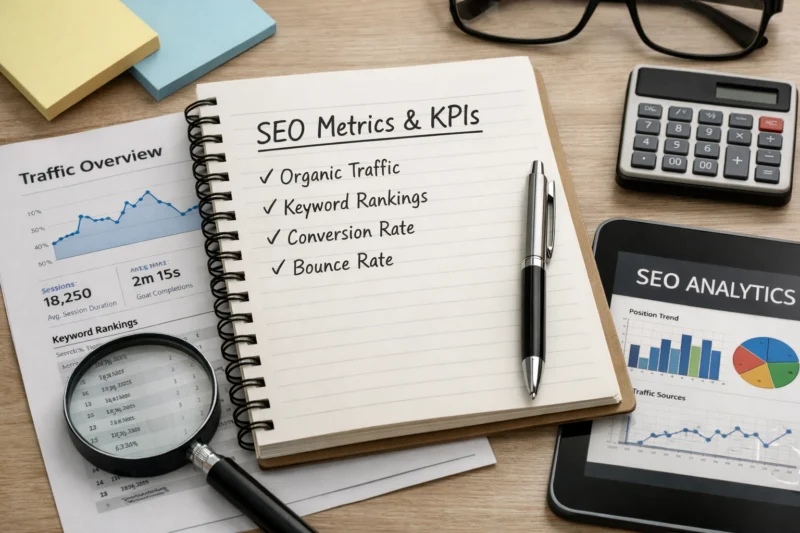
Next, establish a baseline using recent historical data and seasonality context. Compare current performance to the right period, not just the previous week. Some pages naturally fluctuate by season, product cycle, or news cycle, and the KPI review should reflect that. A page selling winter apparel, for example, will not be judged fairly using summer traffic as the benchmark, and a recruitment page may move based on hiring cycles rather than content quality.
Then select 3–7 KPIs that match the objective, plus a small set of supporting metrics. Fewer metrics are usually better because they keep reporting focused and actionable. Weekly reporting works well for movement, monthly reporting works well for trend evaluation, and quarterly reporting is better for outcome review and strategic decisions. For business teams, the role of technical SEO impact, content performance, and conversion behavior should all be visible enough to explain why the KPI moved.
To isolate SEO impact from other channels, promotions, and seasonal shifts, compare search-driven changes against non-search baselines and recent campaign activity. If a social campaign or email promotion coincides with a traffic spike, the SEO report should not claim that SEO caused the full lift. The same is true when a site redesign changes page templates, internal links, or tracking behavior. Data driven SEO only works when attribution is disciplined.
One practical way to avoid confusion is to separate leading and lagging indicators. Impressions, indexation coverage, and CTR can move earlier than revenue, while leads and sales often lag behind content or technical work. This lets the team know whether the SEO engine is improving before the business result fully lands. It also helps avoid overreacting to short-term swings that are just the normal delay between discovery and conversion.
Common mistakes and misconceptions in SEO metrics tracking
The biggest mistake in SEO reporting is treating rankings as the only sign of success. Rankings are useful, but they are not the whole story because they do not show whether users clicked, engaged, or converted. A page can rank well and still underperform if the snippet is weak or the intent does not match the page promise.
Another common error is chasing traffic growth without checking intent quality. Traffic can rise because a page starts ranking for broad informational queries that do not align with the business goal. In that case, the metric improves while performance worsens. This happens often on content hubs where broad visibility creates more clicks but fewer qualified leads. The fix is not always to cut traffic; it is sometimes to refine targeting, improve internal links, or adjust calls to action so the page better supports the next step.
People also confuse correlation with causation when changes happen after a site update. If traffic drops after a redesign, the redesign may be the cause, but it could also be seasonality, SERP changes, indexing issues, or a competitor’s surge. That is why the report should tie metrics to a cause category instead of making assumptions too early. A structured review of user behavior signals and crawl data will usually reveal more than a single graph.
Comparing metrics across unrelated page types is another frequent mistake. A blog article, a category page, a product page, and a support article should not be judged by the same conversion expectation. Average position can also hide huge variance across queries, devices, and locations, which is why one “good” average can disguise poor performance in the markets that matter most. SEO measurement becomes credible when the expectations match the page role.
Many teams also overlook that rankings and traffic can diverge because of SERP layout, featured snippets, image packs, or AI-generated answer panels. Those features can reduce clicks even when visibility remains high. If a team only watches rank position, it may miss the real issue: the results page changed, not the page quality. That is why modern reporting should always connect search visibility with behavior and business outcomes.
Advanced considerations most guides get wrong
Advanced SEO measurement starts with segmentation. Metrics should be split by device, country, page type, and query intent because aggregated numbers can hide important differences. A page that performs well on desktop may underperform on mobile due to layout, speed, or intent differences. A keyword cluster that looks strong in one country may be weak in another because language, seasonality, or SERP composition differs.
Branded and non-branded search must also be separated. Branded queries often inflate performance because they reflect existing awareness, not necessarily new search growth. If a report mixes them together, the business may overestimate how much new demand SEO is creating. This is particularly important for established sites where a large share of clicks comes from brand navigation rather than discovery. A mature SEO dashboard should show both so leaders can see whether the channel is expanding beyond brand demand.
CTR and clicks are also changing in a world with more SERP features, zero-click behavior, and AI-generated answer experiences. Sometimes a page gains impression share but loses clicks because the search result no longer needs to be clicked to answer the query. That does not always mean the content failed. In some cases, it means the search environment changed and the KPI definition needs to adapt. For queries where the search result itself resolves the question, visibility may matter more than visits.
Some SEO wins are efficiency wins rather than volume wins. Fewer clicks with a higher conversion rate can be better than more clicks with no business value, especially for expensive lead generation or limited-inventory ecommerce. This is where boost conversion performance matters as much as scaling traffic. A well-optimized page can improve revenue even if total sessions are flat, because the traffic is better qualified and the page is more persuasive.
Seasonal demand, inventory limits, and lead quality can make traditional comparisons misleading. A store may show lower organic sessions but higher sales because stock availability improved and product match quality increased. A service site may receive fewer leads but better ones, which shortens sales cycles and raises close rates. These cases are why SEO teams should measure both volume and quality and use the right benchmark for the business model.
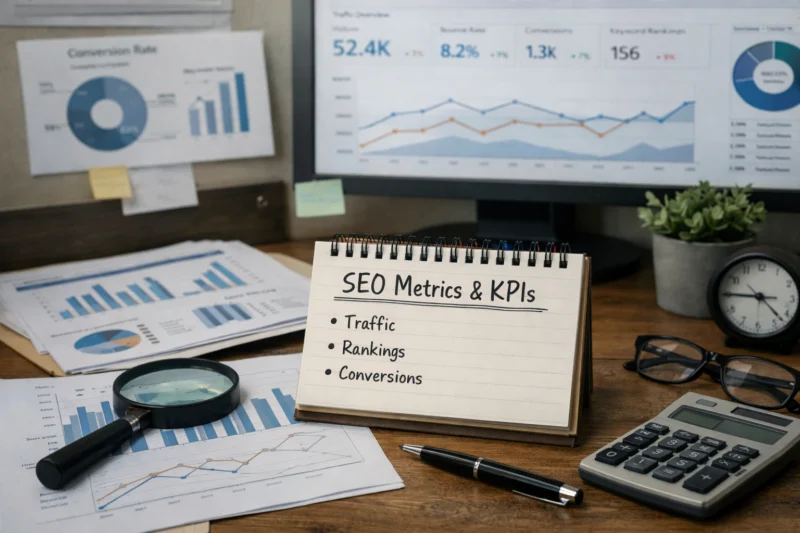
For teams managing complex sites, internal links around technical audits, content optimization, and conversion paths can support deeper analysis. That often includes topics like technical SEO impact, improve organic CTR, and user behavior signals, all of which help explain why a metric changes and what action should follow. Strong reporting also depends on the seamless user journey from search result to landing page to conversion.
How to turn SEO data into decisions, not just reports
SEO data becomes useful when every KPI has an action threshold. A threshold is the point where the team knows whether to investigate, optimize, or leave the page alone. For example, a declining CTR on a high-impression page may trigger snippet testing, while a stable CTR with falling impressions may point to indexing or demand changes. Without thresholds, reports tend to describe what happened without telling anyone what to do next.
Each KPI should also be paired with a likely cause category. If organic clicks are down, the cause may be content relevance, technical visibility, or SERP presentation. If conversions are down, the cause may be conversion friction, weak intent alignment, or a poor post-click journey. If rankings change but conversions do not, the issue may be that the page is moving in the wrong query set. This kind of diagnostic framing keeps teams from treating every problem as a content problem.
Trend patterns help you decide whether the issue is isolated, page-specific, or sitewide. A single page with declining CTR may need a title rewrite, while a sitewide decline in impressions may suggest crawl, indexation, or demand issues. A category of pages losing conversions but gaining traffic may need stronger offers, better calls to action, or better alignment with buying intent. This is where SEO, UX, and CRO intersect in a practical workflow rather than as separate disciplines.
A good review cadence turns SEO into an operating system instead of a status meeting. Weekly checks should be light and movement-focused, monthly reviews should compare trends and causes, and quarterly reviews should decide what to scale, fix, or stop. The goal is not to admire the dashboard. The goal is to prioritize experiments and content work based on the clearest evidence.
One thing most guides get wrong is “dashboard theater,” where metrics are displayed but not assigned. Every KPI should have an owner and a next step tied to it. If impressions fall, who investigates search visibility? If conversion rate drops, who owns the landing page experience? If CTR is weak, who updates the snippet and message? That operating discipline is what makes data driven SEO valuable in real organizations.
For deeper planning, it helps to connect reporting with topics like SEO campaign ROI, analytics conversion tracking, and Search Console metrics so every team can trace the path from search discovery to revenue. That way, the report does more than summarize performance; it creates accountability and action.
Frequently Asked Questions About SEO metrics and KPIs
What is the difference between an SEO metric and a KPI?
An SEO metric is any measurable signal, while a KPI is the subset tied to a business goal and decision. For example, impressions and rankings are metrics, but organic revenue or qualified leads are often KPIs because they connect directly to outcomes.
Which SEO metrics matter most for beginners?
The starter set is impressions, clicks, CTR, organic sessions, rankings, and one conversion metric. That combination gives a beginner enough visibility to see what is happening in search results, on the site, and in the business outcome.
How many KPIs should an SEO report have?
Usually 3–7 KPIs are enough for a focused report. More than that often creates noise, while fewer than that can miss important context; the right number depends on the business objective and page types being tracked.
What are the best KPIs for measuring SEO ROI?
Revenue, leads, conversion rate, and assisted conversions are the most useful ROI KPIs. Attribution is never perfect, so the best practice is to pair direct outcomes with supporting metrics that show how SEO contributed along the path.
Why do SEO rankings and traffic not always match?
Rankings and traffic can diverge because of intent changes, CTR shifts, SERP features, seasonality, and query mix changes. A page may rank higher but get fewer clicks if the result page changes or if the query starts resolving without a visit.
How do you know if SEO is improving overall?
You need to review visibility, traffic quality, and business outcomes together. If impressions, clicks, engagement, and conversions are all moving in the right direction over the same period, SEO is likely improving in a meaningful way.
SEO metrics tell you what is happening, but KPIs tell you what matters. The best measurement system does not collect every number available; it chooses a small set of business-aligned indicators and uses the rest as context. When you balance visibility, engagement, and outcomes, you get a clearer view of whether SEO is actually helping the business.
The most reliable reporting also respects interpretation. Trends, segments, page intent, and seasonality usually explain more than any single raw number can. If you want stronger reporting, start by auditing what you track today, trimming vanity metrics, and defining 3–7 KPIs tied to one clear goal. That is the simplest path to better SEO decisions in 2026.
Updated April 2026