
Salem Web Design For Small Businesses should be built to turn local visitors into calls, quote requests, bookings, and store visits, not just to look polished. For Salem business owners, the real win is a site that improves visibility, builds trust fast, and makes it easy for nearby customers to take the next step.
That matters more in Salem than many owners realize because local buyers often compare a few businesses quickly, scan reviews, and decide based on clarity, credibility, and convenience. A website that looks good but hides the offer, buries contact details, or loads slowly on mobile will usually lose leads before a conversation even starts.
In practice, the best approach combines local design planning, strong messaging, and the right structure for how Salem customers search and decide. Whether you run a service business, a professional firm, or a storefront, the site should guide people from first impression to inquiry with as little friction as possible.
Contents
- 1 What Salem Small Businesses Actually Need From a Website
- 2 How to Plan a Web Design Project That Produces Leads
- 3 Salem Local SEO and Location Signals That Support Conversions
- 4 Design Elements That Turn Visitors Into Leads
- 5 Common Mistakes Salem Business Owners Make With Web Design
- 6 Salem Web Design Options: DIY, Freelancer, or Agency
- 7 What to Look for in a Website Partner for Salem Small Businesses
- 8 Advanced Considerations Most Salem Web Design Guides Get Wrong
- 9 How to Evaluate Whether a New Site Will Convert Before It Launches
- 10 Frequently Asked Questions About Salem Web Design for Small Businesses
- 10.1 How much does Salem web design for a small business cost?
- 10.2 How long does a small business website take to build?
- 10.3 What makes a website convert more leads?
- 10.4 Do I need local SEO with my web design?
- 10.5 What pages should a small business website have?
- 10.6 Is a one-page website enough for a Salem business?
- 10.7 How do I know if my website is outdated?
- 10.8 What should I ask before hiring a web designer?
- 10.9 How can I tell if my current site is losing leads?
- 10.10 What’s the best website approach for a service business in Salem?
- 11 Conclusion
What Salem Small Businesses Actually Need From a Website
A Salem small business website needs one primary job: generate the action that creates revenue. That action might be a phone call, a form fill, a quote request, an appointment booking, or an in-store visit depending on the business model.
The right website for a contractor in Salem is not the same as the right website for a boutique, dentist, or accountant. Service businesses usually need strong lead capture, service detail pages, and trust proof. Retail businesses need location clarity, product discovery, hours, and easy directions. Professional firms need authority, clear positioning, and a low-friction way to request a consultation. The site structure should reflect that reality instead of forcing every business into the same template.
This is where many owners get stuck. They invest in visual polish but ignore whether visitors can understand what the company does, who it helps, and what to do next. A visually impressive site can still fail if the offer is vague, the navigation is confusing, or the call to action is hidden below the fold. Strong small business development starts with conversion goals first, design second.
At minimum, most lead-focused sites need a focused homepage, service pages, an about page, a contact page, and location or service-area details when geography matters. If the business serves multiple customer types, the site may also need dedicated pages for each core service. The best sites use a clear navigation structure so people can move from interest to action without guessing where to click.
How to Plan a Web Design Project That Produces Leads
Plan the website around business goals, target customers, and the exact action you want visitors to take. If you do not define that up front, the design process becomes subjective and revisions multiply because nobody is judging the site against a measurable outcome.
The structure should follow user intent. A Salem homeowner looking for emergency plumbing wants different information than a business owner looking for a long-term marketing consultant. That means the homepage should introduce the business clearly, service pages should answer service-specific questions, and conversion pages should remove friction with direct calls to action. This is one of the core advantages of SEO driven web design: it aligns page structure with what people actually search for and what they need to decide.
Before design begins, gather the essentials: target service areas, priority services, ideal customer profile, proof points, brand positioning, common objections, and the specific lead flow you want. The stronger the input, the less expensive the revisions later. Weak positioning is a common failure point because even elegant design cannot fix a message that is too broad, too generic, or too similar to every competitor in town.
Good planning also helps your design partner decide whether the site needs custom copy, photo direction, conversion tracking, or a deeper content strategy. Many delays come from owners asking design questions before the business fundamentals are clear. If the offer is blurry, the website will be blurry too, no matter how premium the visuals are.
Salem Local SEO and Location Signals That Support Conversions
Local search visibility and web design work together because people rarely convert from design alone; they convert when a site feels relevant, trustworthy, and easy to verify as local. For Salem businesses, that means the website should support both discovery and confidence.
On-page location cues help visitors confirm that the business truly serves Salem or the surrounding area. That can include a visible address, service-area references, embedded map context where appropriate, local testimonials, and page copy that names nearby communities naturally. The goal is not to cram “Salem” into every paragraph. It is to signal relevance in a way that feels human and credible.
Service-area pages can be useful when a business serves Salem plus nearby towns, but they should only exist when they add unique value. Thin duplicate pages created just to chase keywords can hurt trust and may not help rankings. Natural references, real job examples, and genuine area coverage are more effective than repetitive location stuffing. This is especially important when combining local search visibility with conversion goals, because traffic that lands on a spammy page often leaves before contacting anyone.
Trust details matter too: accurate business hours, direct phone number, staff names, review snippets, and clear service descriptions all help. For businesses that rely on a physical location, map and direction cues can reduce hesitation. For service-area businesses, explanation of how travel or scheduling works can do the same. Local relevance should always feel practical, not forced.
Design Elements That Turn Visitors Into Leads
The highest-converting pages make the offer obvious immediately. Above the fold, visitors should understand what the business does, who it helps, and how to take the next step within seconds.
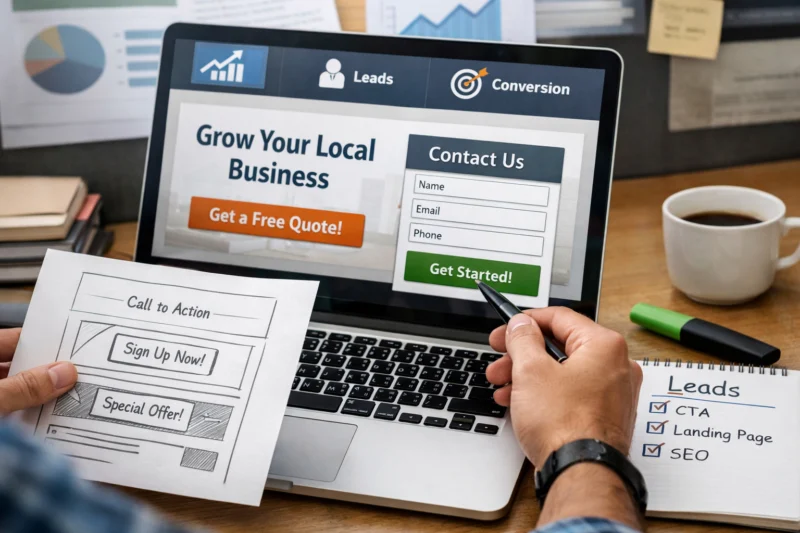
That starts with the headline, supporting text, and call-to-action placement. If the hero section is all branding and no substance, users have to work too hard to figure out the value. A strong CTA can be as simple as “Request a Quote,” “Book a Consultation,” or “Call for Same-Day Service,” but it should match the business model and the buyer’s urgency. This is where conversion focused UX matters more than decorative details. Visitors need a path, not a puzzle.
Trust-building elements make that path easier. Testimonials, review snippets, certifications, association logos, before-and-after examples, case studies, and local proof all reduce uncertainty. People in Salem often compare a few providers before making contact, so the site has to answer the quiet question: “Can I trust this company?” The answer should be visible without digging.
Mobile-first layout, readable copy, and simple forms are also direct conversion drivers. If forms ask for too much too soon, or if buttons are tiny on phones, leads drop. The same is true when a “pretty” design adds distracting animations, oversized sliders, or hidden menus that slow the user down. In accessible website design terms, clarity helps more people complete the next step, including users with impairments or temporary limitations.
For broader support, fast loading and image optimization matter because even good content can underperform when the page feels heavy. Clean hierarchy, short sections, and visible contact options usually beat flashy layouts that make the user hunt for the offer.
Common Mistakes Salem Business Owners Make With Web Design
The most common mistake is building a site around aesthetics instead of lead generation. Owners often approve a design because it feels modern, but later discover the homepage does not explain the offer, the service pages are too thin, or the contact path is buried.
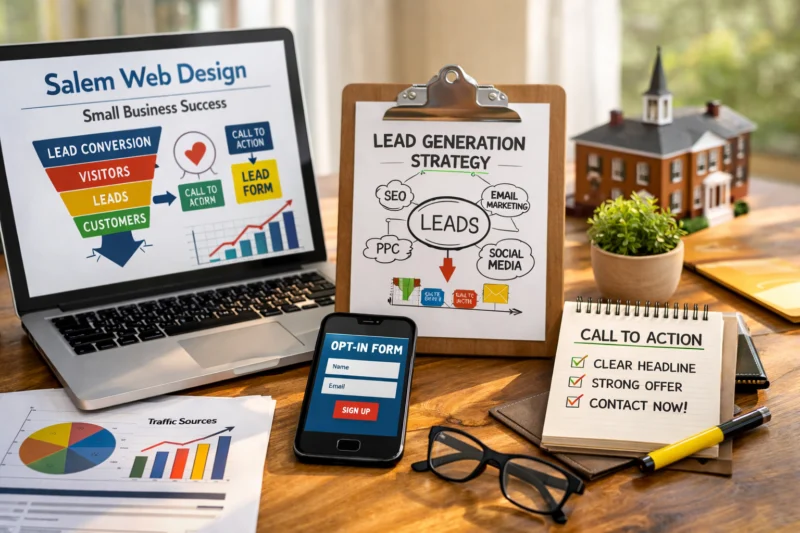
Another problem is generic copy. If the site sounds like every other business in the region, it does not help visitors decide why they should choose you. Generic wording also weakens SEO because it fails to match the actual questions Salem customers ask. Strong web copy should speak to the specific service, the local market, and the pain points that motivate the inquiry. That is why reviewing common design mistakes before a redesign can save both time and revenue.
Hiding contact options is another preventable issue. Some sites force visitors through multiple clicks, lengthy forms, or vague menu labels before they can ask for help. Others ask for unnecessary details too early, which creates friction. The simpler the inquiry path, the more likely a visitor will complete it.
Many owners also assume traffic alone will solve poor results. It will not. If the offer is weak, the messaging is unclear, or the page hierarchy makes the next step hard to find, more traffic just exposes the problem faster. That is why the first improvement is often not “more marketing” but better page structure and clearer conversion logic.
Salem Web Design Options: DIY, Freelancer, or Agency
DIY is best when budget is tight, the site is simple, and the owner has time to learn the platform. Freelancer works well for smaller projects that need custom attention without agency overhead. Agency makes more sense when the website needs strategy, copy support, SEO, branding, and conversion planning in one coordinated process.
The right choice depends on scope, not just price. A DIY site can get a business online quickly, but it often lacks strategy, tracking, and polish in the right places. A freelancer may deliver a better-looking site and stronger customization, but the quality depends heavily on their process and range of skills. An agency usually brings more structured planning, but the investment is higher and the process may feel more formal. If the project is complex, the extra coordination can be worth it; if the need is very small, it can be overkill.
Here is a simple comparison to help weigh the options:
| Option | Best For | Main Strength | Main Tradeoff |
|---|---|---|---|
| DIY | Very small budgets, simple sites | Lowest upfront cost | Limited strategy and rework risk |
| Freelancer | Small businesses needing custom support | Flexibility and lower cost than agency | Skill sets vary widely |
| Agency | Lead generation, SEO, and growth-focused builds | Process, breadth, and strategy | Higher cost and sometimes longer timelines |
The cheapest option often becomes the most expensive if it requires a redesign, missed leads, or a second round of development. In many cases, the real cost is not the build fee; it is the revenue lost while the site fails to convert. That is why small business development should be evaluated as an investment in lead flow, not just a design purchase.
What to Look for in a Website Partner for Salem Small Businesses
The right partner should understand both the Salem market and the mechanics of lead generation. That means they talk about goals, audience, conversion paths, and measurement instead of only colors, fonts, and homepage mockups.
Look for proof that they can do more than make a site look good. Ask for examples of lead-focused work, page strategy, copy guidance, mobile optimization, and launch planning. If they can explain how they think about user behavior, SEO basics, and form completion, that is a much stronger sign than a portfolio full of attractive screenshots. A strong partner will also think in terms of clear navigation structure and page intent, because those are the details that help users move from browsing to contacting.
Process quality matters. Good projects usually include discovery, wireframes, content planning, design review, development, testing, and post-launch support. If a proposal jumps straight to visuals without discussing business goals, that is a warning sign. The best website partner is not the one with the fanciest pitch deck; it is the one who can explain how the site will support revenue.
Also check whether they understand analytics and basic conversion tracking. Without measurement, you cannot tell whether the site is improving inquiries or merely looking better. A capable partner should be able to discuss forms, calls, events, and lead attribution in plain language. That is part of finding the right design partner for a Salem business, especially when the website needs to support growth over time.
Advanced Considerations Most Salem Web Design Guides Get Wrong
Many guides ignore the complexity of businesses that serve multiple locations or large service areas. A Salem company may work locally, travel across nearby communities, or serve both residential and commercial customers. The site has to reflect that scope without becoming confusing or thin.
That often means creating service pages that map to intent, plus location or area pages only when they are genuinely helpful. The content should explain where you work, what kinds of jobs you take, and how customers from different areas should contact you. This is one of the places where local search visibility intersects with lead quality: the page should attract the right visitor, not just any visitor. If you rank for a term that brings the wrong audience, traffic can rise while inquiries stay flat.
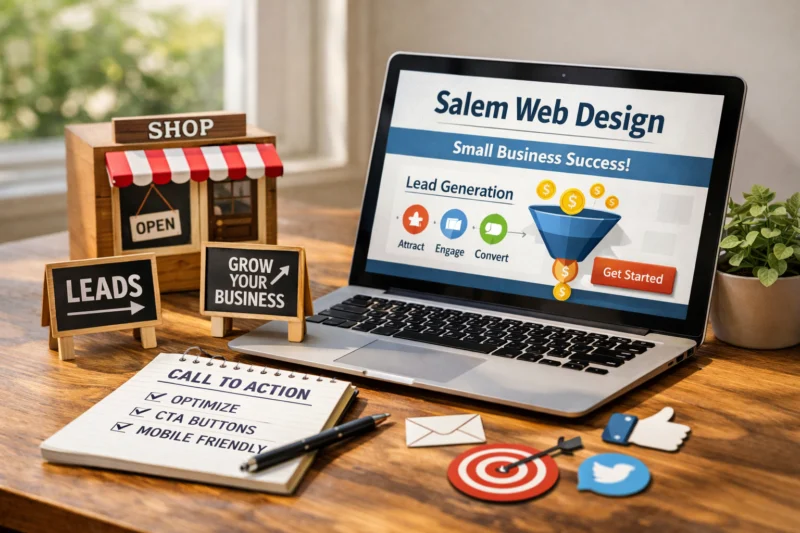
Measurement is another area many guides oversimplify. Accessibility, analytics, call tracking, and form tracking are not “extras” for serious sites; they are growth tools. Without them, you cannot tell whether visitors are dropping off because the form is too long, the CTA is unclear, or the page loads too slowly. You can also miss important issues like inaccessible labels, low contrast, or broken keyboard navigation that silently reduce conversions.
The other mistake is assuming more content always means better results. Content depth helps when it answers real questions and objections. It hurts when it becomes bloated or unfocused. Good pages rank because they match intent and provide useful detail. Better still, they convert because the structure supports decision-making. That is where SEO driven web design has an edge over generic design: it connects relevance with measurable business outcomes.
How to Evaluate Whether a New Site Will Convert Before It Launches
Evaluate the site by following the visitor journey from first impression to inquiry. If a person lands on the homepage, can they understand the offer in seconds, see proof quickly, and know exactly what to do next?
Start with the message. The homepage should clearly state what the business does and who it serves. Then check whether the CTA is visible and specific. After that, review the service pages to see whether they answer objections, explain the process, and present enough proof to build confidence. If the pages feel scattered or overly clever, they may look good in design review but fail in the real world.
Technical readiness matters too. The site should be mobile responsive, fast enough to feel immediate, indexed correctly, and set up with analytics and conversion tracking. Forms should be tested end to end, phone numbers should be clickable, and all contact paths should work on a phone. One of the most overlooked pre-launch checks is friction testing: ask someone unfamiliar with the business to complete the main task without help. If they hesitate, the site likely needs simplification.
This is also the stage to confirm that the content supports both trust and action. If the site looks polished but the next step is unclear, it is not ready. If the structure is solid but the page lacks proof, it is not ready either. A launch is successful when the page flow, messaging, and measurement all support real leads rather than just traffic.
Frequently Asked Questions About Salem Web Design for Small Businesses
How much does Salem web design for a small business cost?
Cost depends on scope, customization, content needs, SEO support, and whether the project includes strategy or conversion tracking. A simple brochure site costs less than a lead-focused build with custom pages, copy support, and integrated analytics.
How long does a small business website take to build?
Timelines vary by project size and how quickly content, approvals, and feedback are provided. Smaller sites can move in weeks, while more strategic builds take longer because planning and revisions matter.
What makes a website convert more leads?
Clear messaging, strong CTA placement, trust elements, mobile usability, and low-friction forms usually have the biggest impact. A website converts better when visitors can understand the offer and contact the business without extra effort.
Do I need local SEO with my web design?
Yes, if you want nearby customers to find you through search and feel confident that you serve their area. Design and local SEO should support each other so the site ranks well and converts well.
What pages should a small business website have?
Most need a homepage, service pages, an about page, and a contact page. Businesses with multiple services or locations often benefit from additional pages that target specific customer intent.
Is a one-page website enough for a Salem business?
It can work for very simple offerings or short-term campaigns, but it usually limits SEO and depth. Service businesses that need explanation, trust building, or multiple lead paths typically do better with more pages.
How do I know if my website is outdated?
Common signs include poor mobile usability, slow loading, weak calls to action, outdated visuals, and limited trust signals. If visitors have to hunt for contact details or the site does not feel current, it is probably holding you back.
What should I ask before hiring a web designer?
Ask about their process, deliverables, revision policy, SEO support, analytics setup, and who owns the finished site. You also want to know how they approach strategy, not just design production.
How can I tell if my current site is losing leads?
Look for low call volume, form abandonment, high bounce on service pages, or lots of traffic with little contact activity. Analytics, heatmaps, and basic form tracking can reveal where visitors are dropping off.
What’s the best website approach for a service business in Salem?
The best approach is a lead-focused site that balances design, local relevance, proof, and inquiry flow. Service businesses usually need clear service pages, trust signals, and simple ways to request a quote or call.
Conclusion
Effective Salem web design for small businesses is about converting local interest into inquiries, not just producing a polished look. The best sites combine clarity, trust, local relevance, mobile usability, and a structure that makes the next step obvious.
The right approach depends on your goals, budget, timeline, and whether your current site already has momentum. If you already have traffic but weak leads, focus on conversion fixes first. If you are starting fresh or rebuilding from the ground up, plan the strategy before the visuals so the site is built to perform.
If you are deciding between options, request an audit, compare build approaches, or book a strategy consultation so you can choose the path that fits your business goals. A better-looking site is nice, but a site that consistently brings in leads is what actually grows a Salem business.
Updated April 2026