
Search engine marketing is the practice of gaining visibility in search results by paying for ads on relevant queries. It matters because it places your offer in front of people who are actively looking for information, products, or services, which can drive traffic, leads, and sales faster than many other channels.
In practical terms, search engine marketing usually means paid search visibility through search ads, though marketers sometimes use the term more broadly. This article will help you understand what SEM is, how it works, how it compares with related tactics, and how to judge whether it fits your business goals.
Contents
- 1 What search engine marketing actually means
- 2 How search engine marketing works from query to click
- 3 Why businesses use search engine marketing
- 4 How to evaluate whether search engine marketing is the right fit
- 5 Search engine marketing vs SEO vs other search options
- 6 Core components of a successful SEM campaign
- 7 How to build a search engine marketing strategy step by step
- 8 What to look for in SEM keywords and audience signals
- 9 Common search engine marketing mistakes and misconceptions
- 10 Advanced considerations most SEM guides get wrong
- 11 Measuring search engine marketing performance the right way
- 12 Frequently Asked Questions About search engine marketing
- 12.1 What is search engine marketing in simple terms?
- 12.2 Is search engine marketing the same as SEO?
- 12.3 How does search engine marketing work?
- 12.4 Is search engine marketing paid advertising?
- 12.5 How much does search engine marketing cost?
- 12.6 Is search engine marketing good for small businesses?
- 12.7 How long does search engine marketing take to work?
- 12.8 What are the main benefits of search engine marketing?
- 12.9 What are the disadvantages of search engine marketing?
- 12.10 How do you measure search engine marketing success?
- 13 Conclusion
What search engine marketing actually means
Search engine marketing means paying to appear in search results when people type or say queries related to your business. In most modern usage, that points to paid search ads rather than all search-related activity, although some marketers use SEM as an umbrella term that can include both paid and organic search work.
The core idea is simple: if someone is searching for a solution right now, you can pay to show up at the moment of intent. That is why SEM is so useful for demand capture, competitive categories, and offers that convert best when the searcher already has a clear need. The term can be interpreted differently by different teams, so it helps to be precise when discussing strategy, budget, or reporting.
This article is about understanding the concept, not setting up a live campaign. That distinction matters because the strategic question is whether paid visibility in search should be part of your marketing mix, not which buttons to click in an ad platform. If you later compare SEM against a broader keyword research strategy, the terminology should stay clean so decisions are not based on vague labels.
It also helps to think of SEM as a channel with a specific job, not a universal fix. When used well, it complements content strategy planning, supports launch campaigns, and creates a quick feedback loop on what people search for. When used poorly, it can become an expensive way to buy clicks that never had a real chance to convert.
How search engine marketing works from query to click
SEM works by matching a user’s query to ads that are eligible to appear for that search. A keyword trigger enters the ad auction, the platform evaluates bids and relevance, ad rank determines placement, and the ad may receive an impression, a click, and then a visit to a landing page.
Timing is what makes search-based advertising so powerful. When a person searches for a specific service, product, or brand, that query often signals immediate need, comparison, or purchase intent. That is why search intent signals matter so much: the closer the query is to a buying decision, the more valuable the click can be, but only if the message and page match that intent.
Winning visibility is not just about bidding higher. Search platforms weigh relevance, expected user response, and site experience factors, which means the ad, keyword, and landing page all influence performance. A business with a strong offer but weak page experience can pay more per click than a competitor with tighter alignment and clearer messaging.
In practice, the flow from query to click is a chain of small decisions. Keyword selection determines where you enter the auction, ad copy determines whether you earn the click, and the landing page determines whether the traffic becomes a lead or sale. That is why many campaigns underperform even when they receive ample impressions: they solve visibility before they solve relevance.
Why businesses use search engine marketing
Businesses use SEM to capture demand when people are already searching for a solution. That makes it valuable for lead generation, ecommerce sales, phone calls, booking requests, store visits, and branded visibility when competitors are trying to intercept your audience.
It is especially useful in high-intent categories where search behavior maps closely to revenue. Local services, B2B software, emergency repairs, and product comparisons are common examples. SEM also works well for time-sensitive promotions because it can put an offer in front of the market quickly, without waiting for organic visibility to build.
Another reason businesses use SEM is insight. The search terms that generate clicks and conversions can reveal market demand patterns faster than many other channels. That information can shape product positioning, sales messaging, and even broader content strategy planning. In other words, SEM is not only a traffic source; it is a signal source.
There are tradeoffs. SEM can be expensive in competitive industries, and it tends to reward clarity over broad storytelling. But for companies that need immediate visibility on commercial queries, it remains one of the most direct ways to connect with motivated searchers. That is why many teams pair SEM with quality content matters principles and stronger conversion paths instead of treating it as a standalone tactic.
How to evaluate whether search engine marketing is the right fit
SEM is a good fit when your goal is to capture demand quickly, you have a clear conversion action, and the economics work at your likely cost per click. It is less compelling when your offer is hard to explain, your sales cycle is long with weak attribution, or your landing pages are not ready to convert traffic.
Budget and competition matter because paid search is an auction. If your category is crowded, the cost to appear for valuable terms may be high enough that only a small share of clicks can be profitable. In those cases, businesses need a stronger offer, tighter keyword targeting, or a better page experience before they can justify scale.
Landing page quality is often the deciding factor. A strong campaign cannot compensate for a page that loads slowly, confuses visitors, or fails to match the promise in the ad. This is where site experience factors, effective meta tags, and seo content alignment become relevant even in a paid search discussion, because the same user experience discipline that helps organic search can also improve paid conversion rates.
SEM often outperforms slower awareness channels when demand already exists and timing matters. But if the audience is still learning the problem, or if the purchase requires education and trust-building, you may need supporting content, remarketing, or longer-form pages before paid search becomes efficient. The best decision is not “SEM or not,” but “what conditions must be true for SEM to work profitably?”
Search engine marketing vs SEO vs other search options
SEM and SEO solve different problems. SEM buys visibility through ads, while SEO earns visibility through organic optimization and content that ranks without direct payment for placement. Both sit inside a search strategy, but they work on different timelines and with different cost structures.
There are also other search-related options worth considering. Paid search ads are the most common SEM format, shopping ads are often better for product-led ecommerce, and local search placements can matter for map-based discovery and storefront traffic. A company does not need to choose only one; many combine paid search, SEO, and local visibility to cover different query types and funnel stages.
Some queries are better served by organic content. Informational topics, research-heavy questions, and broad comparison terms often benefit from strong SEO and helpful pages that build trust over time. Other queries are better captured with paid search because the intent is immediate, the competition is intense, or the opportunity is time-sensitive.
This is where internal strategy matters. A mature team connects SEM to a keyword research strategy, then uses the same data to refine content strategy planning and long-term organic growth. When both channels are aligned, a brand can appear in more parts of the search journey without cannibalizing its own effort.
| Search option | Main strength | Main limitation | Best use case |
|---|---|---|---|
| SEM / paid search ads | Fast visibility for high-intent queries | Cost rises with competition | Lead generation, promotions, demand capture |
| SEO / organic search | Long-term traffic without per-click spend | Slower to produce results | Educational content, authority building, sustained traffic |
| Shopping ads | Strong for product comparison and ecommerce | Requires product feed quality and margin discipline | Retail and catalog-based sales |
| Local search placements | High relevance for nearby intent | Limited to location-based use cases | Restaurants, services, clinics, storefronts |
Core components of a successful SEM campaign
Keyword targeting is the starting point because it connects your offer to specific intent. The best campaigns do not chase every popular query; they focus on searches that reflect a realistic path to conversion. That means prioritizing commercial terms, excluding irrelevant themes, and shaping the account around user intent rather than vanity volume.
Ad copy is the qualification layer. It tells the searcher what you offer, who it is for, and why they should click now instead of ignoring the result. Strong messaging reduces wasted clicks by filtering out people who are not a fit, which is especially important in competitive categories where every click has a real cost.
Landing pages are the conversion layer, not just the destination. A page should continue the promise made in the ad, answer the likely objections, and make the next step obvious. This is also where quality content matters in a paid environment, because the page has to persuade, reassure, and convert, not merely exist.
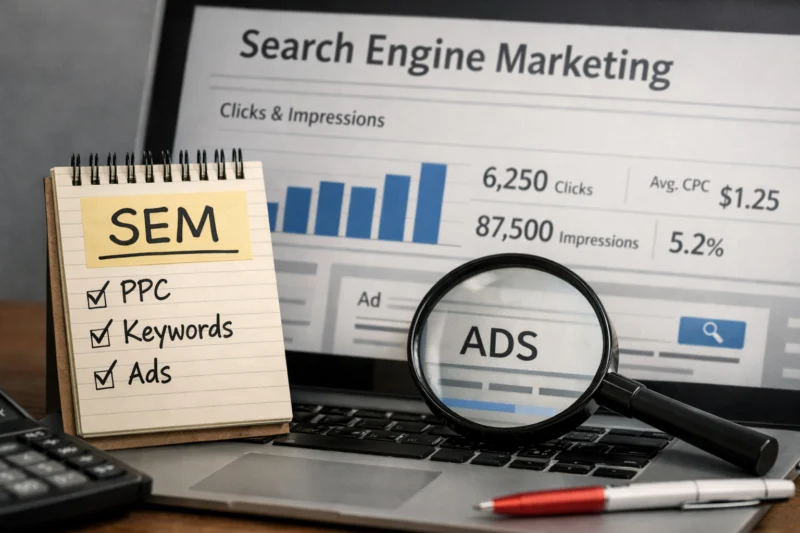
Measurement closes the loop. The basic metrics are conversions, cost per acquisition, return on ad spend, click-through rate, and cost per click, but those numbers only become useful when tied to the business model. For example, a service business may care most about qualified leads and call volume, while ecommerce may focus on revenue, margin, and product-level efficiency.
What most guides get wrong is treating these parts separately. In reality, performance comes from alignment across keyword, ad message, and landing page. When those three pieces reinforce one another, SEM becomes more predictable and much easier to scale. When they conflict, even a strong bid strategy can fail to produce efficient results.
How to build a search engine marketing strategy step by step
Start with the business goal and the conversion action that matters most. The goal might be form fills, demo requests, purchases, booked appointments, or phone calls, but it should be specific enough to measure and optimize against. Without that clarity, you cannot tell whether the campaign is helping the business or simply producing activity.
Next, research search behavior and group keywords by intent. Separate people who are comparing options from those who are ready to buy, then prioritize terms with clear commercial value. At this stage, search intent signals and long tail keywords are especially useful because they often reveal a more precise need than broad head terms do.
Budget planning should reflect both ambition and learning. Some teams want to launch fast, but a better approach is to launch with enough structure to learn reliably. That means assigning budget to a focused set of themes, defining test priorities, and deciding what success looks like before the campaign starts.
Offer positioning matters as much as targeting. If your audience has multiple options, the ad and landing page should show why your offer is relevant now. This is where effective meta tags on organic pages, seo content alignment across the site, and stronger sales messaging can support the same conversion logic that paid search needs.
The review loop is where SEM becomes smarter over time. Search term reports reveal what people actually typed, not just what you expected, and that can expose wasted spend, emerging opportunities, or new variants worth testing. A disciplined team uses that data to refine queries, adjust negatives, and strengthen the page experience instead of assuming the first setup will stay efficient forever.
What to look for in SEM keywords and audience signals
The first job in keyword evaluation is separating curiosity from intent. Broad educational terms may attract a lot of traffic, but they often produce weak conversion rates because the user is still learning. High-intent terms usually contain commercial language, brand names, service descriptors, or problem-specific phrases that indicate readiness to act.
Match types, modifiers, and search context all affect relevance. A keyword can look promising on paper and still behave poorly if the platform matches it to loosely related searches. That is why monitoring actual search terms is essential, and why negative keywords are a core protection against wasted spend.
Ambiguous queries are a common trap. Some high-volume keywords underperform because they attract mixed intent, not because the category is weak. For example, a term may bring in researchers, job seekers, DIY users, and buyers at the same time, which makes the traffic look active while the conversion rate stays disappointing.
This is where a deeper understanding of audience signals helps. If a query repeatedly produces clicks but few conversions, the issue may be mismatched intent, weak offer framing, or a landing page that fails to speak to the right segment. Smart teams use search terms to refine not only bids but also their long-term messaging, audience segmentation, and content strategy planning.
Common search engine marketing mistakes and misconceptions
One of the biggest misconceptions is that SEM is just bidding on keywords. In reality, it is a full-funnel system that includes targeting, messaging, landing page experience, and measurement. If any one of those pieces is weak, the campaign can underperform even when the auction mechanics look fine.
Another common mistake is blaming ads for poor conversion when the landing page is the real problem. If the page is slow, vague, or disconnected from the query, the ad may have done its job by earning the click, only for the page to fail afterward. This is why site experience factors and seo content alignment are worth studying even for paid search teams.
Chasing volume over intent is also expensive. A campaign can generate impressive traffic while attracting the wrong audience, especially when broad keywords are used without enough filtering. The idea that more spend automatically means better results is one of the most persistent errors in the channel; higher budget only helps when the targeting, page quality, and measurement are already working.
Weak measurement creates false conclusions. If conversions are not tracked well, teams may assume SEM is unprofitable when the problem is attribution, offline sales tracking, or incomplete lead quality data. In many cases, the channel is not failing; the reporting setup is failing to show what is actually happening.
Advanced considerations most SEM guides get wrong
Advanced SEM is not just about spending more. It is about understanding auction dynamics, query nuance, and how performance changes across brand, non-brand, and high-intent campaigns. Each segment behaves differently, so treating the account as one blended bucket can hide both opportunities and inefficiencies.
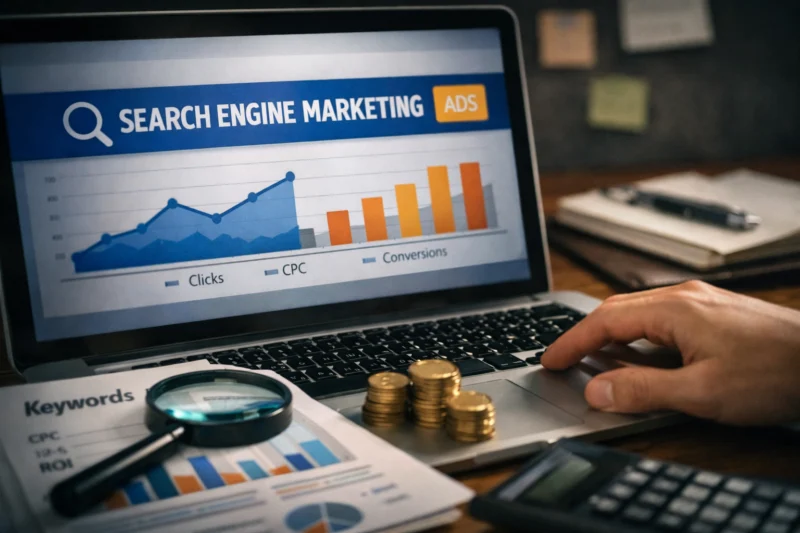
Segmentation matters because brand terms often convert well at low cost, while non-brand terms may be more competitive and less predictable. If those are evaluated together, a campaign can look healthy even when the non-brand portion is inefficient. Good reporting separates them so decisions reflect reality rather than averages.
Edge cases are where many guides fall short. Low-volume categories may not generate enough conversions for quick optimization, and long sales cycles may make last-click data look weaker than the true value of the channel. In those cases, patience, tighter segmentation, and better offline attribution become essential.
Good performance can also hide bad efficiency if attribution is incomplete. A campaign may appear to generate conversions, but if many of those leads are low quality or assisted by other touchpoints, the headline numbers can be misleading. This is where backlink authority building, quality content matters, and broader search ecosystem thinking can support trust and demand generation beyond the ad click itself.
Measuring search engine marketing performance the right way
The right SEM metrics depend on where you are in the funnel. Impressions tell you whether you are entering the auction; click-through rate shows whether the ad is compelling; cost per click shows the price of attention; conversion rate shows whether the traffic is relevant; and cost per acquisition or return on ad spend shows business efficiency.
Those numbers must be interpreted in context. A top-of-funnel campaign may have a lower conversion rate than a branded campaign, but that does not automatically make it bad. What matters is whether the traffic is moving people toward profitable outcomes, whether that means direct sales, qualified leads, or assisted conversions later in the cycle.
Last-click attribution can mislead decisions because it credits only the final interaction. That can overstate branded or retargeting performance and understate the role of non-brand search in creating demand. For larger accounts, combining platform data with CRM or analytics data gives a more honest picture of how SEM contributes to revenue.
One more caution: a good CTR does not guarantee business success if lead quality is poor. A message can attract curiosity without attracting the right buyer. The best measurement plans include downstream quality checks, such as qualified lead rate, sales acceptance, close rate, or margin, so the channel is judged on actual business value rather than click volume alone.
Frequently Asked Questions About search engine marketing
What is search engine marketing in simple terms?
Search engine marketing is paid advertising in search results. It means paying to show an ad when someone searches for a relevant keyword or phrase.
Is search engine marketing the same as SEO?
No. SEM is paid search visibility, while SEO is about earning organic rankings through content, technical improvements, and authority building. They often work best together because they solve different parts of the search journey.
How does search engine marketing work?
A search query triggers an auction, eligible ads compete for placement, and the platform decides which ads to show based on bid, relevance, and experience. If the user clicks, they land on a page that should match the query and drive the intended action.
Is search engine marketing paid advertising?
Yes. SEM is a form of paid advertising, usually through paid search ads. You are paying for the opportunity to appear when someone searches for a relevant term.
How much does search engine marketing cost?
Cost depends on competition, keyword value, quality, and the goals of the campaign. High-intent terms in crowded markets usually cost more, and the final economics also depend on how well the landing page converts traffic.
Is search engine marketing good for small businesses?
It can be, especially for local services, niche offers, and products with clear buying intent. The main constraint is budget efficiency, so small businesses usually need tighter targeting and stronger conversion pages than larger advertisers.
How long does search engine marketing take to work?
Traffic can start quickly after launch, but performance takes time to stabilize. The first few weeks often reveal whether keywords, ads, and landing pages are aligned well enough to scale.
What are the main benefits of search engine marketing?
The main benefits are fast visibility, intent capture, control over messaging, and measurable results. It is especially useful when you want to reach people who are actively searching for a solution now.
What are the disadvantages of search engine marketing?
Costs can rise quickly in competitive markets, and the learning curve is real if targeting or tracking is weak. It also depends heavily on landing page quality and conversion readiness.
How do you measure search engine marketing success?
Measure success with the metrics tied to your business goal, such as conversions, cost per acquisition, and return on ad spend. If you sell longer-cycle services, qualified lead quality and downstream revenue matter more than clicks alone.
Conclusion
Search engine marketing is the paid side of search visibility, and its main strength is capturing people at the moment they are actively looking for a solution. It is most valuable when intent is clear, competition is manageable, and the landing page is ready to convert traffic into leads, sales, or booked actions.
The right decision is rarely about choosing SEM in isolation. It is about comparing it against your business goals, your budget, your competition, and your conversion readiness, then deciding how it fits alongside SEO, local search, shopping ads, and supporting content. If you are evaluating your search strategy in 2026, audit the quality of your current search approach and speak with a qualified marketing professional before investing heavily.
What matters most is not a one-time launch, but ongoing measurement and refinement. The businesses that do best with SEM treat it as a learning system: they review search terms, improve ad relevance, strengthen pages, and use the data to guide broader marketing decisions.
Updated April 2026