

Website design and development is the process of building a business asset that attracts traffic, converts leads or sales, and supports long-term growth. In a commercial context, the goal is not just to make a site look good; it is to create a platform that performs as part of your marketing and revenue engine. Today, buyers compare providers, pricing, process, and results before they ever contact a team, so the right web design and development services need to be evaluated on outcomes, not aesthetics alone.
This guide explains how to choose the right approach, avoid expensive mistakes, and evaluate vendors with confidence. It also clarifies the website development process, what to expect from different delivery models, and how to judge whether a proposed build is likely to produce measurable results. If you are planning a new site or redesign, the key is to align design, development, content, and conversion goals before anyone starts building.
Contents
- 1 What Website Design and Development Actually Covers for Businesses
- 2 How to Plan a Website Project That Supports Revenue Goals
- 3 What to Look for in a Web Design and Development Partner
- 4 Website Design and Development Options: In-House, Freelancer, Agency, or Hybrid
- 5 The Step-by-Step Process Behind a Successful Build
- 6 Core Elements That Affect Performance, Trust, and Conversions
- 7 Common Mistakes in Website Design and Development
- 8 Advanced Considerations Most Website Guides Get Wrong
- 9 What to Expect in Pricing, Timelines, and Deliverables
- 10 How to Evaluate Quality Before You Hire
- 11 When a Redesign Is Better Than a Refresh
- 12 Frequently Asked Questions About Website Design and Development
- 12.1 How long does website design and development usually take?
- 12.2 What is included in website design and development services?
- 12.3 How much should website design and development cost?
- 12.4 Is it better to use a template or custom build?
- 12.5 What makes a website good for lead generation?
- 12.6 How do I choose between a freelancer and an agency for my website?
- 12.7 Do I need SEO during website design and development?
- 12.8 What should I prepare before starting a website project?
- 12.9 How do I know if my current site needs a redesign?
- 13 Final Takeaways for Choosing the Right Website Partner and Approach
What Website Design and Development Actually Covers for Businesses
For businesses, website design and development covers the full journey from discovery and strategy through UI design, front-end and back-end development, testing, launch, and ongoing improvements. Design shapes how the site looks, feels, and guides attention. Development turns those decisions into a working system that loads properly, integrates with tools, and stays maintainable.
That distinction matters because business goals should drive the build. A lead generation site needs strong page hierarchy, service messaging, and form strategy. An ecommerce store needs product discovery, trust signals, checkout optimization, and inventory integration. A B2B company may care more about credibility, case studies, and quote requests. Commercial intent changes the blueprint, which is why a site should never be treated like a visual brochure. The best commercial sites also support search visibility strategies, analytics, and content updates without creating friction for the internal team.
A good build is not simply attractive. It has to support measurable outcomes, be easy to edit, and remain stable as the business grows. That is why experienced teams think in terms of conversion paths, CMS structure, technical performance, and future-proof architecture. For readers comparing options, this is where choosing the right agency becomes more about strategy and operational fit than portfolio aesthetics alone.
How to Plan a Website Project That Supports Revenue Goals
The best way to plan a website project is to start with business objectives, the target audience, and the single most important conversion action. That could be booked calls, quote requests, purchases, newsletter signups, or qualified demo submissions. Once that primary action is clear, the rest of the scope becomes easier to evaluate because every page, feature, and content block should support that goal.
Scope discipline is critical. Define the required pages, integrations, content types, approval process, and stakeholder responsibilities before the build starts. Projects often run into trouble when teams add features late, underestimate content production, or leave decisions unresolved until design is underway. A lean, focused site can outperform a bloated one if it is built around a clear conversion path. This is especially true for custom business website builds, where complexity can grow quickly if every department wants a different feature.
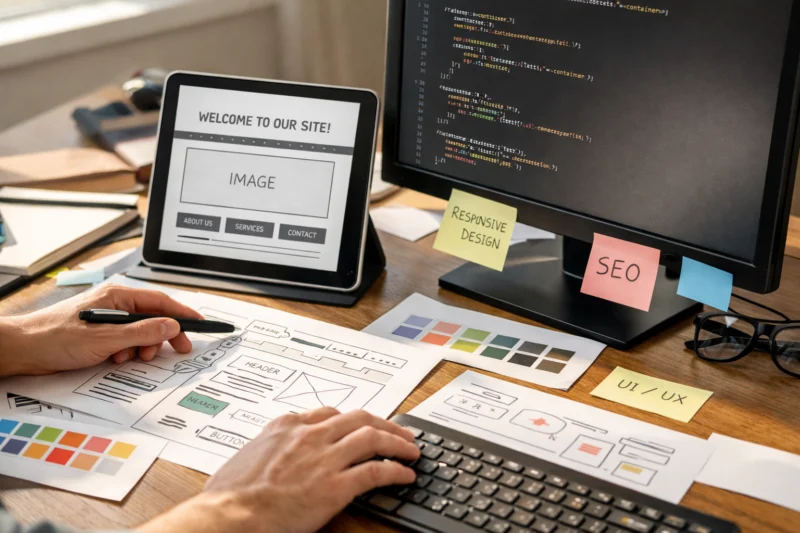
There is also a tradeoff between speed and scalability. A faster launch can help you validate offers and start generating leads sooner, but a rushed build may create rework later if the CMS structure or architecture cannot support growth. The most effective projects balance immediate business needs with future flexibility, which is why the website build process should include planning for maintenance, content updates, and expansion from day one.
What to Look for in a Web Design and Development Partner
The right partner should demonstrate strategy, user experience thinking, technical execution, and post-launch support. If a team only shows visuals, that is not enough. You want evidence that they understand how design decisions affect conversion, how technical choices affect performance, and how the site will be maintained after launch.
Review portfolios for relevant industry experience, complexity, and conversion quality. A polished homepage is useful, but you should also inspect interior pages, mobile layouts, forms, and service flows. In many commercial projects, the most telling evidence is how well the site supports action: clear calls to action, useful proof points, and a path from interest to inquiry. Good providers can explain why certain layouts were chosen, not just show what was built. They should also be transparent about ownership of files, code, logins, and content assets, because that affects your ability to switch vendors later.
Communication and project management matter as much as design skill. Look for clear timelines, defined revision limits, and a process for feedback that prevents scope creep. Red flags include vague delivery dates, overselling, and “pretty but ineffective” work that looks refined but does not support business outcomes. For companies evaluating high converting ecommerce sites or lead generation builds, the best partners are usually the ones who can explain tradeoffs and recommend what not to do, not just what is possible.
Website Design and Development Options: In-House, Freelancer, Agency, or Hybrid
Most businesses choose between four engagement models: in-house teams, freelancers, agencies, or a hybrid approach. Each works best under different conditions, and the right choice depends on budget, timeline, control needs, and the amount of specialization required. The cheapest option up front is not always the lowest-risk option once maintenance, revisions, and lost opportunity are included.
| Model | Best For | Strengths | Tradeoffs |
|---|---|---|---|
| In-house | Ongoing content and iterative growth | Strong control, fast internal collaboration | Higher payroll cost, limited skill breadth |
| Freelancer | Smaller sites or focused tasks | Cost-efficient, direct communication | Single-point dependency, limited capacity |
| Agency | Complex, strategic, or multi-discipline builds | Access to design, UX, development, and strategy | Higher cost, more formal process |
| Hybrid | Teams with internal marketing but external technical support | Flexibility, specialization, shared ownership | Requires strong coordination |
In-house teams work best when the organization needs constant site updates, internal governance, or close alignment with other departments. Freelancers are often a strong fit for simpler sites, limited budgets, or highly specific tasks such as design implementation or CMS setup. Agencies tend to be the right choice when a business needs multiple skill sets at once, especially for custom builds, brand repositioning, or complex lead and ecommerce flows. Hybrid models are common when a company wants internal ownership of strategy and content but needs outside help for development or specialist work.
The decision should also account for access to multiple skill sets. A site that needs UX, copy strategy, analytics, accessibility, and development will usually benefit from a broader team. Businesses seeking ongoing site maintenance often prefer an arrangement that includes support after launch, since design and development choices affect how easily the site can be updated later.
The Step-by-Step Process Behind a Successful Build
A successful build usually moves through discovery, planning, wireframes, design mockups, development, testing, and launch. Discovery clarifies goals, audiences, competitors, content, and technical requirements. Planning translates those findings into site structure, page priorities, and feature scope. Wireframes establish layout logic before visual work begins, and mockups define the final visual direction.
Development should follow a controlled process, not an improvisational one. Once the design is approved, the team builds the front end, configures the CMS, connects integrations, and prepares the staging environment. Testing should cover forms, browser behavior, mobile responsiveness, speed, redirects, accessibility basics, and tracking. The launch stage should include final QA, backups, DNS changes, and post-launch monitoring. For businesses comparing providers, the website build process is often the clearest sign of professionalism because it reveals how the team handles detail, approvals, and risk.
Stakeholder feedback has to be managed carefully. Too many reviewers, late-stage content changes, or unclear approval authority can create delays and scope creep. The most overlooked project failure is not visual quality; it is missing content, unresolved technical decisions, or approval bottlenecks. A strong process reduces those risks by setting ownership early and making sure content readiness matches the design schedule. That is also why “done” should never mean only “launched.” The website must be monitored, iterated, and improved after go-live.
Core Elements That Affect Performance, Trust, and Conversions
The core elements that affect performance and conversions are information architecture, navigation, calls to action, and page hierarchy. If visitors cannot quickly understand where they are, what you offer, and what action to take next, the site will underperform even if the design looks polished. Good structure reduces friction and helps the right users move toward inquiry or purchase.
Trust is built through visual consistency, clear messaging, proof points, and professional branding. That includes case studies, testimonials, certifications, client logos, service clarity, and specific outcomes where appropriate. Strong layout choices also support “improving user experience” because they reduce cognitive load and help visitors scan content efficiently. This is especially important on service pages and landing pages, where attention is limited and the user often compares multiple providers at once.
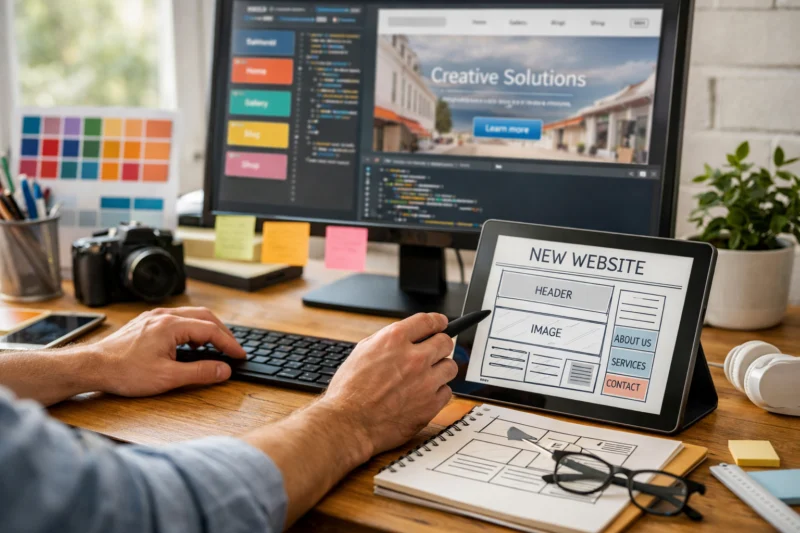
Technical foundations matter just as much. Mobile responsiveness, speed, accessibility, and security affect whether the site performs under real conditions. A site that loads slowly or breaks on phones can undermine paid media, organic traffic, and offline referrals. Poor conversion structure can also waste traffic, meaning a business pays to bring visitors in only to lose them on the page. This is where design and SEO impact intersect: good visuals, useful content, and technical quality all reinforce one another, especially when the site is intended to generate leads or sales.
Common Mistakes in Website Design and Development
One of the most common mistakes is starting with visuals before clarifying strategy. When design is chosen first, teams often discover later that the site does not support the actual sales process, content needs, or technical requirements. That leads to rework, stretched timelines, and frustration for everyone involved.
Other frequent problems include feature overload, weak content planning, and ignoring mobile users. A business may ask for too many animations, extra page types, or unnecessary custom functionality, which increases cost and complicates maintenance. Development mistakes can be just as damaging: poor CMS setup makes updates difficult, fragile code creates risk, and weak testing leads to bugs at launch. In practical terms, these failures can force a site rebuild earlier than expected.
Another misconception is that the website is finished once it goes live. In reality, launch is the starting point for measurement, iteration, and ongoing optimization. The best teams plan for analytics, edits, and continuous improvement from the beginning. Businesses that ignore this often see their site stagnate, even when traffic grows. That is why articles on ongoing site maintenance are relevant to any commercial build, not just technical support contracts.
Advanced Considerations Most Website Guides Get Wrong
Many guides focus only on appearance and basic functionality, but long-term value depends on scalability, modular content systems, and future integrations. If your team expects to add service lines, locations, languages, or marketing campaigns later, the site architecture should make that easy. Modular systems let you reuse sections and build new pages faster without redesigning everything from scratch.
Edge cases matter because they expose whether a solution is truly flexible. Multi-location businesses need location pages, local trust signals, and often separate lead paths. Service companies with complex lead flows may need branching forms, qualification logic, or CRM integrations. Ecommerce sites with many product variables need careful product architecture and filters. In these situations, “custom” is not automatically better if it slows iteration or makes updates difficult. The most effective solution is the one that supports speed, clarity, and operational control.
SEO, analytics, and conversion tracking should also be baked in before launch. That includes page titles, metadata structure, event tracking, form measurement, and baseline reporting. Skipping these decisions until after launch creates blind spots that make it hard to evaluate performance. For businesses investing in search visibility strategies or high-value lead generation, this integration should be part of the original scope, not a follow-up task.
What to Expect in Pricing, Timelines, and Deliverables
Pricing is driven by complexity, custom functionality, content volume, integrations, and the number of revisions required. A small brochure site with a few templates will cost far less than a platform with custom lead flows, ecommerce logic, or multiple stakeholder approvals. The same applies to content-heavy projects, where copy editing, migration, and page setup can take significant time.
Timeline expectations should be realistic. Simpler sites may move relatively quickly, while larger builds take longer because discovery, design, development, and testing each require review cycles. Rush projects usually increase risk because they compress feedback, reduce testing time, and leave little room for content delays. Buyers should ask what happens if approvals slip, because that is one of the most common reasons schedules change.
Deliverables should be confirmed upfront. At minimum, buyers should know whether the project includes sitemap creation, wireframes, design comps, a staging site, launch support, CMS training, and post-launch QA. A low quote may exclude essentials such as content migration, accessibility review, or handoff documentation. This is where website maintenance and launch support become part of the real cost, not optional extras.
How to Evaluate Quality Before You Hire
Quality should be judged through UX, messaging clarity, page speed, technical robustness, and mobile performance. A good site should help users understand the offer quickly, trust the brand, and complete the desired action without friction. If a portfolio looks beautiful but the sites are slow, hard to navigate, or weak at converting, the quality is only skin deep.
Before hiring, ask how the team handles revisions, ownership, support, and success metrics. You want specific answers about who writes content, who owns the code, how bugs are handled after launch, and how the project is measured once it goes live. A trustworthy proposal should explain scope, deliverables, assumptions, timeline, and exclusions. Missing details often signal future disputes.
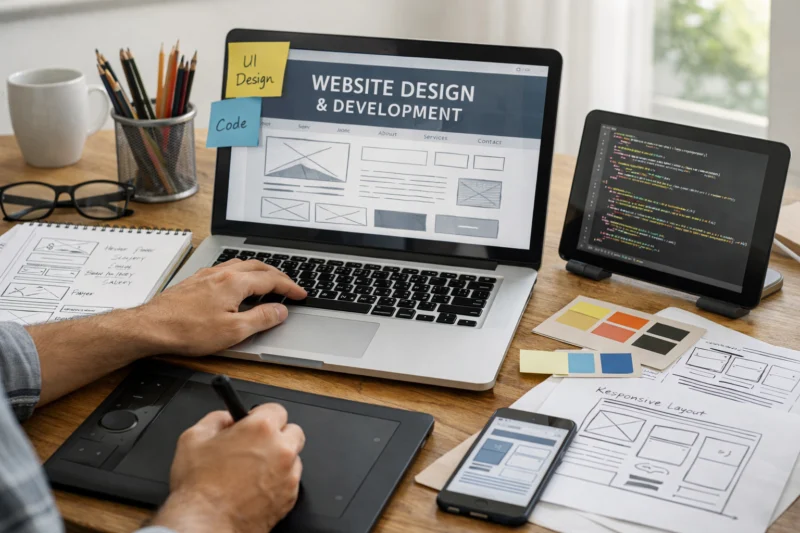
The best teams can explain tradeoffs. They should be able to tell you why one CMS, layout pattern, or interaction is better for your goals than another. They should also be able to connect their decisions to practical outcomes, not just style preferences. For businesses focused on choosing the right agency, that ability to reason through options is often more valuable than a promise to do everything.
When a Redesign Is Better Than a Refresh
A refresh updates the look and feel of a site without changing the underlying structure very much. A redesign goes deeper by improving information architecture, content strategy, templates, and often the CMS or technical foundation. A full rebuild is justified when the current system prevents the business from moving forward.
Signs that a redesign is needed include an outdated CMS, poor conversion rates, hard-to-edit content, weak mobile experience, and a brand mismatch that confuses visitors. If the team cannot quickly update pages, test offers, or publish new content, the site may be slowing growth more than helping it. In those cases, the issue is usually not cosmetic; it is structural. That is why “mobile responsive website design” alone may not be enough if the content hierarchy and conversion flow are also weak.
A partial refresh is enough when the strategy is sound but the visuals feel dated or the site needs modest usability improvements. A full redesign is warranted when the business model, audience, or technical needs have changed. The deeper nuance is that redesigns should be driven by evidence, not just dissatisfaction with the current look. The most effective rebuilds are tied to measurable issues, such as lead quality, bounce behavior, or content management limitations.
Frequently Asked Questions About Website Design and Development
How long does website design and development usually take?
Timelines vary by project size, complexity, and how quickly stakeholders approve work. A simple site may take several weeks, while a custom build with strategy, content, integrations, and testing can take a few months.
Approval speed is often the biggest variable, not the design itself. If content, feedback, or technical decisions are delayed, the schedule usually stretches.
What is included in website design and development services?
Most web design and development services include discovery, sitemap planning, design, development, testing, launch support, and some level of post-launch help. Strong providers also include CMS training and documentation.
Always confirm whether content migration, analytics setup, and accessibility checks are included, because those items are sometimes quoted separately.
How much should website design and development cost?
Cost depends on page count, custom functionality, content volume, integrations, and revision rounds. A quote that looks low may omit essential work such as QA, training, or launch support.
The best way to compare pricing is by scope, not just by total number. Two proposals with the same budget can include very different levels of strategy and support.
Is it better to use a template or custom build?
A template can be faster and more affordable, which works well for simpler sites with limited requirements. A custom build is better when your structure, integrations, or conversion paths need to be tailored.
The key tradeoff is flexibility versus speed. Custom is not automatically better if it makes updates harder or delays launch without improving outcomes.
What makes a website good for lead generation?
Lead generation sites need clear messaging, strong page hierarchy, visible calls to action, and trust signals such as testimonials or case studies. The form experience should be simple and aligned with the value of the offer.
If visitors do not quickly understand what you do and why they should trust you, they are less likely to convert. Landing page structure and proof points matter just as much as visual design.
How do I choose between a freelancer and an agency for my website?
Choose a freelancer when the site is relatively simple, the budget is tighter, and the scope is well defined. Choose an agency when the project needs multiple disciplines, such as UX, copy strategy, development, and ongoing support.
Agencies are often a better fit for growth-oriented projects because they can coordinate specialists. Freelancers can be excellent for focused work, but they may not be ideal for complex multi-stage builds.
Do I need SEO during website design and development?
Yes, SEO should be part of the project from the beginning, not an afterthought. Structure, metadata, page templates, internal linking, and tracking all affect how a site performs in search.
Ignoring SEO at build time often leads to expensive fixes later. It is much easier to plan for search visibility strategies before launch than to retrofit them afterward.
What should I prepare before starting a website project?
Prepare your goals, target audience, brand assets, content plan, and examples of sites you like and dislike. You should also identify stakeholders, approvals, and any required integrations.
The more aligned your team is before kickoff, the fewer delays you will face later. Clear internal ownership is one of the easiest ways to keep a website project moving.
How do I know if my current site needs a redesign?
If your site is hurting conversions, is difficult to edit, performs poorly on mobile, or no longer matches your brand, a redesign may be justified. Technical constraints and outdated architecture are often stronger signals than visual dissatisfaction.
Evidence should drive the decision. If the site is still supporting business goals well, a refresh or targeted optimization may be enough.
Final Takeaways for Choosing the Right Website Partner and Approach
The best website design and development decisions start with business goals, not visuals alone. A commercial site should attract the right traffic, move users toward a clear conversion action, and stay easy to maintain as the company grows.
Choosing the right delivery model depends on complexity, budget, timing, and the number of skill sets required. Whether you choose a freelancer, agency, in-house team, or hybrid setup, the strongest projects are the ones that define scope clearly, manage feedback well, and prioritize the right outcomes from the start. If you are evaluating providers, compare proposals against measurable commercial goals, not just design taste.
In practice, the most successful builds balance usability, trust, performance, and maintainability. That means paying attention to the website build process, the post-launch plan, and the systems that support growth over time. Request a scoped proposal, compare providers carefully, and choose the partner that can explain tradeoffs clearly while building for results.
Updated April 2026