
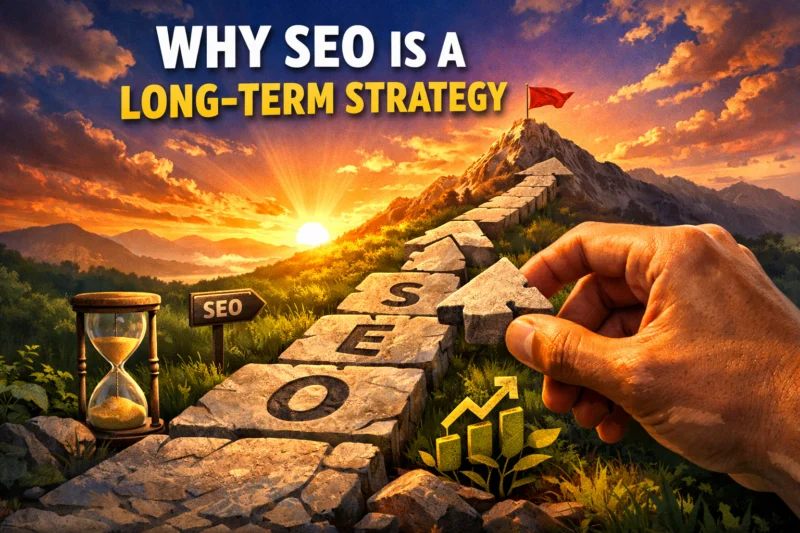
SEO is a long-term strategy because search visibility compounds through crawlability, indexation, content quality, authority, and trust signals that usually take time to mature. In plain English, that means a page rarely earns durable rankings the moment it is published; it grows by proving relevance, usefulness, and reliability over repeated searches and site-wide consistency. If you are deciding whether the wait is worth it, this article explains the mechanism, the timeline factors, the common mistakes that slow results, and how to judge SEO as an investment rather than a quick campaign. It also shows how Why SEO is a Long-Term Strategy changes depending on competition, site history, and how well your content strategy is organized.
What makes SEO compound over time
SEO compounds because a page can keep earning visibility long after publication, especially when the topic stays relevant and the content keeps matching search intent. Unlike paid traffic, where exposure stops when the budget stops, organic pages can continue attracting clicks, links, and brand familiarity for months or years if they remain useful. That is the core reason SEO behaves like an asset: each improvement can reinforce the next one.
The compounding effect takes shape when a page is crawled, indexed, and evaluated against competing results. If users click on it, remain engaged, and interact, the page may gain stronger performance signals over time. However, this does not guarantee a rise in rankings. Pages with weak content can stagnate quickly, and even once-useful pages may decline if competitors enhance their offerings, queries change, or the content is not updated. Sustainable growth relies on the critical role quality content plays in SEO, rather than merely increasing publication volume.
Many teams misinterpret SEO when they assume that a single post can generate momentum on its own. In reality, achieving compounding effects typically requires a network of interconnected pages that reinforce each other through related topics, effective internal linking, and consistent relevance. A robust content strategy often involves planning a content calendar for SEO, along with a well-structured blog layout, ensuring that each new page enhances the site’s overall authority rather than remaining isolated. Additionally, effective SEO is supported by thorough keyword research, making it easier to create pages that target realistic search opportunities instead of broad, irrelevant terms. For guidance on how to effectively organize your content efforts, check out this resource on how to construct an SEO-focused content calendar.
There is also a practical limitation: compounding can reverse if the site becomes stale or overly aggressive. For example, publishing thin content in high volume may create a temporary lift, but it rarely builds lasting authority. Search engines learn from patterns, and the pattern they trust most is consistent usefulness over time.
How search engines reward trust, relevance, and consistency
Search engines reward pages that show sustained relevance, predictable quality, and a trustworthy site structure. The strongest pages usually win because they are easier to understand, easier to crawl, and better connected to a broader topic ecosystem. Relevance matters at the page level, but consistency matters at the site level; a single strong article helps, yet a site full of well-aligned pages sends a much clearer signal.
Trust is usually built through repeated evidence. That evidence can include topical coverage, clean internal linking, fast crawl access, and backlinks from credible sources. Over time, the site becomes easier for search engines to classify, and that classification influences how fast new pages are discovered and how confidently existing pages are ranked. One reason backlink authority building matters is that links often act like public endorsements, but they work best when the linked page already deserves trust through content quality and strong on-page relevance.
Search engines continuously assess a page's performance rather than simply ranking it once and moving on. They evaluate how the page compares with competitors, monitor its performance, and adjust their assessments as the search environment evolves. This is why maintaining a consistent publishing schedule, creating clear topic clusters, and establishing structured internal links can lead to sustained visibility rather than relying on isolated “viral” hits. Additionally, the positive effects of loading speed on SEO play a crucial role; if users and crawlers encounter difficulties in accessing content quickly, it may hinder the site’s ability to gain and retain high search rankings.
The deeper lesson is that trust is easier to lose than gain. A site that appears spammy, over-optimized, or thin on useful information can stall or slip even if it briefly ranked well. Most guides over-focus on keywords and under-focus on the stability of the whole domain. Search engines are looking for a pattern, not a stunt.
Typical SEO timeline: what to expect in the first 3, 6, and 12 months
In the first 3 months, SEO is usually about setup, discovery, and early indexing rather than dramatic traffic growth. Search engines need time to crawl new or updated pages, understand the site structure, and compare your content with existing results. Even when the strategy is correct, the early months often look modest because the system is still learning what the site should rank for.
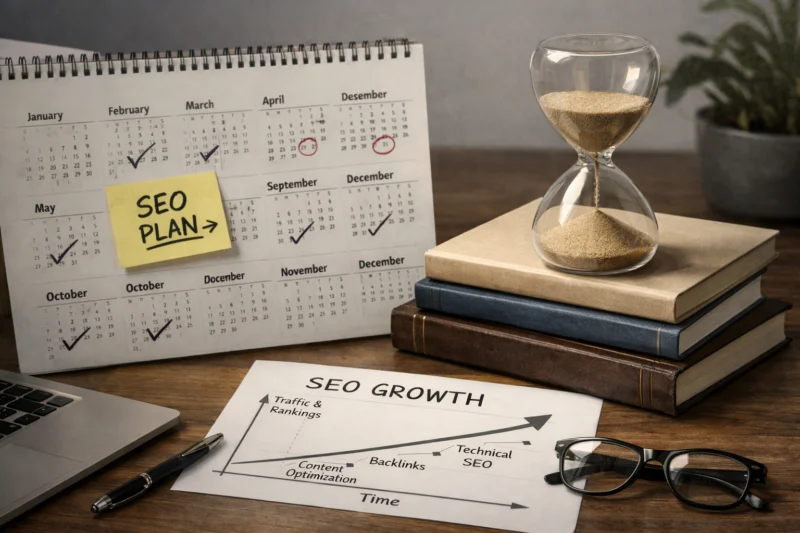
By month 6, many sites begin seeing more stable impressions, better keyword coverage, and the first signs of compounding from internal links and updated content. This is often the point where the site’s strongest pages start pulling related pages upward. The timeline may still feel slow, but the work is becoming more measurable. For businesses, this is also where time to rank and time to revenue often separate: a page can rank for informational queries long before it contributes meaningfully to qualified leads or sales.
LONG-TERM RESULTS
Transform your website into a powerful asset with our expert SEO services that drive organic traffic and build lasting visibility.
REQUEST A FREE CONSULTATIONBy month 12, a well-executed strategy typically has enough history for patterns to emerge across the site. Strong pages may be easier to refresh, weaker pages easier to identify, and new content may index faster because the domain has built some trust. That said, the pace depends on competition, domain strength, and whether the content aligns with actual demand. A mature site with a focused SEO campaign can move faster than a brand-new domain, but both still need patience.
| Timeframe | Typical SEO focus | What progress often looks like |
|---|---|---|
| First 3 months | Technical fixes, content creation, indexing | More pages discovered, modest impressions, little revenue impact |
| 3–6 months | Optimization, internal linking, first refreshes | Rising impressions, some ranking movement, early traffic quality signals |
| 6–12 months | Expansion, content updates, authority building | More stable rankings, stronger clusters, clearer conversions from organic traffic |
One thing most teams miss is that timelines are not just about publishing more. They are about how quickly your content earns enough evidence to be trusted. That means a strong foundation, a realistic topic set, and patience through the early learning period.
Factors that make SEO slower or faster
SEO moves faster when the domain already has trust, the topic is specific, and the content fills a clear gap in the market. It moves slower when the site is new, the competition is broad, or the pages are thin and disconnected. In practice, the strongest accelerators are usually domain history, content depth, technical health, and how well the site is organized for discovery.
High-intent, low-competition topics often rank faster than large, broad keywords because the search engine can more easily see why the page deserves attention. A niche service page, a local landing page, or a problem-specific guide may gain traction quickly if it matches the query well and the site is technically clean. By contrast, a new site trying to rank for a highly competitive term usually faces a longer trust-building period because other results already have stronger signals.
Internal linking also changes the pace. A page buried deep in the site with few references may take longer to be crawled and understood, while a page supported by relevant internal links can benefit from faster discovery and clearer topical context. This is why blog structure planning and a consistent SEO content calendar are not administrative details; they affect how search engines perceive the site’s relationships. The same is true for page speed impact, because slower pages can reduce engagement and make it harder for search engines to see positive user behavior.
There is also an overlooked variable: refresh cycles. Large sites can update and recrawl content more frequently, while smaller sites may wait longer between visits from search engines. That means the same optimization effort can produce different speeds depending on site size and publishing cadence. The common mistake is assuming that one strategy should perform identically everywhere.
SEO vs. faster marketing channels: what the tradeoffs look like
SEO is slower than paid search, social media promotion, and some email campaigns, but it is often more durable once it works. Paid ads can create traffic immediately, but that traffic ends when the spend ends. Social posts can create bursts of awareness, yet they usually have short lifespans. SEO, by contrast, can keep generating traffic without paying for every click, which makes it especially valuable for long-term efficiency.
The real tradeoff is not speed versus value; it is speed versus permanence. If a business needs demand now, paid search or outbound promotion may be the right first move. If the goal is to build an asset that keeps working after the campaign ends, SEO is usually the stronger long-term choice. Many teams use SEO as the durable base while email and social create near-term demand around launches, events, or seasonal campaigns.
This is also why slow does not mean inefficient. SEO has higher upfront effort, but its lifetime return can be strong because a single well-ranked page may deliver visits for a long time. The key is understanding when SEO should lead and when it should support. In a long sales cycle, SEO can nurture early-stage interest while other channels close the loop later. In a product-led business, SEO can reduce acquisition costs over time by steadily increasing qualified organic demand.
One common misunderstanding in many guides is the assumption that all marketing channels operate on the same timeline. In reality, a well-crafted SEO strategy can enhance the overall effectiveness of your marketing efforts. By reducing reliance on paid advertising and generating reusable content, you can also support sales initiatives, nurturing, and retargeting. To learn more about how to effectively enhance your online presence, check out these strategies for a successful SEO initiative.
The right way to build a long-term SEO strategy
A long-term SEO strategy starts with topic selection based on search intent, business relevance, and realistic ranking opportunities. If the topics are too broad or too far from buyer needs, even strong content may fail to create meaningful results. A better approach is to choose clusters where the site can become genuinely useful, then build from the most valuable pages outward.
Technical foundations matter because they make content discoverable and indexable. Content quality matters because it gives search engines a reason to rank the page. Internal linking matters because it shows how topics relate and helps distribute authority across the site. The best strategies connect these pieces instead of treating them as separate checkboxes. That is where content strategy planning, internal linking basics, and quality content signals work together in a practical system.
From there, the process should be iterative. Publish, measure, refine, and expand. Use search performance data to identify which pages deserve updates, which topics deserve deeper coverage, and which clusters are underdeveloped. A strong SEO content calendar helps you stay consistent, while the keyword research process keeps you focused on opportunities with actual demand. The point is not to publish forever; it is to build momentum around the pages most likely to compound.
If you want to prioritize correctly, think in terms of compound value rather than raw search volume. A lower-volume page tied closely to revenue, retention, or a service category may be more valuable than a high-volume article with weak business relevance. That prioritization is often what separates a successful SEO campaign from a busy one.
- Choose topics with clear search intent and business value
- Fix crawlability, indexation, and site structure first
- Publish content clusters instead of isolated pages
- Use internal links to connect related pages logically
- Refresh pages based on performance, not guesswork
- Measure traffic quality, conversions, and assisted revenue
Common mistakes that make SEO feel ineffective
SEO often feels ineffective when people expect immediate rankings, choose overly competitive terms, or publish without a real plan. Those mistakes create long delays between effort and reward, which makes the channel look worse than it is. In many cases, the strategy is not failing; the measurement or execution is too shallow to show results.
Thin content is another major problem. A page that repeats obvious points without solving the searcher’s actual problem is unlikely to hold visibility for long. Poor site structure can make the issue worse by burying important pages or leaving them disconnected from related content. Weak internal linking reduces the site’s ability to reinforce its strongest pages, and without that support, even good content may underperform. This is why blog structure planning and a solid SEO content calendar are often more important than people expect.
Another common error is quitting too early. SEO needs enough time for indexation, comparison, and trust-building to happen. Teams that stop after a few weeks or months never give the compounding effect a chance to appear. They also tend to measure success only by rankings, which can hide useful progress. Impressions, qualified traffic, engagement, assisted conversions, and lead quality are all part of the picture.
The deeper mistake is treating SEO like a one-time project instead of an operating system. Pages need updates. Topics need expansion. Search intent can shift. A site that ignores those realities can stall even after early wins. The fix is not more hype; it is better process, better pages, and better patience.
Advanced considerations most guides get wrong
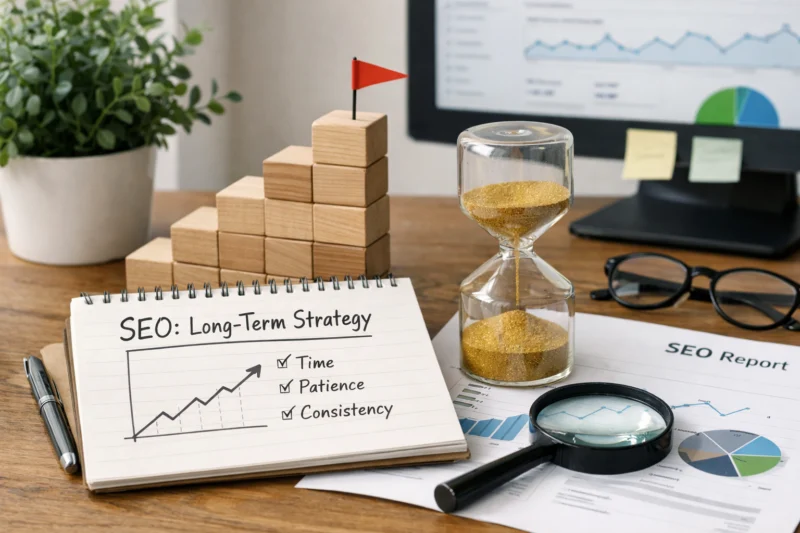
Long-term SEO does not mean waiting passively. The strongest programs actively improve pages, re-evaluate priorities, and respond to changes in demand and competition. Search performance is dynamic, so the work never truly ends; it simply changes from building to refining to defending. That is why ongoing optimization matters as much as initial publication.
Seasonality is one edge case that many beginners underestimate. Some topics peak at predictable times, which means a page can look weak in the off-season and then surge later. Algorithm volatility is another factor. A page that loses traffic during a broad update may not be “bad”; it may simply need better alignment with intent, stronger evidence of expertise, or a more useful structure. These situations require analysis, not panic.
Brand demand also amplifies SEO in ways that many guides ignore. When users already know your brand, they may click more often, search for you directly, or engage more deeply with your content. That sends positive signals that can strengthen broader organic performance. In other words, SEO does not exist in isolation. A stronger brand can make the same content perform better, which is why direct traffic and branded search should be part of the conversation.
Another advanced decision is whether to improve an existing page or replace it. In many cases, an established page with historical trust is better to refresh than to delete and start over. But if the page is structurally flawed, targets the wrong intent, or cannot be salvaged without losing focus, a replacement may be smarter. Most guides oversimplify this choice; in reality, it affects how much compounding value you preserve.
Is your website struggling to gain visibility? At eDesignerz, we specialize in creating SEO-optimized websites that not only attract visitors but convert them into loyal customers. Let's discuss how our tailored solutions can enhance your online presence and boost your business.
Get Your Free Website ConsultationHow to decide whether SEO is the right long-term investment
SEO is usually the right long-term investment when you have enough budget runway to wait through the early learning period, a market worth owning organically, and the content resources to publish consistently. If your sales cycle is longer, your products need education, or your category has recurring informational demand, SEO can create durable value. If your business needs immediate leads with no patience for a ramp-up period, SEO should probably support the plan rather than lead it.
Competitive landscape matters too. In crowded markets, SEO may require a stronger commitment to content depth, technical polish, and authority building before you see material returns. In narrower markets or local services, the payoff can arrive sooner because intent is more specific and competition is often less intense. The point is to match the channel to the opportunity instead of assuming every company should follow the same timeline.
It also helps to ask whether SEO can influence more than one business outcome. The best long-term strategies do not only generate traffic; they reduce paid acquisition dependence, support sales conversations, improve brand discovery, and create assets that compound across the site. That is why SEO should often support, not replace, a broader growth plan. A strong website, a credible brand, and a disciplined content system make the channel much more resilient.
If your team can commit to a realistic 3–12 month plan, keep improving pages, and measure the right outcomes, SEO can be one of the most efficient long-horizon marketing investments available. If not, it may still be valuable, but only as part of a hybrid approach with faster channels carrying the near-term load.
Why does SEO take so long to work?
SEO takes time because search engines need to crawl, index, compare, and test content before it earns stable visibility. It also takes time to build trust through relevance, internal links, and backlinks, especially in competitive spaces.
Early results are often small because the page is still collecting signals. That is why a site may show impressions before it shows strong rankings or revenue.
How long does SEO usually take to show results?
Many sites begin seeing early movement within 3 to 6 months, but meaningful results often take longer depending on competition and starting authority. “Results” can mean different things: indexing, impressions, traffic, leads, or sales.
A new domain in a competitive niche may need closer to 6 to 12 months for visible traction, while a strong site in a niche market may move sooner.
Is SEO worth it for small businesses?
Yes, especially when the business serves a local area, a niche audience, or a service with clear search intent. SEO can be cost-effective because a well-ranked page can keep generating demand without ongoing ad spend.
Small businesses with limited resources should focus on realistic opportunities first, such as local pages, service pages, and a focused content plan rather than broad, high-competition topics.
Can SEO work faster in less competitive industries?
Yes. Lower competition usually means search engines have fewer strong alternatives to compare against, which can shorten the time to rank. A well-matched page with good technical health and clear intent can move faster in a niche market.
Even then, “faster” still usually means weeks or months, not days. The same trust-building process still applies.
Why is SEO better than paid ads in the long run?
SEO is often better long-term because organic pages can keep earning traffic after the initial work is done, while paid ads stop when the budget stops. That creates compounding value over time.
Paid ads are still useful for speed, testing, and immediate demand capture, but SEO usually offers a more durable return if you can wait for the ramp-up period.
What makes a long-term SEO strategy successful?
Success usually comes from consistency, quality content, strong technical foundations, and ongoing optimization. A good strategy keeps publishing, refining, and expanding rather than treating SEO as a one-time task.

It also depends on choosing topics with real business value and linking related pages in a way that builds site-wide authority.
How do I know if my SEO is working?
Look at leading indicators like indexing, impressions, and keyword coverage, then compare them with lagging indicators like qualified traffic, leads, and conversions. Rankings alone can be misleading if they do not attract the right audience.
Traffic quality matters just as much as volume. A page that brings fewer visits but more sales may be outperforming a higher-ranking page with weak intent match.
Does updating old content help SEO grow over time?
Yes, often more than publishing new content alone. Updates can improve freshness, search intent match, internal links, and clarity, which may help a page regain or expand visibility.
This is especially effective for pages that already have some authority but need better structure, more complete coverage, or a stronger answer to the current query.
What are the biggest mistakes that delay SEO results?
The biggest mistakes are unrealistic expectations, poor topic targeting, weak site structure, thin content, and stopping too early. Each one slows the feedback loop that helps search engines trust and rank a page.
Measuring only rankings is another common problem because it hides progress in impressions, engagement, and conversions.
Why SEO is a long-term strategy for new websites?
New websites usually start with little authority, so they need more time to prove relevance and trust. Search engines must first learn what the site covers and whether it consistently provides useful answers.
That trust gap is normal. A new domain can still grow quickly in the right niche, but it generally needs more patience, stronger topic focus, and better site structure than an established site.
SEO That Lasts
Invest in Long-Term SEO Success.
Harness the power of SEO to build a trustworthy online presence that attracts consistent traffic and leads over time. Our expert team at eDesignerz can guide you in crafting a winning strategy.
Proven Strategies Personalized Service Satisfaction Guaranteed
Conclusion
SEO is a long-term strategy because it compounds through trust, relevance, and site-wide authority rather than instant exposure. The pages that win are usually the ones that keep earning evidence over time: crawlability, indexation, engagement, links, and consistency across the site.
How long it takes depends on competition, domain history, content quality, and how disciplined your publishing and optimization process is. That is why SEO should be treated as an investment with durable returns, not a short campaign that is judged too early.
The best next step is practical: review your current content, identify the pages with the highest compound value, and set a realistic 3–12 month plan for publishing, updating, and linking them. If you do that well, SEO stops feeling slow and starts behaving like an asset.
External sources: Google Search Central — official guidance on how search works and how content is discovered; U.S. Small Business Administration — practical context for long-horizon marketing planning; NIST — useful background on trust, measurement, and digital systems reliability.
Updated April 2026