
The right local website designer in Salem, Oregon is the one who can turn your business goals into a site that generates leads, builds trust, and performs well after launch.
If you are comparing Local website designers in Salem Oregon, start by looking for fit, process, and support—not just price or a polished portfolio. A local designer can be easier to communicate with, more familiar with Salem-area buyers, and more accountable when deadlines, revisions, or technical issues come up. But local presence alone is not enough. The best choice is the designer or team whose experience matches your budget, timeline, and the kind of results you need.
That matters because a website is not just a visual asset. It is a sales tool, a credibility signal, and often your primary lead source. A smart selection process helps you avoid paying for pretty pages that do not convert, load slowly, or fail to support your marketing plan.
Contents
- 1 What “local” really means when hiring a Salem website designer
- 2 How to choose the right web design partner for your Salem business
- 3 What to look for in local website designers in Salem Oregon
- 4 Comparing your main options: freelancer, small studio, or full-service agency
- 5 Pricing, scope, and what you should expect to pay
- 6 Common mistakes Salem businesses make when hiring a website designer
- 7 Advanced considerations most guides get wrong
- 8 Questions to ask before you sign a contract
- 9 Red flags that should make you pause
- 10 Frequently Asked Questions About local website designers in Salem Oregon
- 10.1 How do I choose a website designer in Salem Oregon?
- 10.2 What should local website designers in Salem Oregon include?
- 10.3 Are local website designers better than remote designers?
- 10.4 How much does a website designer in Salem Oregon cost?
- 10.5 Should I hire a freelancer or agency for my site?
- 10.6 How long does a typical website project take?
- 10.7 Do local website designers in Salem Oregon handle SEO too?
- 10.8 What if I already have a website and just need a redesign?
- 10.9 How do I know if a designer is a good fit for my business?
- 10.10 What questions should I ask before hiring a web designer?
- 11 Conclusion
What “local” really means when hiring a Salem website designer
“Local” can mean three different things: the designer is physically based in the area, they understand the Salem market, or they simply serve Salem clients remotely. Those are not the same thing, and a business owner should not treat them as identical. A local presence may make meetings easier and accountability stronger, but market knowledge and process quality often matter more than a downtown address.
Salem-specific familiarity can improve messaging because the designer may understand how local customers compare service providers, what trust signals matter, and how regional geography affects conversion behavior. For example, a contractor, law office, or healthcare practice may benefit from location pages, service-area language, and mobile-friendly page layouts that reflect how people actually search in the Mid-Willamette Valley.
At the same time, some agencies outside Salem still do excellent work for Salem businesses because they have strong systems, strategic discovery, and proven delivery. On the other hand, some locally based shops lack documentation, content strategy, or the capacity needed for a growing company. That is why “local” should be one factor, not the deciding factor. A good evaluation includes local market knowledge, relevant experience, and whether the team can support an SEO-focused site structure, ongoing website maintenance, and future growth.

The deeper point most guides miss is that local does not always mean better for every project. If your business needs advanced integrations, ecommerce, or a complex strategic website redesign, specialization may matter more than geography. If you want to compare Salem web design firms, focus on whether they understand your audience and can explain how they would improve conversions, not just whether they can meet in person.
How to choose the right web design partner for your Salem business
The right partner is the one whose strengths match your business goal. If you need phone calls and appointments, choose someone who thinks in terms of lead generation and conversion-driven design tactics. If you need an ecommerce site, prioritize product presentation, checkout clarity, and technical reliability. If you need credibility more than complexity, a simpler build with strong messaging may outperform a visually elaborate site.
Before you discuss colors or layouts, evaluate how the designer asks questions. A strong partner will want to know what the business sells, who the ideal customer is, what objections prospects have, and how success will be measured. That is where many projects succeed or fail. The best designers challenge assumptions, explain tradeoffs, and guide decisions rather than simply agreeing with every aesthetic preference.
Communication style matters as much as design talent. If a designer is slow to respond before the contract is signed, unclear about timelines, or vague about who does what, that pattern usually continues during the project. In contrast, clear scope, regular updates, and an organized approval process reduce delays and make it easier to keep content and design moving. This is especially important for small business web partners that need a site launched without draining internal staff time.
One common mistake is choosing a designer based on visual style alone. A beautiful homepage does not guarantee lead quality or a useful navigation structure. The better approach is to identify whether the designer is experienced in your project type, whether they explain process clearly, and whether they can support the business goal after launch. For businesses comparing freelancer versus agency options, the right fit often comes down to how much strategic guidance and capacity you need.
What to look for in local website designers in Salem Oregon
Start with the portfolio, but do not stop at appearances. You want to see whether their past work fits your industry, whether the sites are easy to navigate on mobile, and whether the calls to action are clear. A portfolio full of attractive pages is useful only if those pages also make it obvious what the visitor should do next.
Look for evidence of outcomes, not just aesthetics. Good case studies mention what the project was trying to solve, what changed in the redesign, and what business result improved afterward. Even when a designer cannot share exact numbers, they should be able to explain how they approached messaging, page hierarchy, and conversion points. That is often a better sign of competence than an oversized gallery of screenshots.
Also check what the designer actually handles. Some teams provide strategy, copy guidance, basic SEO, hosting help, and support after launch. Others only provide design files or development work and leave the rest to you. If your business needs help with content and launch logistics, those differences affect both price and success. In practice, the strongest choice is often the team that can combine design with practical support, especially when you need budget-friendly design choices without sacrificing performance.
A strong portfolio can hide weak project management, so ask about revisions, approvals, and communication cadence. Many businesses lose time because the designer is talented but disorganized. If you want a future-proof site, ask how they handle mobile usability, page speed, and content structure, because those details influence whether the site becomes a lead generator or just a brochure.
Comparing your main options: freelancer, small studio, or full-service agency
The best provider type depends on your budget, complexity, and risk tolerance. A freelancer is often the most budget-conscious option and can be flexible for straightforward sites. A small studio usually offers a better balance of collaboration, coverage, and specialist skills. A full-service agency is often the best fit for larger projects that require strategy, content, development, SEO, and ongoing marketing support.
Here is a practical comparison of the usual tradeoffs:
| Option | Best for | Strengths | Tradeoffs |
|---|---|---|---|
| Freelancer | Smaller sites, limited budgets, simple redesigns | Lower cost, direct communication, flexible scope | Limited bandwidth, fewer backup resources, narrower skill range |
| Small studio | Most service businesses and growing brands | Balanced cost, collaborative process, broader capability | May still rely on a small team for specialized needs |
| Full-service agency | Complex sites, multi-channel marketing, larger brands | Deep specialization, more systems, scalable support | Higher cost, less personal attention in some cases |
The deeper decision is not freelancer versus agency in the abstract. It is whether you need one talented person, a compact team, or a larger system with multiple capabilities. A solo designer may be perfect for a simple brochure site with a clear message. But if you need copywriting, SEO planning, integrations, and maintenance, a small studio or agency may be better. Businesses that already have internal marketing help can sometimes work well with a freelancer, while businesses with little internal support often benefit from a more complete team.
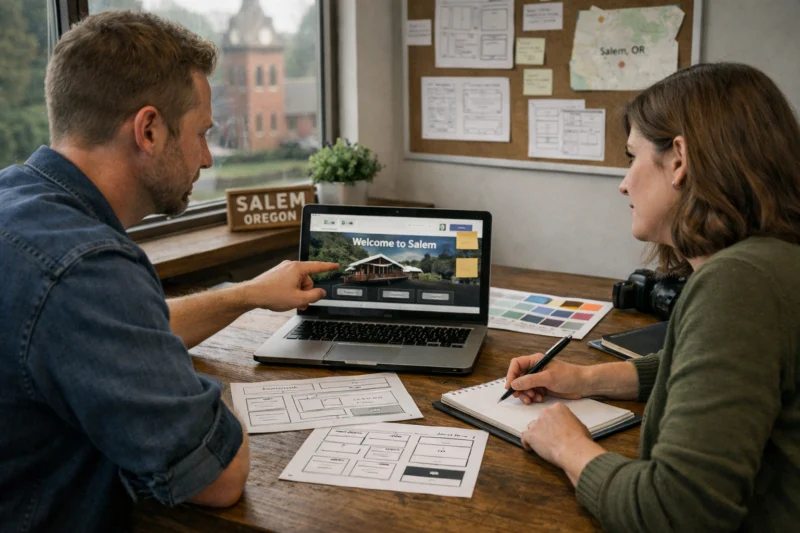
This is also where the best “local” choice may not be the closest one. Some Salem web design firms have strong systems and support, while a remote specialist may provide better results for ecommerce or regulated industries. If your project depends on speed and coordination, choose the model that reduces risk, not just the one that feels most familiar.
Pricing, scope, and what you should expect to pay
Website pricing varies widely because the scope can range from a simple refresh to a custom build with content, integrations, and post-launch support. Most designers use one of four models: a fixed project price, an hourly rate, a retainer, or a phased engagement that breaks the work into stages. Each model can be appropriate depending on how defined the project is when you start.
A standard scope should include discovery, sitemap planning, design rounds, development, testing, launch support, and basic SEO setup. If a designer is not specific about what is included, that is where overruns begin. The site may still get built, but revisions, content help, redirects, or device testing can become surprise costs. For that reason, the cheapest proposal is often the most expensive by the end of the project.
Common add-ons can materially change the price: copywriting, photography, ecommerce setup, CRM or scheduling integrations, accessibility work, and ongoing website maintenance. These are not optional extras for many businesses; they are part of a functioning website. When comparing proposals, ask how many revision rounds are included, what launch support looks like, and whether updates after launch are billed separately. That clarity matters more than a low headline number.
Many businesses save money by making good decisions early, not by cutting corners at the start. That is why budget-friendly design choices should be evaluated alongside long-term value. A leaner site with clear messaging, strong mobile usability, and a well-defined page structure can outperform a more expensive build that lacks strategy. The most common pricing mistake is assuming the designer will absorb vague scope, content delays, or extra requests without charge.
Common mistakes Salem businesses make when hiring a website designer
The most common mistake is choosing on price alone. Low bids can work when the scope is tiny and the expectations are clear, but they can also create hidden costs if revisions, content help, or post-launch support are not included. A low initial quote often becomes expensive when the business discovers it needs more pages, better navigation, or fixes after launch.
Another mistake is ignoring mobile usability and page speed. A site can look polished on a laptop and still fail on a phone if menus are hard to use, text is cramped, or forms are frustrating. That is especially damaging for service businesses, because many leads come from mobile visitors who need quick answers and a simple next step. If the site does not support mobile behavior, you lose leads even when traffic is healthy.
Businesses also make trouble by failing to define ownership and revision limits. If nobody knows who supplies content, who approves design, or how many changes are included, the project slows down fast. That is where vague expectations create scope creep and delay. In practical terms, a designer cannot rescue a project that has no decision-maker, no content plan, and no deadline discipline.
The deeper mistake is assuming the designer will “figure it out” without strategic input. Good designers can solve problems, but they still need a clear business objective and a realistic content plan. That is why a good discovery process is not a luxury. It is how the project avoids becoming a pretty site with weak conversion structure and unclear value. If you want search visibility and lead quality, the project should also account for local SEO basics and a mobile-first structure from the beginning.
Advanced considerations most guides get wrong
A website should not just look good; it should help people take action. For some businesses, that means scheduling appointments. For others, it means qualifying leads, supporting recruitment, or guiding buyers to the right service. The design choices that matter most are often invisible at first glance: page hierarchy, trust signals, CTA placement, form friction, and how fast a visitor can find the next step.
Local SEO should often be built into the project from day one, not added later as a separate fix. That means planning service pages, location signals, page titles, internal linking, and an SEO-focused site structure before development gets too far along. If the site architecture is built badly first, SEO work later becomes slower and more expensive. The same applies to content: if the website cannot clearly explain services, service areas, and trust points, the marketing team has to work much harder after launch.
There are also edge cases that many generic guides ignore. Multi-location businesses need careful location pages and consistent NAP details. Regulated industries may need review workflows, disclaimers, or stricter compliance language. Businesses with accessibility concerns should ask how the designer handles keyboard navigation, contrast, and semantic structure. These issues do not always show up in a portfolio, but they can affect legal risk, user experience, and lead generation.
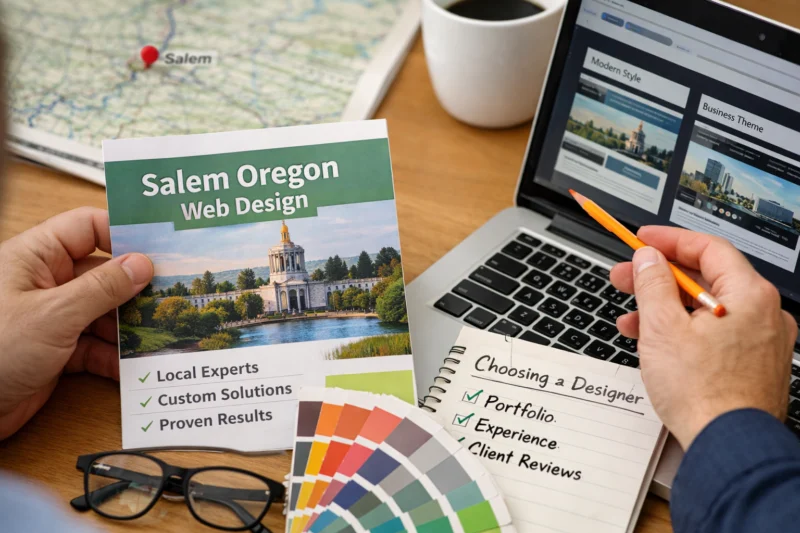
The biggest mistake is thinking launch is the finish line. The real risk is launching a site that cannot scale, measure, or support future campaigns. If the structure cannot handle analytics, new landing pages, or future offers, the business ends up redesigning sooner than expected. That is why you should ask whether the site is built for growth, not just for appearance. Strong teams also think ahead about conversion-driven design tactics and content systems that can evolve over time.
Questions to ask before you sign a contract
Ask how they define success for a project like yours. A good answer will mention concrete outcomes such as more qualified inquiries, smoother scheduling, stronger credibility, or clearer navigation. If the response is only about design taste, that is a sign the conversation has not reached business strategy yet.
You should also ask what happens if your content, approvals, or schedule slow down. Real projects hit delays, and the best designers already have a process for handling them. They should be able to explain how timeline changes affect milestones, whether work pauses until content arrives, and what parts of the process depend on your feedback.
Ownership is another critical question. Ask who owns the files, logins, and final website assets after launch. If you do not control the domain, hosting access, CMS credentials, and design deliverables, you may be locked into a relationship longer than you want. You should also ask about post-launch support, because the job is not complete when the site goes live.
For practical use, a short contract review can save major headaches later. Ask about revision rounds, launch support, maintenance options, and what counts as out-of-scope work. The quality of their answers matters as much as the answers themselves. Clear, specific language is a better signal than polished sales talk, especially when you are comparing small business web partners for a project that needs to perform from day one.
Red flags that should make you pause
Vague promises are a major warning sign. If a designer says they can improve everything but cannot explain how they work, what the process is, or what outcomes they have produced for similar clients, be cautious. Good providers can describe their workflow, what they need from you, and how they handle revisions without sounding evasive.
Another red flag is broad service language without relevant examples. If a provider claims to do everything but shows no Salem business experience, no similar project types, and no clear process, the pitch may be stronger than the delivery. It is not enough to say they do design, SEO, branding, and development. You want to know how they prioritize work and which parts they do well in practice.
Also watch for no mention of support after launch. Sites need updates, security attention, and occasional fixes. If a proposal does not address ongoing website maintenance or who handles issues after launch, you may be left solving problems on your own. That is a problem even for simple sites, and it becomes serious when forms, plugins, or integrations break.
The deeper red flag is overconfidence without transparency. A polished presentation can hide weak follow-through, and many business owners discover that only after the contract is signed. Responsiveness, clarity, and a willingness to explain tradeoffs are often better indicators than a flashy pitch. If a designer avoids specifics about timeline, ownership, or support, pause before moving forward.
Frequently Asked Questions About local website designers in Salem Oregon
How do I choose a website designer in Salem Oregon?
Choose based on fit, process, budget, portfolio, support, and business goals. The best designer is the one who understands what your site must do, not just how it should look.
What should local website designers in Salem Oregon include?
A proper scope should usually include strategy, design, development, mobile responsiveness, launch support, and basic SEO setup. If content help, analytics, or maintenance are important to you, make sure those are spelled out before work begins.
Are local website designers better than remote designers?
Local knowledge can help with trust, messaging, and easier communication, but expertise and process often matter more than geography. A remote specialist may be the better choice if your project needs niche experience or deeper technical capability.
How much does a website designer in Salem Oregon cost?
Pricing depends on scope, complexity, content needs, and post-launch support. A simple brochure site will cost less than a custom build with ecommerce, integrations, or a strategic redesign.
Should I hire a freelancer or agency for my site?
Hire a freelancer if the project is small, the scope is clear, and your budget is tight. Choose an agency or studio if you need broader support, more capacity, or multiple disciplines working together.
How long does a typical website project take?
Timelines vary based on page count, approvals, content readiness, and technical complexity. A simple project can move quickly, while a redesign with copywriting, SEO, or integrations usually takes longer.
Do local website designers in Salem Oregon handle SEO too?
Some do, but “SEO included” often means only the basics, such as page titles, metadata, and structure. If you need deeper work, ask whether they handle local SEO strategy, content planning, and technical setup.
What if I already have a website and just need a redesign?
A redesign should preserve useful SEO value, keep important pages accessible, and improve the parts of the site that are underperforming. The best redesigns treat the old site as an asset to evaluate, not just something to replace.
How do I know if a designer is a good fit for my business?
Look for strong discovery questions, practical recommendations, and a clear understanding of your market or service model. A good fit feels collaborative, specific, and focused on business results rather than personal taste.
What questions should I ask before hiring a web designer?
Ask about success metrics, process, timeline risks, asset ownership, revisions, and post-launch support. If the answers are clear and specific, that is usually a strong sign you are talking to a professional who understands the full project lifecycle.
Conclusion
The best way to choose a Salem website designer is to compare local understanding, proven process, relevant experience, and support after launch. Do not decide based on design style alone. A site that earns leads and builds credibility needs strategy, clarity, and a team that can execute reliably.
As you review candidates, focus on outcomes, communication, scope clarity, and how well they understand your business goals. Then ask the hard questions before signing anything. The smartest move is to compare two or three candidates, schedule a discovery call, and review the scope in detail before you commit.
Updated April 2026