
Salem Oregon website design helps local businesses turn search traffic into calls, bookings, quote requests, and in-store visits by making the website easier to trust, easier to understand, and easier to act on.
In 2026, that matters more than ever because customers in Salem compare businesses quickly, and the website often decides whether they click, call, or keep scrolling. If your pages do not clearly show what you do, where you work, and why you are credible, your competitors can win even when their services are not better. A strong salem oregon website design strategy is not just about appearance; it is about helping your business rank better in Salem and turn visits into customers.
For local owners, the real question is not whether a site looks modern. It is whether the site supports commercial intent, local relevance, and conversion paths that match how Salem buyers search. That is why this guide focuses on decision-making: what to prioritize, what to avoid, and how to evaluate design choices that affect Google visibility and lead quality.
Contents
- 1 Why local Salem businesses are winning more Google traffic with better websites
- 2 What Salem Oregon website design needs to accomplish for commercial intent
- 3 The process local businesses should follow to get results from design
- 4 Choosing between the main website design options available to Salem businesses
- 5 Local SEO signals that the website must support to compete in Salem
- 6 Common mistakes Salem businesses make with website design and why they lose leads
- 7 What most guides get wrong about local business websites in 2026
- 8 What to look for when evaluating a Salem website design provider
- 9 Advanced considerations that separate average local sites from the ones dominating Google
- 10 Frequently Asked Questions About Salem Oregon Website Design
- 10.1 How much does Salem Oregon website design usually cost?
- 10.2 How long does it take to build a local business website?
- 10.3 What should a Salem business website include to get leads?
- 10.4 Is a template website good enough for local SEO?
- 10.5 How do I know if my current website is hurting Google performance?
- 10.6 Do I need separate pages for each service or location?
- 10.7 What makes a website convert more visitors into customers?
- 10.8 How often should a Salem business redesign its website?
- 10.9 What is the difference between web design and local SEO?
- 10.10 Can a new website help my business rank better in Salem?
- 11 Conclusion — planning notes for the writer
Why local Salem businesses are winning more Google traffic with better websites
Local businesses in Salem win more Google traffic when their websites match search intent, location signals, and trust expectations better than competing sites. Search engines are not rewarding decoration; they are rewarding pages that make it obvious a business is relevant to the query and useful to the visitor.
This is why a strong website can outperform social media alone for high-intent searches. Someone looking for a roofer, dentist, attorney, or remodeler is often comparing businesses, not browsing casually. If your site answers the question immediately, shows local proof, and gives a clear next step, it can convert that traffic into a call or form submission. That outcome matters more than simply attracting visits.
The deeper reason stronger sites eventually overtake weaker ones is consistency. A competitor may rank temporarily because of age, weak competition, or a few backlinks, but if their page is thin, slow, or vague, they tend to underperform in engagement and conversions over time. Search engines can detect when users bounce, hesitate, or look for more detail. This is where practical content, better website UX, and clearer local signals separate durable rankings from short-lived ones.
Business owners often start by comparing nearby design choices, but the better path is to evaluate the whole experience: the content, the service pages, the contact flow, and the credibility markers. Salem businesses that do this well often get more map clicks, calls, appointment requests, and quote submissions without relying on constant ad spend.
For broader context, local businesses should think about search visibility as a combined system of content and authority. Guidance from Google Search Central and Google Business Profile Help reinforces that websites, profiles, and content quality work together rather than separately.
What Salem Oregon website design needs to accomplish for commercial intent
For commercial intent, Salem Oregon website design needs to do three things fast: explain the service, prove the business is credible, and make contact easy. If a visitor cannot tell what you offer above the fold, they will often leave before they ever reach a deeper page.
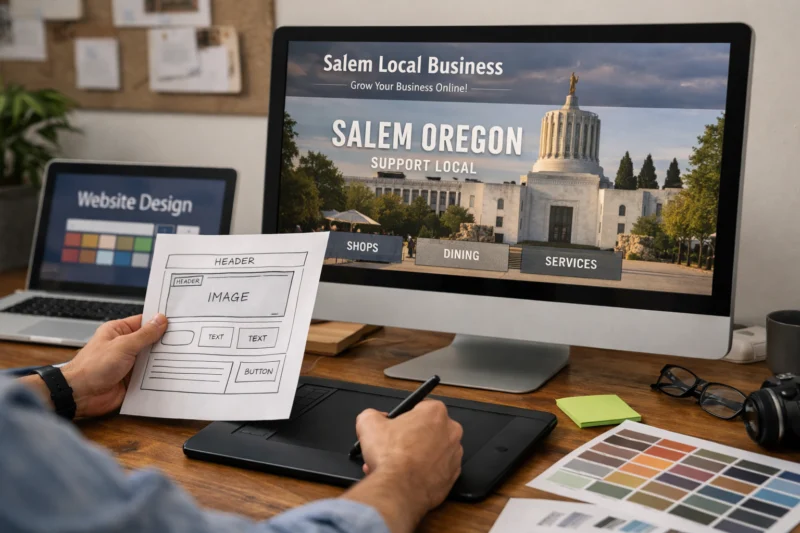
Local buyers usually look first for service clarity, trust markers, and contact options. That means the homepage and core service pages should immediately answer who you help, what you do, where you serve, and how someone can take the next step. A clean headline alone is not enough if the page does not quickly show proof, such as reviews, local experience, certifications, or recognizable project examples.
The conversion path also changes by business type. A contractor may need quote requests and project photos, while a med spa may need booking flows and service clarity, and a storefront may need directions, hours, and product categories. Local intent changes content priorities because buyers are not trying to learn everything about your company; they are trying to decide whether you are the right local option right now.
Urgency matters too. High-urgency visitors, such as someone with a broken HVAC system, need a direct phone number, service area confirmation, and emergency language. Lower-urgency visitors, such as someone researching a remodel, may need more educational content, testimonials, and portfolio detail. The layout and CTA placement should reflect that difference instead of forcing every visitor into the same path.
Businesses that take this seriously usually need a custom website strategy, not just a visual refresh. The goal is not to impress visitors with design trends; it is to remove friction from the buying decision. When that happens, the website becomes a lead system instead of an online brochure.
The process local businesses should follow to get results from design
The right process starts with goals, not pages. Before choosing layouts or features, a Salem business should define what success means: more calls, more quote requests, more booked appointments, more store visits, or more service-area inquiries.
Once goals are clear, the next step is to audit what current visitors are doing. Look at which pages they enter on, where they leave, how far they scroll, and whether mobile users can actually complete a contact action without friction. This tells you where the highest-leverage fixes are. A small improvement on a high-traffic service page often produces more value than redesigning a low-traffic blog page.
Information architecture should be built around services, locations, and trust content rather than internal company departments. That usually means clear service pages, relevant location pages, an about page that builds credibility, and a contact path that is visible across the site. Mobile-first layout matters because many local searches happen on phones, and slow or cluttered pages reduce engagement before a lead ever forms.
When budget only covers the highest-impact pages, prioritize the homepage, top service pages, contact page, and any page that receives the most organic traffic. If those pages are weak, improving them first creates faster results than spreading the budget across every page evenly. This is also where website redesign planning becomes strategic rather than cosmetic.
The decision framework is simple: fix the pages that influence leads first, then expand into supporting content. That is how businesses get value from salem design services without overbuilding too early. For deeper page-structure advice, teams often pair this with conversion-focused UX work and on-page SEO best practices.
| Priority | Best first move | Why it matters |
|---|---|---|
| High traffic, low conversion | Rewrite the headline, CTA, and proof blocks | Improves lead flow without rebuilding the whole site |
| Weak mobile experience | Fix layout, speed, and tap targets | Reduces abandonment from phone users |
| Poor local relevance | Add service-area and location signals | Helps Google and users understand fit |
| Low trust | Add reviews, credentials, and project proof | Supports both ranking confidence and conversions |
Choosing between the main website design options available to Salem businesses
Most Salem businesses choose between custom design, template-based design, semi-custom design, or redesigning an existing site. The right choice depends on budget, speed, scalability, and how competitive your market is.
Custom design is best when the business needs a unique structure, advanced conversion paths, or a brand experience that supports higher-value services. Template-based design is faster and cheaper, and it can work well for simpler businesses if the content, SEO structure, and local signals are customized properly. Semi-custom design sits between the two, giving a business a faster launch than full custom work while still allowing meaningful differentiation.
Redesigning an existing site is often the most efficient option when the domain already has history, backlinks, and some rankings. In those cases, rebuilding everything from scratch can be riskier than improving what already exists. That is why many owners should choose design option based on business stage rather than preference alone. A startup with a tight launch deadline may need a template now and stronger upgrades later, while an established service brand may need a more strategic rebuild with a clearer custom website strategy.
The hidden cost of “cheap” design is usually not the first invoice. It is the rebuild that follows when the site cannot support SEO, content expansion, or conversion tracking. If the structure is too rigid, the business ends up paying twice: once for the launch and again for a proper site later. That is why smart buyers also compare local agencies and ask whether the provider has experience with website redesign planning, not just development.
For businesses exploring nearby design choices, the best test is not what looks polished in a portfolio. It is whether the provider can explain why a layout helps generate leads, what can be reused from the current site, and what will need future expansion. That thinking matters more than a trendy homepage animation.
Local SEO signals that the website must support to compete in Salem
A Salem business website must support local SEO signals by making it easy for search engines to understand what the business does, where it serves, and why it is credible. Strong page structure, title tags, service pages, and consistent location references all help Google connect the site to local intent.
That starts with clear service pages for the core offerings, not one vague page that tries to do everything. If a company offers roofing, gutter installation, and repair, each major service deserves enough detail to show relevance and expertise. The same applies to location relevance. If the site serves Salem, surrounding neighborhoods, or nearby cities, that should be reflected naturally in the content rather than stuffed into awkward copy.
Trust elements matter because local search is partly about confidence. Reviews, licensing, contact consistency, service area clarity, and real business information all reinforce local credibility. Google also cross-checks identity across the website and local profiles, so the name, address, phone number, and service descriptions should align. The website should reinforce the same business identity shown elsewhere, not contradict it.
Duplicate or thin location content weakens performance because it fails to give search engines a clear reason to rank the page. A page that changes only the city name but keeps the same copy across multiple locations rarely earns long-term visibility. It is far better to write location pages that explain real differences in service access, local logistics, examples, or customer needs.
The biggest mistake is trying to rank locally without a strong page for each core service. If the site only has a homepage and a generic services page, it leaves too much ambiguity. This is where good local SEO signals and strong design work together: structure helps Google understand the site, while layout helps people trust it. For a deeper support resource, businesses often pair this with dedicated content on local SEO signals and Google Business Profile optimization.
Common mistakes Salem businesses make with website design and why they lose leads
The most common mistake is prioritizing visuals over clarity. A beautiful homepage that hides the offer, buries the CTA, or makes visitors hunt for basic information often loses more leads than a simpler page with stronger messaging.
Another frequent problem is hiding contact information. Ready-to-buy visitors want to act quickly, especially on mobile. If the phone number is not visible, the form is too long, or the next step is unclear, the business creates friction at the exact moment intent is highest.
Generic copy is another lead killer. If the page sounds like every other agency, contractor, or professional service in town, it fails to signal local relevance or service specificity. The better approach is to speak directly to the Salem customer, the specific service need, and the outcome they are looking for. That kind of messaging supports both conversion and local relevance.
Owners also launch pages without conversion tracking, which means they cannot tell what is working. Without tracking calls, form fills, clicks, and page paths, design decisions become guesses. That often leads to endless revisions based on opinions instead of data. In practice, the sites that perform best are usually the ones where the team can see which pages lead to action and which pages stall visitors.
One overlooked mistake is overloading the homepage with too many messages. When every service, award, special offer, and company story fights for attention, the visitor does not know what matters first. That can reduce rankings indirectly because the page becomes harder to understand and harder to engage with. Simplicity is not minimalism for its own sake; it is a conversion tool.
What most guides get wrong about local business websites in 2026
Most guides focus on design trends instead of business outcomes. A local business does not need a site that merely looks current; it needs a site that drives action from the right customers in the right area.
Another mistake is assuming every business needs the same structure, CTA style, or content depth. A dentist, HVAC company, law firm, retailer, and remodeler all face different buyer questions and urgency levels. The page hierarchy should reflect that reality. In some industries, proof and booking matter most; in others, service area clarity and quote flow are more important.
Many guides also underplay credibility signals. For local buyers, trust is not abstract. It is made up of reviews, real project examples, local language, clear contact details, and a sense that the company actually serves the area. That is why design and content cannot be separated. Pretty pages without trust signals do not convert well, and trust-heavy pages with poor layout also underperform.
Another blind spot is overpromising rankings without discussing competition and readiness. A site can be technically sound and still underperform if the business lacks strong service pages, local proof, or a clear conversion path. Search visibility and lead generation are related but not identical outcomes. This is where many owners misunderstand the relationship between web design and SEO.
The biggest misconception is that “pretty design” and SEO are separate problems. They are not. If the design hides relevance, weakens readability, or creates friction, it hurts both the user experience and the site’s ability to compete. That is why smarter providers integrate design, copy, and local SEO rather than treating them as separate deliverables.
What to look for when evaluating a Salem website design provider
When evaluating a Salem website design provider, look first for understanding of commercial intent. They should be able to explain how the site will generate leads, not just how it will look after launch.
Process clarity matters next. A strong provider should walk you through discovery, strategy, content structure, launch, and post-launch optimization. If they skip directly to visuals or ask for a logo before understanding your goals, that is a sign the project may be treated as a production task rather than a business asset. Good providers know how to align salem design services with measurable outcomes.
You should also ask how they handle SEO alignment and conversion strategy early. Do they think about page hierarchy, internal linking, trust blocks, and mobile usability before design begins? Do they ask about lead quality, service priorities, and target neighborhoods? These questions reveal whether the provider understands how local websites compete.
After launch, the best teams measure results with data, not assumptions. That may include form completions, call clicks, scroll behavior, and which pages drive the best leads. If a provider cannot explain how they will use performance data to improve the site, the relationship may stop at launch instead of continuing as a growth partnership.
Communication often matters more than portfolio flash. A polished mockup can hide weak strategy, while a clear communicator can turn a modest budget into a site that performs well. When comparing providers, look for the one who asks the best business questions, not the one who simply shows the best screenshots.
Advanced considerations that separate average local sites from the ones dominating Google
Competitive local sites usually have more content depth on service pages. They do not stop at a few paragraphs and a contact form. They explain service scope, common problems, process, timing, pricing factors, and why the company is qualified to help.
Internal linking strategy is another separator. A strong site connects the homepage to service pages, service pages to supporting articles, and location pages to trust-building content so authority flows where it matters. This makes it easier for search engines to understand priority pages and easier for users to keep exploring. It also helps turn topical depth into measurable visibility.
Schema and structured trust signals can strengthen clarity, especially when paired with consistent website content and local business profiles. The goal is not to “trick” search engines. It is to make the business identity easier to interpret. Readability, speed, accessibility, and mobile interaction quality also matter because they affect real user behavior. If a page is hard to scan or slow to load, visitors hesitate even if the branding is strong.
There are also edge cases. Multi-location businesses need location-specific pages without duplicate copy. Hybrid service-area businesses need content that explains where they work and how they handle travel or dispatch. Seasonal businesses need flexible homepage messaging and campaign pages that adjust to demand spikes. These situations require more than standard templates because the structure itself affects discoverability and conversions.
Businesses that want to stay competitive should treat this as a system, not a single page project. That is why advanced teams often combine content planning, technical SEO, UX improvement, and local profile consistency into one operating model. For readers looking for related support, topics like better website UX, local service page strategy, and multi-location SEO often become the next most useful areas to improve.
Frequently Asked Questions About Salem Oregon Website Design
How much does Salem Oregon website design usually cost?
Costs vary based on whether you need a simple template, a semi-custom build, or a fully custom site with strategy and content support. The cheapest option often lacks the structure needed for SEO, tracking, and conversion, so the long-term value can be lower even if the initial price is attractive.
How long does it take to build a local business website?
Smaller sites can be launched in a few weeks if content and approvals are ready, while larger or more strategic builds may take several months. Timeline usually depends on content readiness, revision speed, and whether the project includes redesign planning or new copy.
What should a Salem business website include to get leads?
At minimum, it should include clear service pages, visible contact options, trust signals, and a homepage that explains what the business does right away. It should also make the next step obvious, whether that is a call, booking, quote request, or store visit.
Is a template website good enough for local SEO?
A template can work if it is customized with strong content, local relevance, proper page structure, and conversion-focused design. A generic template with only swapped text usually becomes limiting once the business wants to rank competitively or expand services.
How do I know if my current website is hurting Google performance?
Warning signs include poor mobile usability, weak traffic-to-lead conversion, thin service pages, and a lack of local proof. If visitors are landing on the site but not calling or submitting forms, the problem is often clarity, trust, or friction rather than traffic volume.
Do I need separate pages for each service or location?
Usually yes for core services and important locations, because separate pages help search engines and users understand what you offer. The key is to make each page genuinely useful, not duplicate the same paragraph with a new city name.
What makes a website convert more visitors into customers?
Clarity, trust, speed, and strong CTA placement usually matter most. If the visitor quickly understands the offer, sees proof, and can contact the business without friction, conversion rates usually improve.
How often should a Salem business redesign its website?
A redesign is usually justified when the site is outdated, hard to update, weak on mobile, or no longer matches the business model. Smaller updates may be enough if the structure is solid but the copy, trust signals, or tracking need improvement.
What is the difference between web design and local SEO?
Web design focuses on layout, usability, messaging, and conversion, while local SEO focuses on how well the site can be understood and ranked for local searches. They overlap heavily because a site that is hard to use often performs worse in search and in lead generation.
Can a new website help my business rank better in Salem?
Yes, if the new site improves local relevance, page structure, trust, and user experience. It will not guarantee rankings by itself, but it can significantly improve the conditions that help a business compete more effectively in Salem.
Conclusion — planning notes for the writer
The businesses dominating local Google results in 2026 are not simply the ones with the flashiest designs. They are the ones whose websites align design, local relevance, and conversion strategy so clearly that customers trust them faster and search engines understand them better.
For Salem owners, the best site is the one that makes it easy to choose, easy to contact, and easy to believe. That means your next move should be based on goals, budget, competition, and how much of the current site can be improved versus rebuilt. If you are unsure where to start, a site evaluation is often the smartest first step before committing to a full redesign.
The most practical next step is to audit your current pages, compare your options, and decide whether you need targeted improvements or a full redesign. That decision will determine whether your website becomes a passive brochure or an active lead engine for Salem customers.
Updated April 2026