
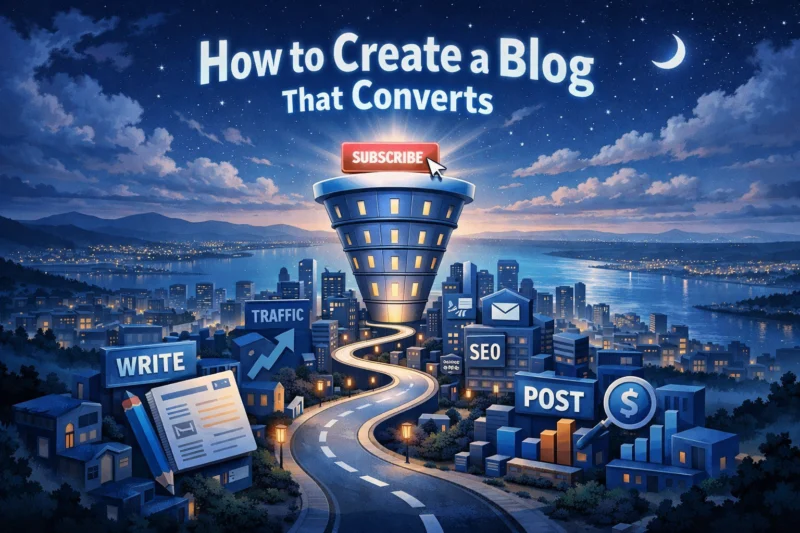
A blog converts when it turns the right reader into a measurable next step, such as an email signup, inquiry, demo request, booking, or sale. In practical terms, how-to-create-a-blog-that-converts means building content that attracts qualified attention and then guides that attention toward action instead of stopping at pageviews.
That is the difference between a content-only blog and a conversion-focused blog: one publishes useful articles, while the other is designed around audience intent, trust, and a clear path forward. This guide is about strategy and structure, not a platform tutorial, and in 2026 that matters more than ever because readers are scanning faster, AI summaries are answering simple queries, and search engines are rewarding content that proves usefulness, originality, and next-step value.
If you want your blog to do more than inform, you need a system that connects topic selection, post structure, calls to action, and measurement. That is where a real content strategy framework starts to matter, along with SEO-friendly blog structure, SEO for blogs, and SEO content alignment that supports both rankings and conversions.
Contents
- 1 What makes a blog convert in 2026
- 2 Start with the right reader and goal
- 3 Choose the blog model that fits your conversion goal
- 4 Build a content strategy around intent, not just keywords
- 5 Structure each post to move the reader toward action
- 6 On-page elements that help a blog convert
- 7 Common mistakes that stop blogs from converting
- 8 Advanced considerations: what most guides get wrong
- 9 Measuring whether your blog is actually converting
- 10 How to improve an existing blog that is not converting
- 11 Frequently Asked Questions About how to create a blog that converts
- 11.1 What does a converting blog actually mean?
- 11.2 How do I create a blog that converts without sounding salesy?
- 11.3 What should a blog conversion rate be?
- 11.4 How do I know if my blog content is attracting the right audience?
- 11.5 What type of blog post converts best?
- 11.6 How to create a blog that converts for lead generation?
- 12 Conclusion
What makes a blog convert in 2026
A blog converts in 2026 when it moves a qualified reader from information to action with as little friction as possible. That action may be a micro-conversion, like joining a newsletter or downloading a checklist, or a lead conversion, like booking a consultation or requesting a quote. The key point is that conversion is not limited to direct sales; it is any measurable step that advances the relationship.
Helpful content is still necessary, but helpful alone is not enough. A post can answer a question and still fail to convert if it attracts the wrong reader, lacks trust signals, or ends without a clear next step. The best blogs combine usefulness with deliberate action design so the article is not just consumed, but also useful to the business.
The core levers are audience match, intent match, clarity, trust, and next-step design. Audience match ensures the reader is the kind of person you can help. Intent match ensures the article answers the actual search or reading motivation. Clarity and trust reduce hesitation, while next-step design makes the path forward obvious. The deeper nuance is that high traffic can still produce weak conversions if the traffic is broad, low-intent, or informational without relevance to your offer.

Start with the right reader and goal
The fastest way to improve blog conversions is to choose one primary reader segment and one primary business goal. If you write for everyone, you usually persuade no one. A blog aimed at first-time founders should not be structured the same way as one aimed at procurement managers, local homeowners, or enterprise marketers, because each group has different questions, risks, and readiness to act.
Your blog’s job must map to a specific business outcome. For some businesses, that means email list growth and repeat nurtures. For others, it means discovery calls, product trials, paid subscriptions, or affiliate clicks. When the goal is vague, content becomes scattered: posts answer random questions, CTAs feel disconnected, and success gets measured by traffic instead of results.
Reader stage also changes the content strategy. Beginners need education and reassurance. Comparison-stage readers need alternatives, pros and cons, and selection criteria. Decision-stage readers need proof, differentiation, pricing logic, and implementation details. Post-purchase readers need support content that reduces churn and increases expansion opportunities. A blog often fails because the audience is too broad, the goal is too generic, or the content does not align with the actual offer. That is where SEO content alignment becomes essential: each topic should support a known buyer stage, not just a keyword list.
Choose the blog model that fits your conversion goal
Different blog models convert in different ways, and the right one depends on your offer, sales cycle, and content capacity. A service-led blog usually converts through trust and consultation requests. A product-led blog often converts by educating readers about use cases and benefits before sending them to a checkout or trial. A lead-generation blog prioritizes capture through forms, lead magnets, and follow-up sequences. An authority or publisher-style blog converts more indirectly through audience loyalty, sponsorship, affiliate programs, or future offers.
Here is the practical comparison:
| Blog model | Best for | Strength | Common limitation |
|---|---|---|---|
| Service-led | Agencies, consultants, local providers | Strong lead quality and clear next steps | Can overfocus on bottom-funnel topics |
| Product-led | SaaS, ecommerce, digital products | Connects education to product use | Needs strong product-market clarity |
| Lead-generation | B2B, high-consideration services | Builds owned audience and pipeline | Requires good nurture follow-up |
| Authority/publisher-style | Media brands, creators, niche sites | Scales trust and topical depth | Can convert slowly without a clear offer |
The right choice depends on whether you need direct sales, assisted sales, or audience capture first. A long sales cycle often benefits from trust-building content before conversion content. A low-friction product can convert faster, but only if the article shows immediate relevance. Some blogs should not optimize for direct sales first; they should optimize for lead capture or authority building until the audience is ready. This is where linking approach becomes part of the model, because a blog can move readers from education to comparison to decision pages without forcing every article to close the sale.
Build a content strategy around intent, not just keywords
A converting blog is organized around search intent, not random keyword volume. That means grouping topics by what the reader wants to do: learn, compare, decide, or act. If you publish only high-volume informational posts, you may get visits but still attract readers who are too early in the journey to convert. If you publish only commercial posts, you may miss the top-of-funnel readers who become buyers later.
The content categories most converting blogs need are problem awareness, solution comparison, decision support, and action pages. Problem-awareness content explains what is happening and why it matters. Comparison content helps readers evaluate options. Decision-support content removes uncertainty with proof, implementation details, and objections. Action pages convert readiness into forms, trials, purchases, or inquiries. This structure is stronger than chasing isolated keywords because it connects every stage of the journey.
It also solves a subtle problem: informational intent still needs a conversion path to be valuable. A reader searching for a definition or how-to article may not be ready to buy immediately, but that visitor can still become an email subscriber or return visitor if the post is designed properly. This is why a smart content strategy framework treats each page as part of a sequence, not a standalone asset. For more support on this relationship, the topics of organic traffic growth and blog post optimization matter, but only when the content actually attracts the right intent.
Structure each post to move the reader toward action
The best converting posts follow a simple flow: hook, problem framing, answer, proof, and next step. The hook shows the reader they are in the right place. The problem framing clarifies the stakes or the mistake they are making. The answer provides the core solution clearly. Proof reduces doubt. The next step gives the reader something to do without making the article feel like a pitch.
Calls to action work best when they are contextual, not random. A CTA should match the promise of the article and the reader’s readiness. For example, a beginner guide might offer a checklist or newsletter, while a comparison guide might invite a demo or quote request. If the CTA is too aggressive, the post feels salesy. If it is too weak or unrelated, it gets ignored.

Conversion architecture is not just “more CTA buttons.” It is the entire design of how the article builds confidence. Examples, checklists, templates, and clarity markers help readers self-identify and reduce uncertainty. A strong post can also use featured snippet tactics, because concise answers at the top increase trust and make the post easier to scan. When you build pages this way, the article itself becomes a conversion path, not just a traffic destination. That is also where an SEO-friendly blog structure supports both reader experience and search performance.
On-page elements that help a blog convert
Headlines, subheads, and intros determine whether the right reader keeps going. A headline should promise a specific outcome or transformation, not just a topic. Subheads should reduce cognitive load by organizing the article into logical decision points. The intro should confirm relevance quickly, so the reader knows this page will help them, not waste their time.
Trust signals matter inside the post because readers need reasons to believe you. Specific examples, firsthand experience, citations, screenshots, and implementation context all improve confidence. If you explain a strategy, show how it works in a real scenario. If you make a claim, support it with evidence or clear reasoning. In 2026, this matters even more because readers are comparing your content to AI summaries and competing pages that may sound similar. Strong on-page ranking signals and visual design improvements can reinforce credibility by making the page easier to skim and more trustworthy at a glance.
CTA placement should be varied: inline, end-of-post, sidebar, and contextual links all have a role. But different post types need different CTA intensity. A top-of-funnel explainer should not push as hard as a decision-stage comparison page. The deeper mistake is assuming every article should convert the same way. That creates friction. The better approach is to match CTA intensity to intent, then use supporting content and blog post optimization to move readers naturally toward the next page.
Common mistakes that stop blogs from converting
The most common mistake is targeting the wrong intent. A post can rank well and still underperform if it attracts readers looking for general education when the offer requires purchase readiness. This happens often when creators chase broad keywords without asking whether the resulting traffic is actually qualified.
Another failure mode is overvaluing traffic metrics and underestimating readiness. Bounce rate, time on page, and pageviews can look healthy while conversions stay flat. That can happen when the content is entertaining, informative, or controversial, but not tied to a next step. Generic CTAs are another problem: “Contact us” or “Learn more” often fail because they do not match the article’s promise or the reader’s stage.
Missing trust signals is equally costly. If a post makes claims without proof, readers hesitate, especially for high-consideration offers. The deeper pitfall is confusing engagement with conversion. A long time on page may mean the post is useful, or it may mean the reader is confused. The difference is whether the page produces action. If it does not, you need to revisit intent match, CTA relevance, and content strategy before assuming the blog itself is the problem.
Advanced considerations: what most guides get wrong
Most conversion guides focus too much on the article and not enough on the offer. A strong post cannot fully compensate for weak positioning, unclear pricing, poor onboarding, or an unattractive lead magnet. Conversion is a system-level outcome. If the offer is confusing or misaligned, the blog will struggle even with excellent writing.
Internal links are another overlooked conversion path. They are not just an SEO tactic; they are a navigation system that can move readers from educational content to comparison content, then to decision pages. This is especially important for complex buying journeys where one post will not close the loop. For example, an article about solving a problem may point to a checklist page, a service page, or a product comparison page. That is where internal linking strategy supports both discovery and conversion.
Long-form depth can help or hurt. It helps when it improves clarity, reduces objections, and creates confidence. It hurts when it adds friction, repeats itself, or buries the answer. The edge case is a blog with multiple audiences or highly technical buyers. In those cases, you may need educational content before conversion content, and you may need separate paths for each audience segment. That is why a blog should not be forced into a sales-first format when the real job is trust-building, decision support, or pre-qualification. Supporting topics like on-page ranking signals, visual design improvements, and SEO content alignment work best when they are used to make that path easier, not louder.
Measuring whether your blog is actually converting
You should measure conversion based on the goal you set, not a generic benchmark. If the goal is email growth, track opt-ins. If the goal is sales, track demo clicks, quote requests, or completed purchases. If the goal is assisted revenue, track how often blog visitors later convert through another page or channel. The point is to measure the action the blog was meant to produce.
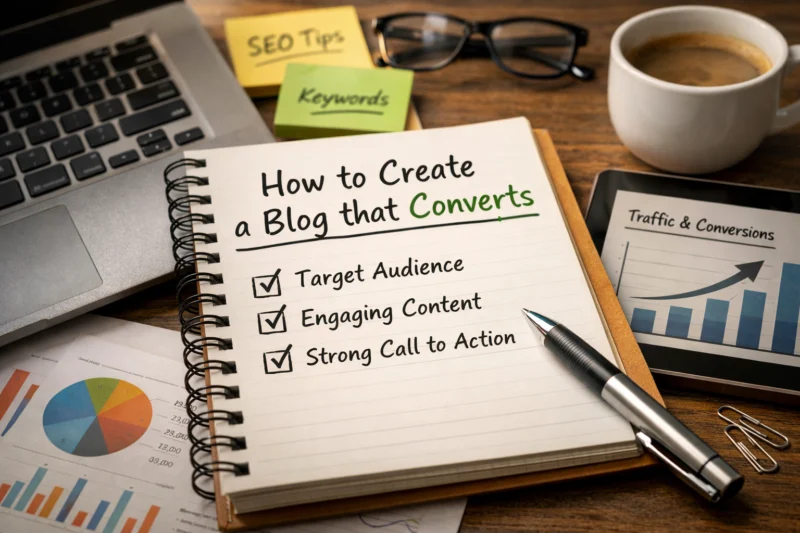
It is also important to separate traffic quality from conversion-page effectiveness. Sometimes the blog is attracting the wrong reader. Other times the content is fine, but the CTA, form, offer, or landing page is weak. If traffic is high and conversions are low, inspect intent alignment first. If conversions are good but traffic is low, the content may be effective but underexposed. That difference matters because the fix is different in each case.
Test one change at a time when possible. Start with CTA wording, placement, offer relevance, and post-intent alignment before redesigning the entire site. If a page has strong traffic but weak conversion, the article may need a better bridge to the next step. If a page converts well but gets little traffic, it may deserve support from internal links, better distribution, or more search-focused topic coverage. In other words, measure the full path, not only the post itself, and connect it to organic traffic growth over time.
How to improve an existing blog that is not converting
Start by auditing the full reader journey from search result to CTA. Check whether the headline matches the query, whether the intro confirms the reader’s intent, and whether the article ends with a meaningful next step. A blog often fails because one of these handoffs breaks, not because the entire site is wrong.
Then look for drop-off points. If readers leave quickly, the title may overpromise or the opening may not establish relevance. If they read deeply but do not act, the article may be useful but not directional enough. If they click CTAs but do not complete forms or purchases, the problem may be the landing page, the offer, or the friction in the conversion process. The highest-impact fixes usually involve tightening the match between audience, content, and offer instead of redesigning the entire website.
A blog with decent traffic but weak audience-to-offer alignment is common in 2026 because search visibility does not automatically equal business fit. Repair it by pruning irrelevant topics, improving internal paths, and rewriting high-traffic pages to better qualify readers. If needed, build support content around decision-stage questions so the blog can educate before converting. That approach is usually more effective than chasing more pages, more volume, or more generic engagement.
Frequently Asked Questions About how to create a blog that converts
What does a converting blog actually mean?
A converting blog is one that turns readers into measurable outcomes, such as email subscribers, leads, booked calls, or buyers. It is not defined by pageviews alone, because traffic without action does not support a business goal. The real test is whether the content moves the right person to the next step.
How do I create a blog that converts without sounding salesy?
Use value-first CTAs that match the reader’s stage and the post’s promise. When the article solves a problem clearly, the next step feels helpful rather than pushy. Trust-building structure, specific examples, and contextual offers usually convert better than aggressive promotion.
What should a blog conversion rate be?
There is no universal benchmark because conversion rates vary by niche, offer type, traffic source, and goal. A lead magnet page, a service blog, and an ecommerce blog will not perform the same way. Focus on whether your current conversion rate is improving against your own baseline and whether the traffic is actually qualified.
How do I know if my blog content is attracting the right audience?
Check the intent behind the keywords, the comments or replies you get, and the conversion behavior of readers. If people read but rarely click relevant offers, they may be in the wrong stage or outside your ideal audience. The strongest signal is when visitors from a post take the exact next step that post was designed to support.
What type of blog post converts best?
There is no single winner because conversion depends on intent and stage. Comparison posts and decision-support posts often convert well for offers with a clear buying process, while educational posts can convert well through lead capture. The best-performing post is usually the one that matches reader readiness most closely.
How to create a blog that converts for lead generation?
Use content that solves an immediate problem and pair it with a relevant lead magnet, such as a checklist, template, or mini-guide. Place contextual CTAs where the reader has enough trust to act, not only at the bottom of the page. The lead offer should feel like the natural next step from the article, not a separate pitch.
Conclusion
A converting blog aligns the right reader, the right intent, the right structure, and the right next step. When those pieces work together, the blog becomes a business asset instead of a content archive.
The biggest lesson is that conversion comes from a system, not isolated posts. Audience choice, content strategy, on-page design, internal paths, and measurement all shape outcomes. If one of those pieces is weak, the blog may still get traffic but fail to produce business value.
If you are starting from scratch, begin with one clear goal and build around it instead of trying to make every post do everything. If you already have content, audit one existing article, identify its audience fit and CTA path, and improve one conversion element first. That single upgrade is often the fastest way to move from content-only publishing to a blog that actually converts.
Updated April 2026