

Optimizing Your Website for Voice Search means making your pages easy for assistants, search engines, and AI systems to understand, extract, and speak back as direct answers. It matters because people now ask conversational questions on phones, smart speakers, car systems, and AI-powered search interfaces, and they expect fast, precise responses rather than long lists of links. For businesses and publishers, voice search SEO can improve discoverability for question-based queries, local intent, and mobile-first experiences that increasingly shape how search traffic is distributed in 2026.
The benefits of an effective content plan are clear: structuring your content around genuine inquiries, ensuring quick load times, and providing straightforward answers makes it more likely for search engines to select your pages for featured snippets and local search results. This approach is no longer just an experimental tactic; it intersects significantly with mobile SEO, the fundamentals of structured data, internal linking approaches, and the overall strategy for your site’s content. To enhance your online visibility, it’s essential to focus on crafting a strategic content plan that meets these criteria.
What voice search optimization actually means in 2026
Voice search optimization is the practice of making your content, pages, and site structure easier for spoken query systems to interpret and use. In 2026, that includes assistants on phones, smart speakers, in-car interfaces, and AI-powered search experiences that combine voice input with synthesized answers. The goal is not just to be “read aloud”; it is to be selected as a trustworthy, concise, and contextually useful source.
Voice queries differ from typed searches because people speak in longer, more natural language. A typed search might be “best plumber Chicago,” while a spoken query is more likely to be “Who is the best plumber near me that can come today?” That shift changes how pages should be written. They need clearer headings, tighter answer blocks, and language that maps to real intent rather than keyword fragments. It also overlaps with long-tail query targeting, because spoken queries often carry more detail and stronger intent than short desktop searches.
The concept of “ranking” for voice search encompasses more than what many guides typically cover. It can refer to direct answers sourced from featured snippets, but it may also include results from local packs, knowledge panels, or summaries compiled from multiple sources. This highlights the importance of optimizing for featured snippets, though it’s only one aspect of a larger strategy. As voice systems increasingly utilize AI for content retrieval and summarization, it’s crucial that your content is not only easily extractable but also trustworthy. For insights on how to achieve this, consider exploring effective techniques for optimizing your site for featured snippets.
The deeper point most sites miss is that voice experiences are becoming hybrid experiences. Users may ask a question out loud, but the engine may answer using a combination of structured data, page content, local information, and brand/entity signals. That means your site should prioritize clarity, source reliability, and topical usefulness rather than chasing one narrow “voice ranking” tactic.
How to optimize your website for voice search: the step-by-step process
The best way to optimize a website for voice search is to start with the questions people actually ask, then reshape your existing pages so the answers are easy to find and easy to quote. That workflow matters because voice visibility usually comes from pages that already have topical relevance. In many cases, the fastest gains come from improving a page that is already near page one rather than publishing a brand-new article and hoping it earns trust quickly.
Start with intent mapping. Group questions into informational, navigational, and local intent so each page serves a clear job. Informational queries need definitions, step-by-step explanations, and comparisons. Navigational queries need clarity around brands, services, and page pathways. Local queries need service areas, hours, contact options, and location signals. This structure also supports content strategy planning because it helps you decide which pages deserve answer blocks, which deserve local detail, and which deserve supporting content clusters.
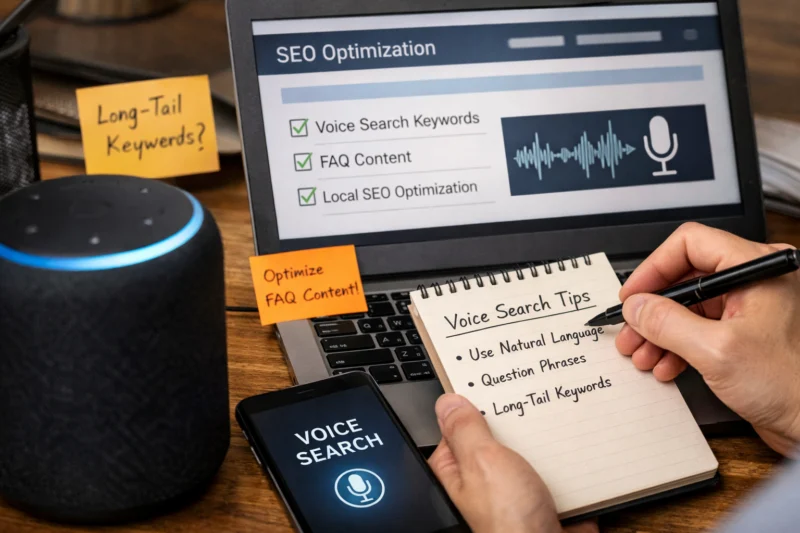
Then align page structure to spoken queries. Use question-led headings, answer the question in the first one or two sentences, and add context below it. That approach improves both user experience and machine extraction. A page about billing, for example, should not bury the direct answer under a long intro. The same is true for product pages, service pages, and help content. Search engines want confidence that the page resolves the query quickly, especially when the query is conversational.
Technical accessibility is an essential layer to consider. You need to ensure that a website is crawlable, indexable, mobile-friendly, and has a clean HTML structure. If a page is slow to load, blocked from search engines, or visually cluttered on mobile devices, it is less likely to perform well in voice search and assistant-driven environments. This is where understanding how to conduct a comprehensive website evaluation for SEO becomes invaluable, as it can highlight whether the site is comprehensible to search systems before investing time in content revisions. For many websites, enhancing the internal linking strategy and improving mobile SEO performance will significantly contribute to voice readiness, often more so than merely increasing the number of pages.
One common mistake is treating voice optimization as a publishing problem only. It is partly a publishing problem, but it is also a page-selection problem. If your best answer lives on a weak page, or if the page is disconnected from the rest of your site, it may never be surfaced. Strong voice results usually come from pages that already sit inside a well-linked topical cluster, especially when supported by clear entity references and concise answer formatting.
Voice Search Matters. Are You Ready?
Optimize Your Website for the Future.
Make sure your site is voice search ready with expert design and SEO strategies. eDesignerz can help you create a fast, user-friendly website that captures voice queries and drives conversions.
29+ Years of Web Design Expertise Discuss Your Project Today!
The content signals that make voice-friendly pages easier to surface
Voice-friendly content reads naturally because it mirrors the way people ask for help. That does not mean stuffing pages with awkward question phrasing. It means writing in plain language, using the terms your audience uses, and making sure the answer appears before the explanation. A good test is whether a person could quote the first two sentences as a direct answer without losing meaning.
This is where semantic coverage matters. If your article is about website speed, do not repeat the same phrase over and over; instead, use related terms such as load time, render blocking, core pages, mobile responsiveness, and performance bottlenecks. Search systems are better at interpreting topical breadth than they used to be, especially in AI-assisted search. Broad coverage helps the model understand that your page is genuinely useful, not just optimized for one narrow keyword. That makes the page more likely to be selected for answer extraction and summary generation.
Direct answers should sit near the top of the relevant section, followed by examples, caveats, and deeper detail. This is not just about snippets; it is about trust. A page that gives a clear answer and then proves it with context tends to perform better than one that hides the answer inside a wall of text. It also reduces user frustration on mobile, where people often want a fast confirmation before deciding whether to keep reading.
The deeper mistake many sites make is over-optimizing for one exact phrase. Voice systems often reward broad topical usefulness over literal repetition, and that matters even more in 2026 because query understanding is more conversational. A page that only repeats one variation of a question can look thin or artificial. A page that naturally covers the topic, the edge cases, and the related entities is more likely to be cited, summarized, or used in a spoken response.
For example, a service page can support “featured snippet optimization” and “structured data basics” without turning into jargon-heavy copy. Likewise, local pages can reinforce “local search visibility” while still sounding like a real business description rather than a keyword template.
Technical website factors that support voice search performance
Technical quality supports voice search because assistants and search engines need pages that render quickly, parse cleanly, and fit mobile behavior. If a page is sluggish or difficult to render, it becomes less attractive as a source for direct answers. This is especially true when many voice queries originate on phones, where users expect immediate utility and search systems need fast access to the answer.
Structured data can help search engines interpret page type, business details, FAQ content, and product information. That said, it is support, not a substitute. A page with excellent markup but weak copy still struggles to earn voice visibility. Structured data basics matter most when they clarify what the page is about and help the engine connect the page to entities, services, and common query patterns. They are most valuable when paired with clean headings, short answer blocks, and strong topical relevance.
Site architecture matters too. A clear heading hierarchy, sensible internal links, and limited layout clutter make it easier for crawlers and AI systems to understand the page. If your content is buried behind excessive widgets, popups, or duplicate blocks, the machine may still index it, but the extractable answer may be weaker. WordPress site speed is a common example of this issue: themes, plugins, and oversized media can slow the page enough that the content becomes less competitive, even if the writing is strong.
There is an important limitation here: technical excellence helps eligibility, but it does not guarantee selection. Many guides overstate markup and speed as if they were enough on their own. They are necessary foundations, not finish lines. If the page is vague, thin, or off-intent, technical improvements will not rescue it. That is why a strong SEO workflow combines crawlability fixes with content refinement and an internal linking strategy that tells search systems which pages matter most.
The comparison below summarizes the main approaches teams use when building voice search readiness.
| Approach | Best use case | Main advantage | Main limitation |
|---|---|---|---|
| Question-and-answer content | Informational queries and help content | Fast answer extraction and strong snippet potential | Can become shallow if it lacks supporting detail |
| Concise answer blocks on existing pages | Pages already earning impressions | Efficient way to improve relevance and visibility | Depends on existing page quality and authority |
| local landing page optimization | Service-area and near-me queries | Strong fit for local intent and assistant lookups | Requires consistent business details and local proof |
| Supporting content clusters | Authority building and topic expansion | Improves topical depth and query coverage | Takes more time and editorial planning |
Comparing the main approaches to voice search SEO
The best voice search SEO strategy is usually layered, not singular. Some pages should be built as direct question-and-answer resources, especially when the audience wants fast definitions or step-by-step guidance. These pages are ideal for informational intent because they give a precise answer while still leaving room for examples, caveats, and related questions.

Other pages should be optimized where they already exist. If a service page, product page, or help article is already getting impressions, adding a concise answer block near the top can make it more competitive without rewriting the whole page. This is often the highest-return move because it leverages existing relevance. It is also a smart place to apply featured snippet optimization, since the page already has proof of visibility and may only need better formatting.
Local businesses usually need a different mix. A local landing page should answer “where,” “when,” “how much,” and “who serves my area” questions clearly. That makes it easier for both users and search engines to understand whether the page fits a nearby, service-based query. This is where local search visibility matters most. A page that clearly states service areas, contact methods, hours, and trust signals is far more useful than a generic city page stuffed with place names.
The strongest programs also build content clusters around core topics. That supports broader authority and helps the site cover follow-up questions that voice users often ask after the first answer. Many guides get this wrong by trying to force every page into the same template. In reality, voice results may come from FAQs, service pages, glossaries, product pages, local pages, or category pages. The win comes from matching intent to format, then using an internal linking strategy to connect the cluster.
Put simply, the right approach depends on whether you are trying to answer, persuade, locate, or support. A site with strong topic depth, solid mobile SEO performance, and clear page purpose usually outperforms a site that only copies a “voice search checklist” without considering how search systems select pages in practice.
Common mistakes and misconceptions about voice search optimization
The biggest misconception is that voice search is its own separate discipline. In practice, it is an extension of search intent, page quality, and technical clarity. If a page is hard to understand, poorly structured, or disconnected from the rest of the site, it will struggle in voice contexts just as it would in standard search. The difference is that voice makes those weaknesses more obvious because the system needs a more confident answer.
Another mistake is writing robotic question pages that sound like they were made for algorithms instead of people. That usually happens when a site repeats exact-match questions too often or publishes short pages with almost no useful detail. The result is content that may look optimized but does not feel trustworthy. Search systems are increasingly good at identifying whether a page is genuinely helpful, and users are even faster at noticing when it is not.
Some teams also overvalue tiny answer snippets at the expense of depth. A one-sentence response might be enough for extraction, but it is rarely enough to build trust across more competitive topics. If the page does not explain the nuance, the edge cases, or the tradeoffs, it may win a short-lived snippet while losing broader ranking potential. That tradeoff matters because voice and AI search often use the same content to decide whether the site is a credible source.
The deeper mistake is ignoring page experience and topical authority. Many sites chase “spoken answers” while neglecting page architecture, internal links, and supporting articles that help those answers get selected. A good answer on a weak page still loses to a slightly less polished answer on a stronger page. That is why optimization should be viewed as part of a broader website SEO audit, not as a standalone content trick.
Sites that invest in content strategy planning, clean page structure, and deliberate long-tail query targeting tend to build a more durable advantage than sites that only chase voice-specific phrasing.
Boost Your Voice Search Visibility.
Ready for the Future of SEO?
Transform your website to align with voice search trends and maximize your online reach. Our expert design and SEO services will help you craft answers that speak volumes to your audience.
29+ Years of Experience Personalized Service Free On-Page SEO After Launch
Advanced considerations: what most guides get wrong about voice search
Voice search is not one universal behavior. A person speaking to a smart speaker behaves differently from a person asking a question through a mobile assistant or an in-car system. Smart speaker queries often lean toward quick answers, routines, and local requests. Mobile queries may be tied to immediate tasks, navigation, or multitasking behavior. In-car queries can be shorter and more urgent because the user is driving and wants minimal friction.
That means content should be useful in multiple formats. Sometimes the engine wants one best answer. Sometimes it wants a collection of sources, or a summary of several relevant pages. Sometimes it wants structured facts rather than a paragraph explanation. If you only optimize for one answer style, you may miss opportunities elsewhere. This is why competitive advantage often comes from precision, not just markup or schema. The page needs clear entities, unambiguous language, and enough context to fit more than one retrieval pattern.
Brand names and ambiguity also matter more than many tutorials admit. If a query could refer to a product, a service, a person, or a location, the selected page may depend on very subtle signals. That is especially true for local service businesses and complex topics where multiple intent layers exist. For example, a search that includes a location may still be informational rather than transactional. The page should match the real intent instead of assuming every location mention means a sales page is the right answer.
Many guides also underplay the role of content precision. If your definitions are fuzzy, your entity references are weak, or your topic boundaries are unclear, AI-assisted search is less likely to trust the page. The best voice-friendly pages are specific enough to answer a question cleanly and broad enough to sit inside a useful topical ecosystem. That combination is what helps a page perform across spoken queries, assistant summaries, and synthesized answer surfaces.
Voice search optimization for local and service-based businesses
Local and service-based businesses often have the most immediate upside from voice search because many spoken queries include location, urgency, or scheduling intent. The first priority is location clarity. Make it obvious where you operate, what services you provide, and who you serve. If your business covers multiple neighborhoods or regions, say so in plain language and keep the details consistent across your site.
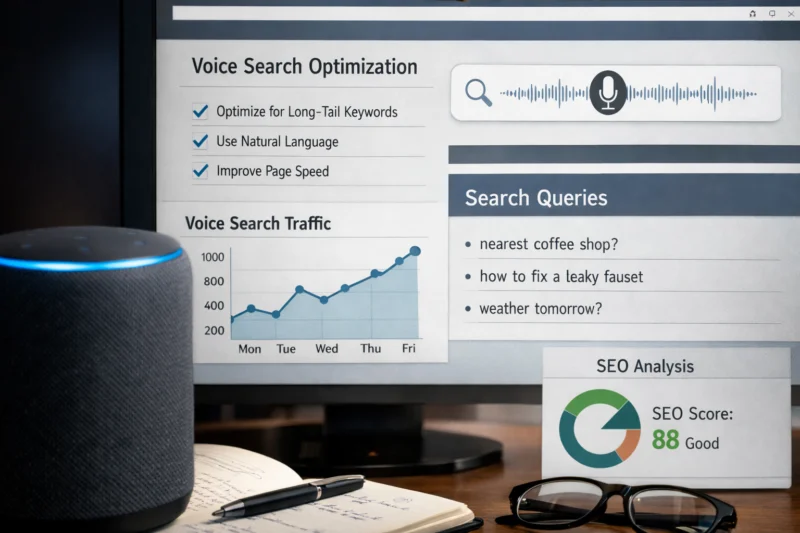
Pages should answer practical questions clearly: where you are, when you are open, how much the service might cost, and whether you serve the user’s area. This is especially important for voice queries because many people ask these questions when they are ready to act. A page that gives a direct response and then explains the service boundaries is more useful than a generic homepage paragraph with no specifics. This also supports local SEO pages that are designed around service areas rather than broad brand messaging.
Trust signals matter, but they should feel real. Contact information, service areas, booking options, business hours, and relevant credentials help search systems and users understand whether the business is a fit. If you have physical locations, make each location page distinct. If you are service-area only, avoid pretending to have storefront details. Misleading local signals can create confusion and weaken local search visibility, especially when assistants try to identify the nearest legitimate option.
The edge case many businesses miss is that not every query with a location phrase is truly local intent. Someone searching “how long does roof repair take in Dallas” may be looking for information, not a contractor. If you build only sales pages around these queries, you may miss the informational opportunity. The best local strategy blends useful educational content with service pages, so the site can serve both ready-to-buy and still-researching users.
How to measure whether your voice search efforts are working
Measuring voice search is harder than measuring standard organic traffic because attribution is often incomplete. Many voice interactions do not show up cleanly in analytics as “voice.” That is why you need a mix of direct and proxy metrics. Search Console query patterns, especially longer conversational searches and question-based terms, can reveal whether your content is becoming more relevant for spoken intent.
Featured snippet performance is another useful indicator, along with impression growth for pages that answer questions directly. If a page starts earning more non-branded impressions after you add a clearer answer block, that is a strong sign the content is becoming easier to extract. Branded vs. non-branded discovery also matters: if non-branded discovery improves, your topic coverage may be expanding in ways that support assistant-generated answers.
Since true voice attribution is limited, proxy metrics matter. Watch click-through rate on answer-led pages, local visibility changes, and assisted conversions from users who land on informational pages before converting later. Those signals are especially helpful for service businesses and publishers with complex journeys. In some cases, a page may never produce a visible “voice” label, but it still supports a measurable lift in visibility and engagement.
The deeper measurement mistake is expecting a single dashboard to prove voice success. Voice search optimization sits across content, technical health, and query interpretation, so the evidence is distributed. A practical review process should combine Search Console, analytics, local visibility checks, and periodic content audits. That gives you a much better picture than trying to isolate one interaction type that search platforms do not fully expose.
Frequently Asked Questions About optimizing your website for voice search
What is the best way to optimize a website for voice search?
The best approach is to combine intent research, answer-first content, technical accessibility, and ongoing testing. Start with the questions your audience actually asks, then format the page so the direct answer appears near the top and the supporting detail follows naturally.
You should also make sure the site loads quickly, is easy to crawl, and uses clean headings and internal links. Voice visibility usually improves when pages are already relevant and simply need clearer structure, not when they are completely rebuilt from scratch.
How do I know if my content is voice-search friendly?
A voice-friendly page uses natural language, clear headings, and concise answer blocks that can stand on their own. If the first couple of sentences answer the question clearly, the content is on the right track.
It should also be easy to scan on mobile and simple for search engines to parse. If the page feels buried, vague, or overly repetitive, it is probably not optimized well for spoken queries.
Does schema markup help with voice search?
Yes, structured data can help search engines understand the page type, business details, FAQ content, and other entities. It is especially useful when it clarifies meaning that might otherwise be ambiguous.
But schema is not enough by itself. If the content is weak, thin, or off-intent, markup will not make it a strong voice result.
What type of content performs best for voice queries?
Question-led pages, how-to articles, definitions, local landing pages, and concise answer formats usually perform well. These formats make it easier for search systems to find a direct response to the user’s query.
Supporting detail still matters because the page needs depth and trust, not just a short snippet. The best pages answer quickly and then explain enough to remain useful beyond the first sentence.
Can a small website compete in voice search results?
Yes, especially if it serves a niche audience, has strong topical specificity, or offers local relevance. Small sites can win by being more precise and more useful than larger, generic competitors.
The key is to focus on pages where you have real expertise or regional relevance. Thin, broad content usually loses, but focused content with clear answers can compete very well.
How long does it take to see results from voice search optimization?
It depends on competition, current authority, page quality, and how quickly the site gets indexed and re-evaluated. Pages that are already close to ranking often show movement faster than brand-new pages.
OPTIMIZE FOR AI SEARCH. ATTRACT MORE CUSTOMERS.
Transform your website into a voice search powerhouse! With our expert web design and SEO services, we ensure your site ranks high and attracts the right audience through smart, user-focused strategies.
REQUEST YOUR FREE CONSULTATIONMeasurement also takes time because voice attribution is limited. In practice, you may see indirect signals like better impressions, snippet wins, or stronger local visibility before you can confidently claim voice-specific results.
Voice search optimization is ultimately an extension of good SEO: answer the question clearly, make the page easy to understand, and support it with strong site architecture. The best results usually come from combining content structure, crawlability, and topical depth rather than chasing one tactic in isolation. If you are starting now, audit one high-value page, rewrite the answer section so it is direct and conversational, and verify the technical basics before scaling the changes across the site.
A practical next step is to run a focused website SEO audit on pages that already attract question-based impressions, then use content strategy planning to decide which pages deserve refreshes, clusters, or local enhancements. That is the most reliable path to stronger visibility in voice, mobile, and AI-assisted search experiences.
Updated April 2026